
Ministry responds to Seoul Mayor Oh's push to ease redevelopment regulations
Cautious stance also taken on Namsan gondola decree revision
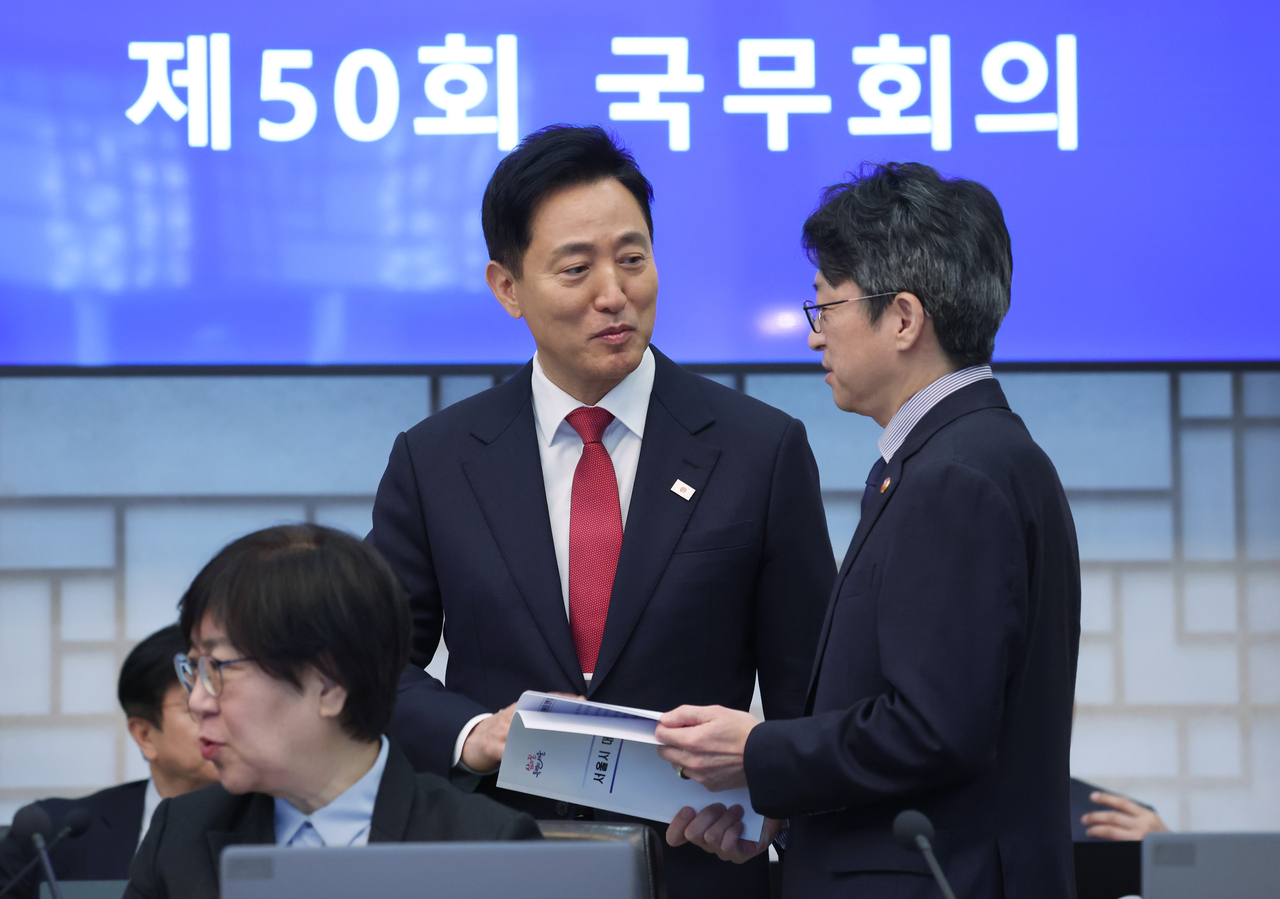
South Korea's Ministry of Land, Infrastructure and Transport said Wednesday it needs to "carefully review" Seoul Mayor Oh Se-hoon's request to ease restrictions on the transfer of reconstruction association membership, signaling a reserved stance on the proposal.
In an explanatory press release issued Wednesday, the ministry said the current restrictions on membership transfers help suppress speculative demand in redevelopment projects and prevent housing prices from overheating within designated redevelopment zones.
Earlier, Oh had conveyed to Land Minister Hong Ji-sun on Tuesday his view that regulations on redevelopment projects need to be eased to expand housing supply — specifically citing relocation loan restrictions, limits on the transfer of association membership, and the reconstruction excess profit recovery levy.
On relocation loan restrictions, the ministry said the Financial Services Commission had already reformed the system "to reflect requests from the Seoul Metropolitan Government, residents and the industry, allowing the larger of either the pre- or post-project asset valuation to be used as the basis for calculating relocation loan amounts." It added that it is also working to introduce a new loan guarantee product to cover cases where loans alone are insufficient to meet relocation costs.
However, the ministry said easing restrictions on the transfer of association membership requires careful consideration given its effects on curbing speculative demand and stabilizing the market. It noted that exceptions are already recognized for association members who have owned a home for 10 years and lived in it for five years as a single-household owner, as well as for those who unavoidably need to relocate.
On the reconstruction excess profit recovery levy, the ministry said the system "recovers a portion of excessive profits generated through reconstruction projects and uses them for residential welfare funding and other purposes," adding that it is necessary to consider comprehensively that the system aims to contribute to real estate market stability while promoting social equity.
The ministry added that the system was revised through National Assembly deliberations and took effect in March 2024, with changes including an exemption from the levy when excess profits fall below 80 million won ($59,500), a reduction scheme for long-term single-household owners, and a payment deferral for those aged 60 and older — all designed to minimize the burden on association members.
The ministry said it would "continue to make efforts to contribute meaningfully to expanding housing supply while balancing the policy goals of revitalizing redevelopment projects and stabilizing the real estate market, and maintaining communication with local governments including the Seoul Metropolitan Government, residents and the industry."
On Oh's separate call to revise the enforcement decree of the Parks and Green Spaces Act to advance the Namsan gondola project, the ministry said "related litigation is ongoing and opinions for and against the revision are sharply divided," adding that it needs to "comprehensively review expert opinions from various fields and trends in public sentiment."
Meanwhile, Oh told reporters at a press conference after the Cabinet meeting on Tuesday that he had asked Minister Hong before the meeting began whether they could meet before working-level consultations were concluded. Hong said he would review the request.
hss@heraldcorp.com





