Gustave Doré
London flower sellers
Cutthroat competition — even a poisoning attempt
And yet, an unbroken will to carry on
Editor's note
We tell stories through paintings — the issues embedded in images, the histories soaked into masterworks, the human anxieties and desires that art holds. We begin with a single canvas and step out into the world beyond the frame.
Little one.
Would you give this bag of bread to the lady selling flowers over there?
June 26, 1891, London. An 11-year-old girl, Ethel Lily Rountree, was approached by a man with a simple errand. The bag he handed her contained two loaves of bread. By the time she took hold of it, the man had already turned and walked away.
Rountree walked toward the woman the man had pointed out.
Her name was Jane Bass — a flower seller working the street. "Ma'am, a gentleman asked me to bring this to you," Rountree said, handing over the bag. About 10 minutes passed. Rountree turned around when she heard Bass rushing after her, clutching a piece of bread. "Little girl — who gave you this bread?" Bass asked, her face alarmed. With good reason: when Bass had broken the loaf in half, she found a foul greenish substance inside. "A man on Mare Street …" "Do you remember his face? I'm sorry, but you'll have to come with me to the police station."
Just like that, Rountree found herself standing before the police. The following day, she had to accompany Bass and the officers on a walk through the pubs on Mare Street. As it happened, they found the suspicious man. "Is that him?" "Yes. I had never seen him before the incident."
We are police officers.
We are arresting you on charges of attempting to murder a woman named Jane Bass
by placing poison in two loaves of bread.
The man Rountree identified appeared to be well on in years. His name was Patrick Costello. Costello was taken into custody. Rountree said she was certain he was the man, but he protested: "I never bought any bread." Police searched him. On his person they found a small amount of copper sulfate, a tin of zinc ointment, and a bottle of phosphorus paste labeled "poison."
"And you still deny it?" "Officer, it's a lie. Who can prove I did this?" Costello said when police pressed him. "There is a bottle of phosphorus paste here," an officer said. Costello replied that it was for a bad leg.
Meanwhile, Henry Gould, a member of the Royal College of Surgeons, examined the bread in question.
There was no twist. The loaves contained a large quantity of phosphorus paste. "Sufficient to take a life," was Gould's assessment. "I also examined the bottle of phosphorus paste found among Costello's belongings. The amount in the bread and the amount remaining in the bottle together equal the bottle's original capacity. ( … ) This substance is not recommended for treating a bad leg in the first place." It was an analysis that left no room for escape.
Costello continued to insist before the magistrate that he "knew nothing of the bread or the girl," but he was ultimately sentenced to hard labor.
So why had Costello tried to poison Bass, a flower seller?
The motive soon emerged — from the testimony of Constable Albert Percy, who patrolled the area around Mare Street.
"The defendant came to me and asked me to remove Bass, saying she was stealing his customers," Percy said. "I refused and told him she had every right to be there. He then claimed that he and his wife had worked that spot for years and that she had only just started coming. ( … ) He offered to pay me if I moved her away. I refused."
Costello and his wife were flower sellers themselves. The whole affair, in other words, had come down to a fight over a patch of pavement.
Competition among flower sellers
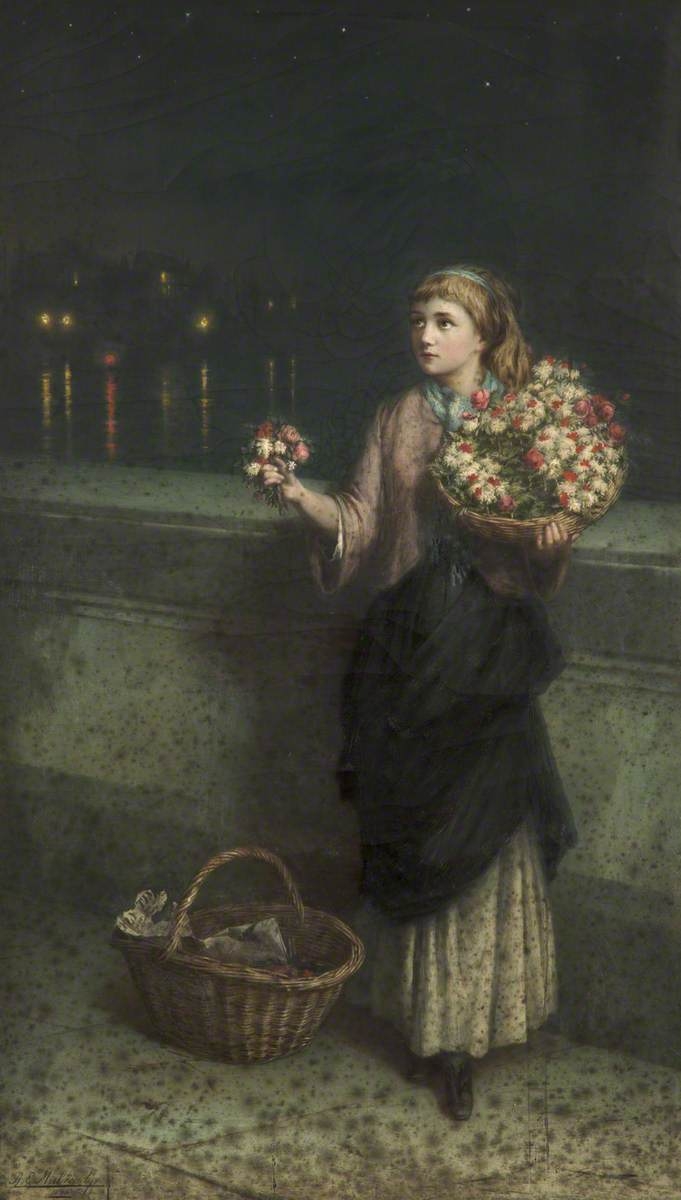
It is hard to picture from the London of today, but in the 19th century there were days when flower sellers packed squares and alleyways across the city. The journalist Henry Mayhew wrote in his 1861 book "London Labour and the London Poor" that their numbers reached between 400 and 800 — a peak summer estimate, made up largely of children and teenagers. The British Weekly Commission's 1889 publication "The Workers of London" put the figure at around 2,000. Street flower sellers can still be found in London today, but nothing like the hundreds or thousands who once lined its streets.
They set up at hospital and cemetery entrances, along main roads and narrow back lanes. Small and large flower markets sprang up throughout the city.
It would be a mistake to romanticize the trade.
Most flower sellers were women — particularly poor girls "between the ages of six and twenty," who made up a large share of the trade. The children were often barefoot. Some would trail after passersby, calling out: "Kind sir, I'm a poor little girl, please buy my flowers," or "Kind lady, please buy a bunch of violets, I beg you."
And with so many sellers crowding the same streets, competition was fierce.
Newspapers published in late-1800s London reportedly carried accounts of flower women brawling while drunk, blocking footpaths with their heavily loaded baskets, and thrusting flowers into rivals' faces before moving in on their pitch. The most shocking case of all was what became known as the phosphorus paste poisoning attempt.
But of course, not everyone behaved that way.
Amid the rivalry and jostling for position, there were surely those who simply stood their ground and sold their flowers — quietly, stubbornly, day after day.
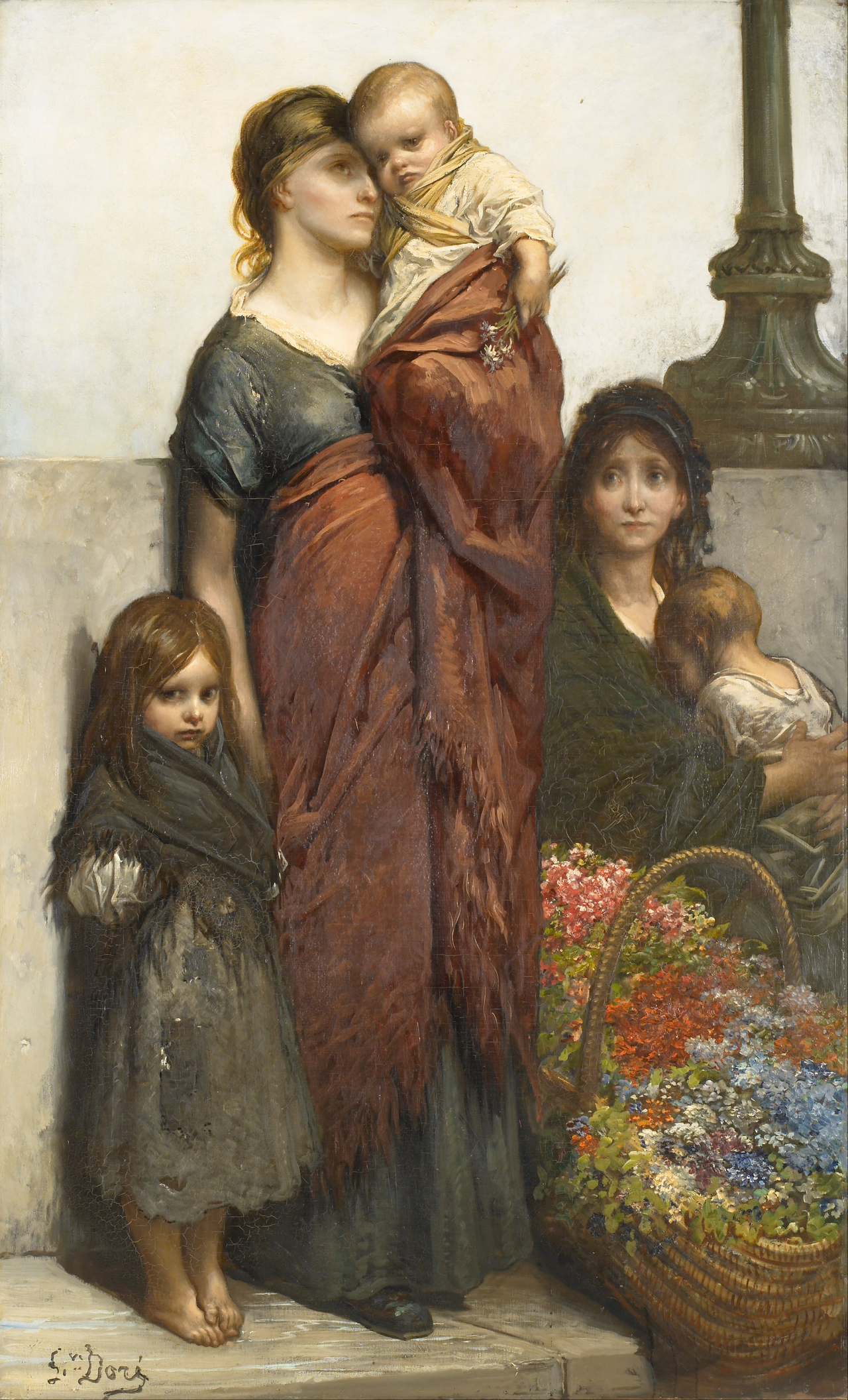
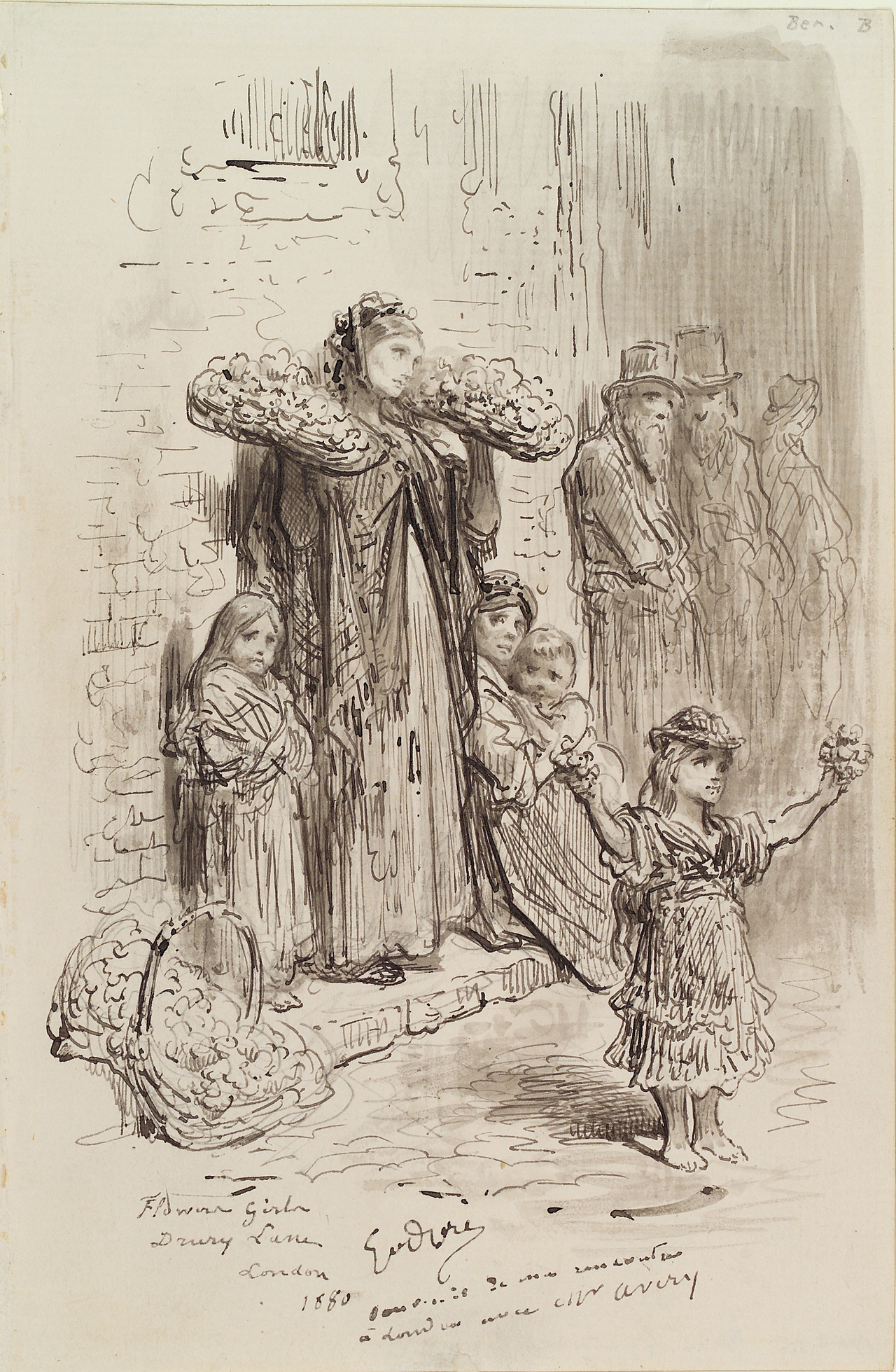
The French painter Gustave Doré is said to have spotted just such a seller — one who was holding on — near the Royal Exchange while touring London. He was moved by what he described as a "sorrowful beauty" he sensed in them. The painting that grew from that inspiration is said to be London Flower Sellers.
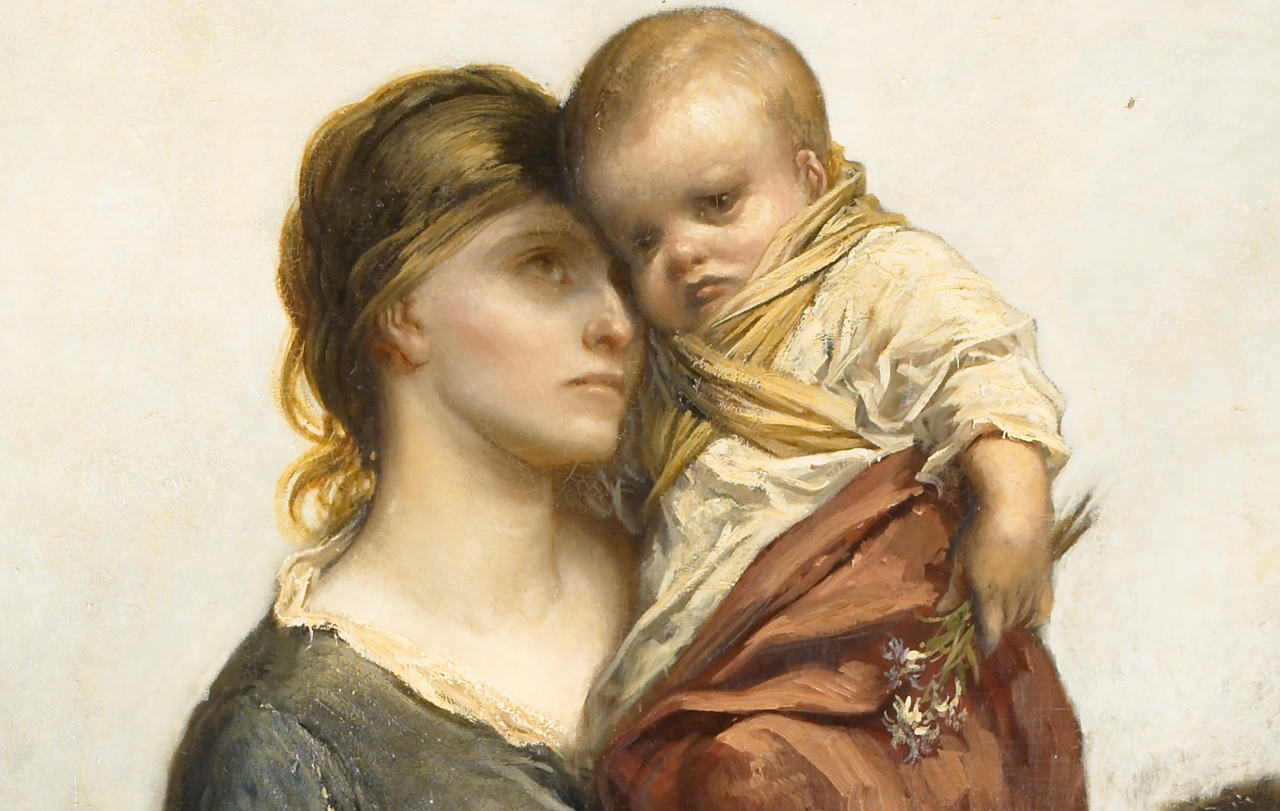
Look at the eyes of the flower seller holding a child. The gaze is unfocused yet still strong and resolute — there is no sign of retreat, no matter the pressures and petty schemes closing in. The face is worn, the clothes threadbare, but the will to hold this spot shines through. The children beside her are the same: swallowing tears, steadying their eyes, flowers in hand, meeting the gaze of those who pass without flinching — determined to get through one more day.
Just beside them, another flower seller watches the three.
She, too, looks spent, as does her child — and that weariness only makes the vitality of the three standing figures burn brighter. The flowers heaped in the basket are lush and vivid. Perhaps that abundance is Doré's tribute to the flower seller he saw that day.
References
Patrick Costello: breaking peace; wounding, The Proceedings of the Old Bailey, July 27, 1891.
yul@heraldcorp.com