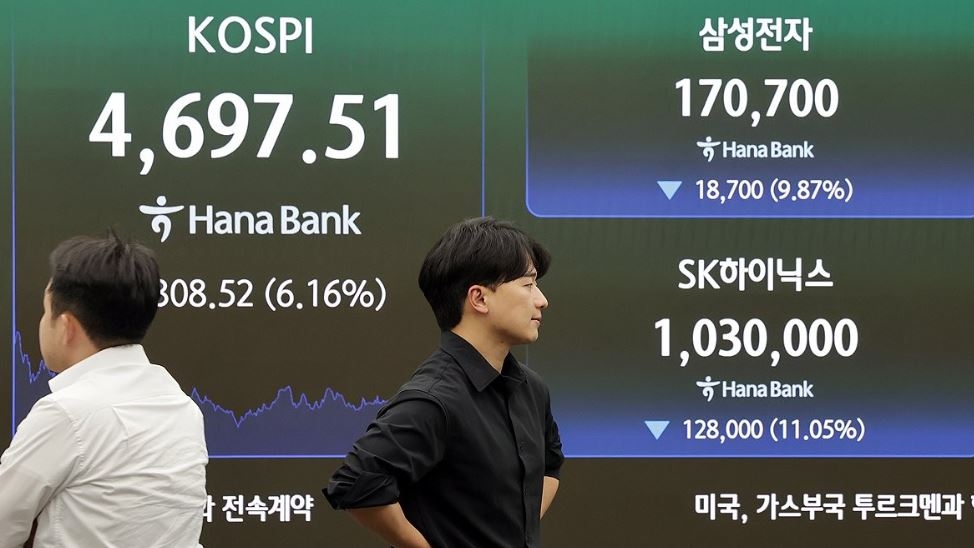
Samsung Electronics and SK hynix surrendered all of their gains in a single session, erasing advances of more than 6 percent driven by news of Nvidia CEO Jensen Huang's return. Weak US semiconductor stocks and mounting concerns about AI industry profitability weighed on investor sentiment. Securities firms remain divided on the outlook, with some arguing the recent share price declines are excessive relative to earnings fundamentals while others warn that the memory chip cycle will turn down next year. For SK hynix alone, target prices across brokerages now span a gap of 950,000 won ($707).
On Wednesday, Samsung Electronics closed down 18,700 won, or 9.87 percent, at 170,700 won, according to MP Doctor. SK hynix fell 128,000 won, or 11.05 percent, to finish at 1.03 million won.
On Tuesday, when news of Huang's return broke, Samsung Electronics surged 6.70 percent to close at 189,400 won and SK hynix rose 6.73 percent to 1.158 million won, as expectations that some of the uncertainty surrounding Nvidia's management would ease filtered through to domestic chipmakers.
The rally lasted just one day. Both stocks came under selling pressure from the opening bell on Wednesday, giving back all of Tuesday's gains. Samsung Electronics slipped into the low 170,000-won range, while SK hynix successively broke below the 1.1 million-won and 1.05 million-won levels.
With the possibility of US interest rate hikes and concerns about funding pressures tied to AI infrastructure investment continuing to weigh on chipmaker sentiment, brokerages are offering sharply different readings of why the shares have fallen and what lies ahead for earnings.
Daol Investment & Securities said the recent share price declines at both Samsung Electronics and SK hynix have been driven more by macroeconomic conditions and supply-demand dynamics than by any deterioration in earnings prospects, and set a target price of 300,000 won for Samsung Electronics and 2 million won for SK hynix.
In a report released Tuesday, Daol Investment & Securities maintained a buy rating on Samsung Electronics and set a fair value target of 300,000 won — roughly 76 percent above Wednesday's closing price.
Analysts Nam Dae-jong and Kim Yeon-mi of Daol Investment & Securities said the recent correction has been "excessively steep relative to fundamentals," adding that investor skepticism about next year's earnings and supply-demand imbalances are capping any recovery. The two analysts said supply-demand factors are weighing more heavily than earnings uncertainty, describing Samsung Electronics as "the most undervalued stock on a valuation basis among major global tech companies."
For SK hynix, the firm set a fair value target of 2 million won — about 94 percent above Wednesday's closing price of 1.03 million won.
The analysts attributed the selloff to a combination of factors: the prospect of rate hikes stemming from persistent inflation, fears of an AI ecosystem collapse, a slowdown in the pace of average selling price increases for memory chips, and profit-taking in a domestic market that has posted strong returns this year.
They added that once US interest rate uncertainty stabilizes and funding pressures related to AI data centers ease somewhat, the stocks should recover to reflect underlying fundamentals.
Kiwoom Securities took a more cautious stance, acknowledging the long-term growth potential of both companies while cutting its target prices to reflect the likelihood of an earnings slowdown next year.
In a report published Nov. 17, Kiwoom Securities analyst Park Yu-ak lowered target prices for Samsung Electronics and SK hynix to 290,000 won and 1.8 million won, respectively, forecasting that quarterly earnings at both companies will begin declining from the second quarter of 2027.
Park expects the shares to pull back as they price in the earnings slowdown before eventually rebounding. "After an adjustment period around year-end and early next year, we expect both stocks to rebound as confidence in HBM earnings and shareholder returns grows," Park said.
BNK Investment & Securities, which had repeatedly flagged the risk of a sharp drop in SK hynix's share price this year, maintained a hold rating on the stock and cut its target price to 1.05 million won in a report titled "What the Accelerating Low-PER Trend Means," published Friday. The firm warned of a dramatic fall in memory chip prices next year.
BNK Investment & Securities analyst Lee Min-hee said customers and distributors in the memory chip supply chain are expected to begin inventory adjustments in the second and third quarters of next year, warning that "a dramatic price decline is anticipated."
Lee said final demand for memory chips already peaked in the second quarter of this year. Global consumer spending hit a high in March, and the cost burden from rising memory prices has also begun to reduce the amount of memory installed per system, Lee said.
Even if memory chip demand softens, manufacturers are likely to keep expanding capacity, Lee said. Smaller players are also recording high operating profit margins, and government-level support in both the United States and China means producers may maintain their capacity expansion plans even in the face of some price declines.
"Despite record-high earnings this year, the stock has been de-rating in the second half as final demand momentum passes its peak — the market is saying these profits are not sustainable," Lee said. "Even after the sharp near-term drop, it is hard to call the stock undervalued."
While Daol Investment & Securities interpreted the recent decline as a widening gap between earnings fundamentals and share prices, BNK Investment & Securities sees the market pricing in a view that the memory chip cycle has already peaked. The two firms' diverging assessments of next year's memory prices and earnings growth have produced a 950,000-won spread in their SK hynix target prices.
rainbow@heraldcorp.com