Land ministry and climate ministry hold 3rd national planning council Friday
Two ministries to strengthen links between national land and environment plans
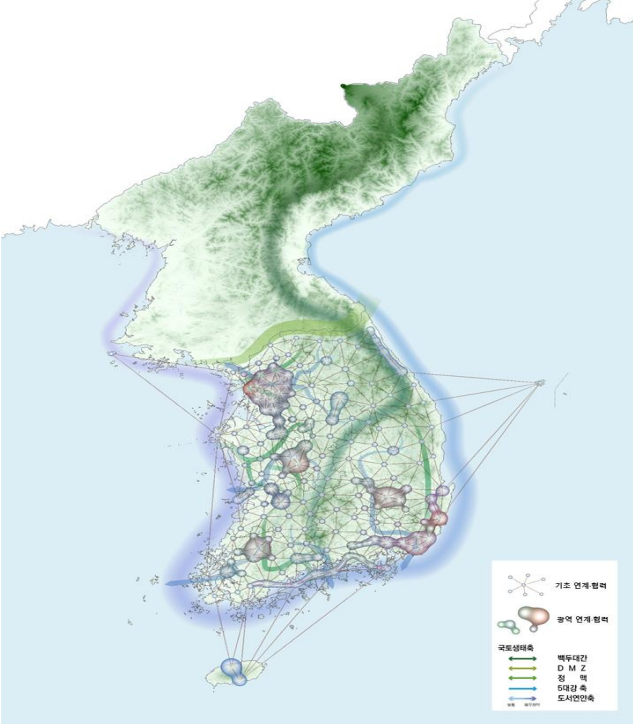
South Korea's Ministry of Land, Infrastructure and Transport and Ministry of Climate, Environment and Energy plan to discuss an integrated management approach for land and environmental planning covering 2026 to 2040, aiming to bring national development and environmental goals into closer alignment.
The two ministries announced Wednesday that they will hold the Third National Planning Council in Seoul on Friday, co-chaired by Land Ministry First Vice Minister Kim I-tak and Climate Ministry First Vice Minister Geum Han-seung, to discuss the 2026–2040 Integrated Land and Environmental Planning Management Plan.
The plan is designed to strengthen the links between the Fifth National Land Plan revision (2026–2040) and the Fifth National Environmental Plan revision (2026–2040), while deepening policy cooperation between the two ministries.
Integrated land and environmental planning management is an interministerial cooperation process that aligns and complements the procedures and content of land and environmental planning under the shared goal of sustainable development. The two ministries previously held councils in 2018 and 2019, synchronizing their planning periods and establishing the 2020–2040 integrated management framework.
The new plan retains the five strategic pillars set out in 2019 while incorporating changed policy conditions, including five-hub, three-special-zone balanced growth; connecting the national ecological network; responding to the climate crisis; and managing land and the environment using advanced technologies such as AI.
To support balanced national growth under the five-hub, three-special-zone framework, the Land Ministry will develop broad metropolitan economic and living zones and build a multi-centered, balanced national territory linking core cities with surrounding urban and residential areas. The Climate Ministry will strengthen regional urban environmental management in line with the reorganization of national space around broad metropolitan and living zones, and pursue optimal coordination and operation of environmental infrastructure. Expanding the wide-area power grid and addressing regional imbalances in electricity supply and demand are also on the agenda.
To promote environmentally friendly land use that takes the national ecological network into account, the Climate Ministry will conserve biodiversity by connecting and restoring key ecological corridors, expanding urban ecological spaces and enlarging protected areas. The Land Ministry will strengthen green space expansion and management within residential areas and factor ecological corridors into development processes to foster a virtuous cycle of development and conservation.
To build a carbon-neutral land and environment, the two ministries will jointly pursue greenhouse gas emission reductions and climate change adaptation. The Climate Ministry will work on clean power supply, decarbonization of industry and transport, and energy efficiency improvements, alongside nature-based climate adaptation solutions and stronger climate disaster safety management. The Land Ministry will cut carbon emissions through hydrogen city development, expansion of zero-energy buildings and promotion of public transit use, while boosting national resilience through expanded disaster-prevention facilities and preventive maintenance systems.
To apply advanced technology to land and environmental management, the Land Ministry will pursue AI city development, digital twin-based land management and next-generation eco-friendly mobility innovation. The Climate Ministry will strengthen integrated monitoring and pollution management of the land and environment using AI and satellite technology.
On international environmental cooperation, the two ministries will pursue economic and ecotourism cooperation in the Demilitarized Zone and border areas, seek to diversify climate and environmental cooperation on the Korean Peninsula, and strengthen international coordination on decarbonization and biodiversity.
Beyond the five strategic pillars, the two ministries will also discuss cooperation measures to ensure that the links between land and environmental planning translate into concrete policy outcomes. They agreed to strengthen coordination among related policies — including power and water supply and the promotion of regional renewable energy production and use — to support the creation of regional growth hubs and the development of national strategic industries. Plans to establish a joint framework for sharing national spatial information and environmental data are also in the works.
Continued identification of cooperative projects linking regional development and ecotourism, along with the establishment of joint performance indicators to monitor progress and manage outcomes, will be taken up by a working-level consultative body. At the local government level, the ministries plan to improve related planning guidelines to facilitate coordination and review support measures for integrated management.
"Balanced national growth and environmental sustainability are important national tasks that must be achieved together amid rapidly changing conditions such as population decline and the climate crisis," Land Ministry First Vice Minister Kim I-tak said. "We will strengthen interministerial cooperation so that land and environmental planning can deliver real policy results on the ground, and work to build a national territory where regional growth and environmental values are in harmony."
Climate Ministry First Vice Minister Geum Han-seung said development and conservation must be balanced for sustainable national development. "We will work to embed environmental values — including ecological network conservation, carbon neutrality and climate crisis response — concretely into the national space, and build a sustainable land and environment for future generations," Geum said.
smh@heraldcorp.com