Korea Federation of SMEs surveys wages across 129 occupations at 1,500 small manufacturers
Electricians' daily wage reaches 158,335 won — 30.7% above overall average
Electrical and precision equipment repairers also see 17.8% increase; skilled trades draw attention
Wages for electricians at small manufacturers have surged over the past year, with daily pay averaging 158,000 won ($118) — a rise of more than 9% from a year earlier, outstripping the overall wage growth rate across the sector.
According to the Korea Federation of SMEs' "Second-Half 2026 Wage Survey by Occupation for Small Manufacturers," released Thursday, the average daily wage for electricians stood at 158,335 won as of August, up 9.2% from 144,953 won a year earlier. That ranked fifth highest among the 129 occupations covered in the survey.
The average daily wage across all 129 occupations rose 5.6% year-on-year to 121,126 won. Electricians' wage growth outpaced the overall average by 3.6 percentage points.
Wage gaps within electrical trades are also notable. Industrial electricians averaged 135,073 won per day, up 3.1% from a year ago, while electrical technicians fell 1.8% to 129,707 won. Electricians earned 22.1% more per day than electrical technicians.
Wages for workers who maintain or repair machinery also climbed sharply. Daily pay for electrical and precision equipment repairers rose 17.8%, from 125,138 won in August last year to 147,453 won in August this year. Mechanical engineers saw a 12.0% increase over the same period, from 137,979 won to 154,523 won. Safety managers averaged 149,313 won per day, up 3.7%.
Interest in electrical certifications is also growing. According to the Human Resources Development Service of Korea, the number of candidates who sat the written examination for the electrician license last year reached 64,080, up 11.6% from 57,417 in 2024. The written exam pass rate last year was 29.9%, and the practical exam pass rate was 33.2%. The number of candidates for the electrical technician written exam also reached 67,010, the fifth highest among all national technical qualification categories.
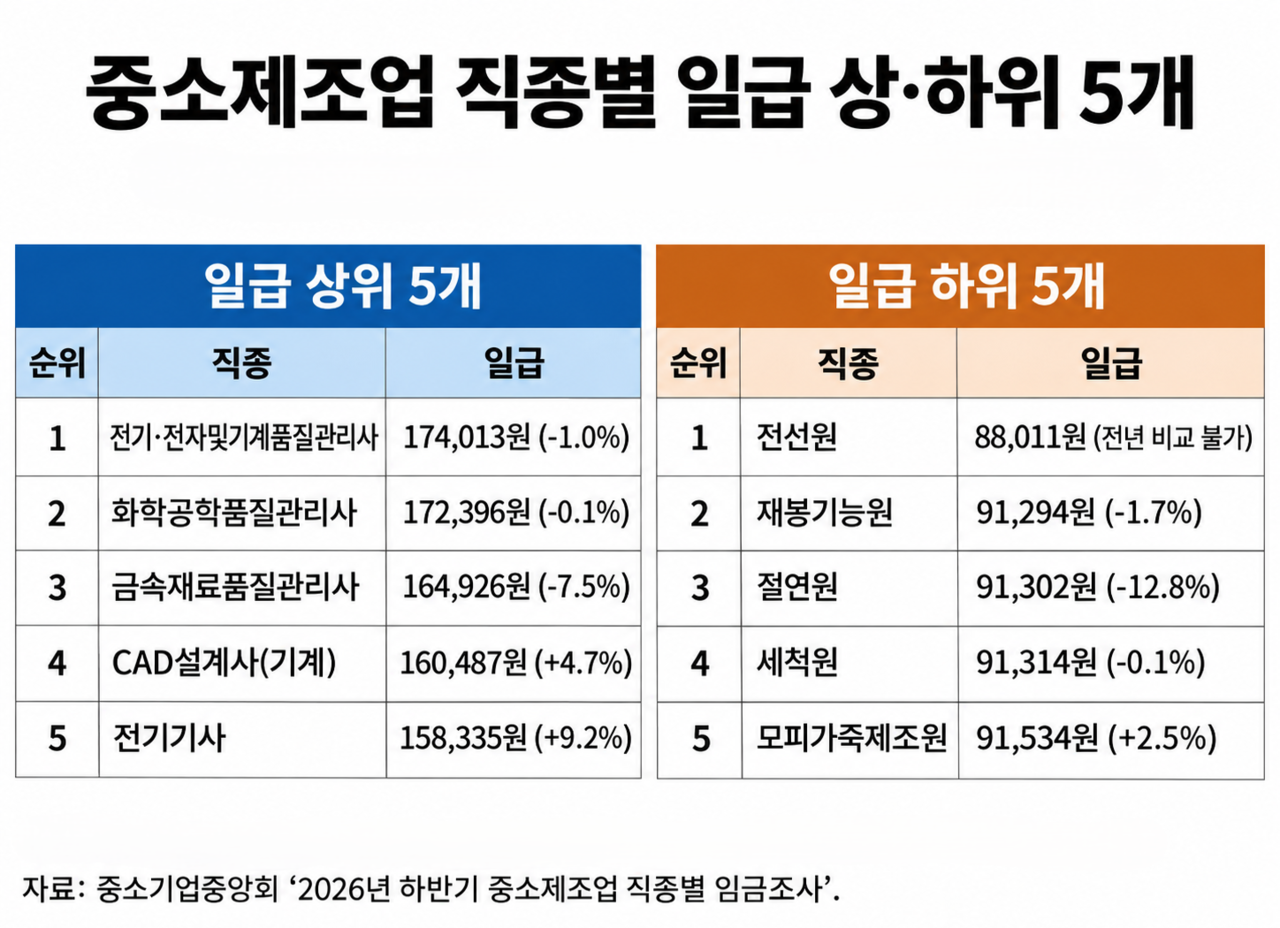
The highest daily wage among all 129 occupations went to electrical, electronic and mechanical quality control engineers at 174,013 won. Chemical engineering quality control engineers (172,396 won), metal and materials quality control engineers (164,926 won) and mechanical CAD designers (160,487 won) followed. Four of the top 10 highest-paid occupations were in quality control.
At the other end of the scale, wire drawers recorded the lowest daily wage at 88,011 won. Sewing machine operators (91,294 won), insulation workers (91,302 won), cleaning workers (91,314 won) and fur and leather manufacturers (91,534 won) also earned less than 100,000 won a day. The gap between the highest- and lowest-paid occupations was 1.98 times.
Parts assemblers — one of the most common production roles in small manufacturing — saw their average daily wage rise just 0.4% year-on-year to 110,492 won. General laborers earned 97,930 won, up 2.3%, while team leaders received 147,237 won, up 0.1%. All three occupations fell below the overall average wage growth rate of 5.6%.
The survey covered 1,500 small manufacturers with annual sales of at least 3 billion won and 10 or more full-time employees. The daily wage figures are calculated by converting basic pay and standard allowances to an eight-hour workday basis. Overtime, night-shift and weekly holiday allowances are excluded. The figures are intended as baseline data for calculating manufacturing costs under government contracts and may differ from the starting pay or actual take-home wages of newly certified workers.
hong@heraldcorp.com