
Base grant amount adjustment to 84.1 trillion won demanded
School-age population weighting to be cut from 35% to 10%
Payment of 11.7 trillion won in this year's settlement funds sought
Wage gap coverage and elementary-secondary fund support requested
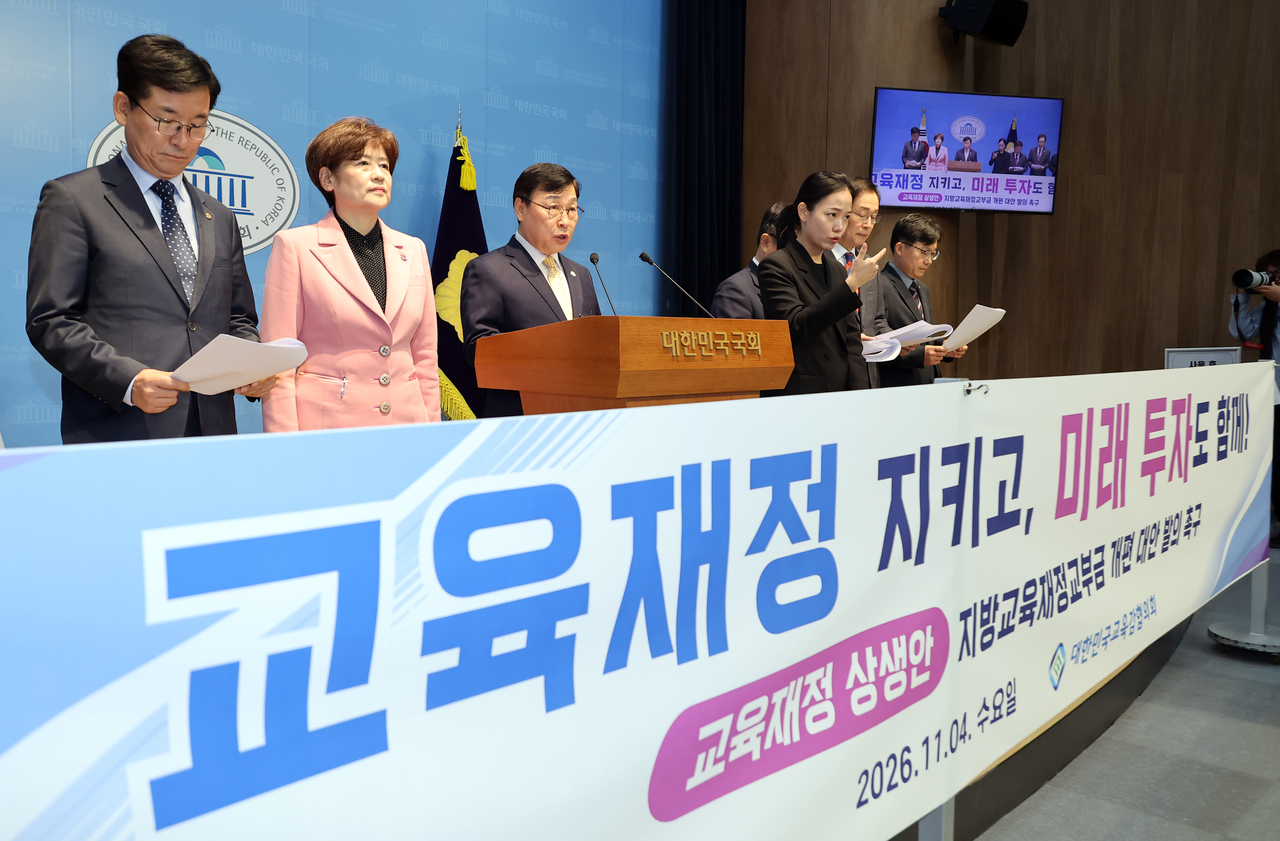
Superintendents from across the country warned Thursday that the government's proposed reform of local education finance grants would leave schools 9.5 trillion won ($7.07 billion) short of what they need to operate next year, and called on the National Assembly to strengthen the bill.
The Korea Superintendents Association held a press conference at the National Assembly's second main gate Thursday morning and announced four demands regarding the grant reform proposal. Twelve superintendents attended, including Seoul Metropolitan Government Superintendent of Education Jung Geun-sik, who chairs the association.
The association said its position remains unchanged: the current framework linking grant allocations to domestic tax revenue must be preserved. However, given the imminent deadline for National Assembly review, it said it was presenting the minimum supplementary measures that must be reflected in the legislation.
Central to the demands is raising the base amount used to calculate grants. The association estimated the minimum grant needed for next year at 88.4 trillion won — 9.5 trillion won more than the 78.9 trillion won projected under the government's reform plan.
To secure that minimum, the association said the base calculation amount must be adjusted to 84.1 trillion won and the weighting given to the school-age population reduced from 35 percent to 10 percent. The rationale is that school operating costs cannot be cut at the same rate as the decline in student numbers. The association also warned that if the base amount is set too low in the first year of the new formula, funding shortfalls could compound annually.
The association also demanded payment of this year's grant settlement funds. With national tax revenue coming in above the original budget this year, the settlement amount owed to local education offices is expected to reach about 11.7 trillion won, the association said. It said the government's reform proposal would block payment of those funds and urged that the supplementary provisions of the revised bill explicitly guarantee payment under current law.
The association further called for a legal mechanism requiring the central government to cover any shortfall in personnel costs. Under the government's plan, next year's grant increase would amount to about 2.4 trillion won — falling short of the roughly 2.5 trillion won rise in personnel costs. The association asked that the law be amended to require the government to make up the difference if the grant increase cannot cover the wage increase.
The association also called for the future response fund to explicitly include support for elementary and secondary education. While some of the revenue generated by the grant reform would flow into the fund's education and human resources account, the account's stated purposes do not actually mention support for elementary and secondary schools. The association said the 2.5 trillion won in surplus funds within that account should be used for improvements to aging school facilities, and that the National Assembly's education committee should be guaranteed the right to conduct a preliminary review.
The National Assembly education committee's legislation subcommittee discussed a bill to revise the local education finance grant law on Nov. 17 but failed to reach agreement, according to the association. The association warned that if the review is not completed by Monday, the government's reform proposal could be referred directly to a plenary session without a vote by the education committee, and asked for sufficient deliberation and revision.
"Securing stable education finances and preparing for the nation's future are not separate goals — protecting our children's learning is an investment in South Korea's future," association chair Jung said. "We will continue to persuade and consult with the National Assembly and the government to ensure our children's education is not disrupted."
brunch@heraldcorp.com





