Core inflation at 2.8%, raising demand-side price pressure alert
Fed December hike could widen Korea-US rate gap again
Private consumption slips as stock market correction dents sentiment
Consumer recovery expected next year, but real estate concentration a concern
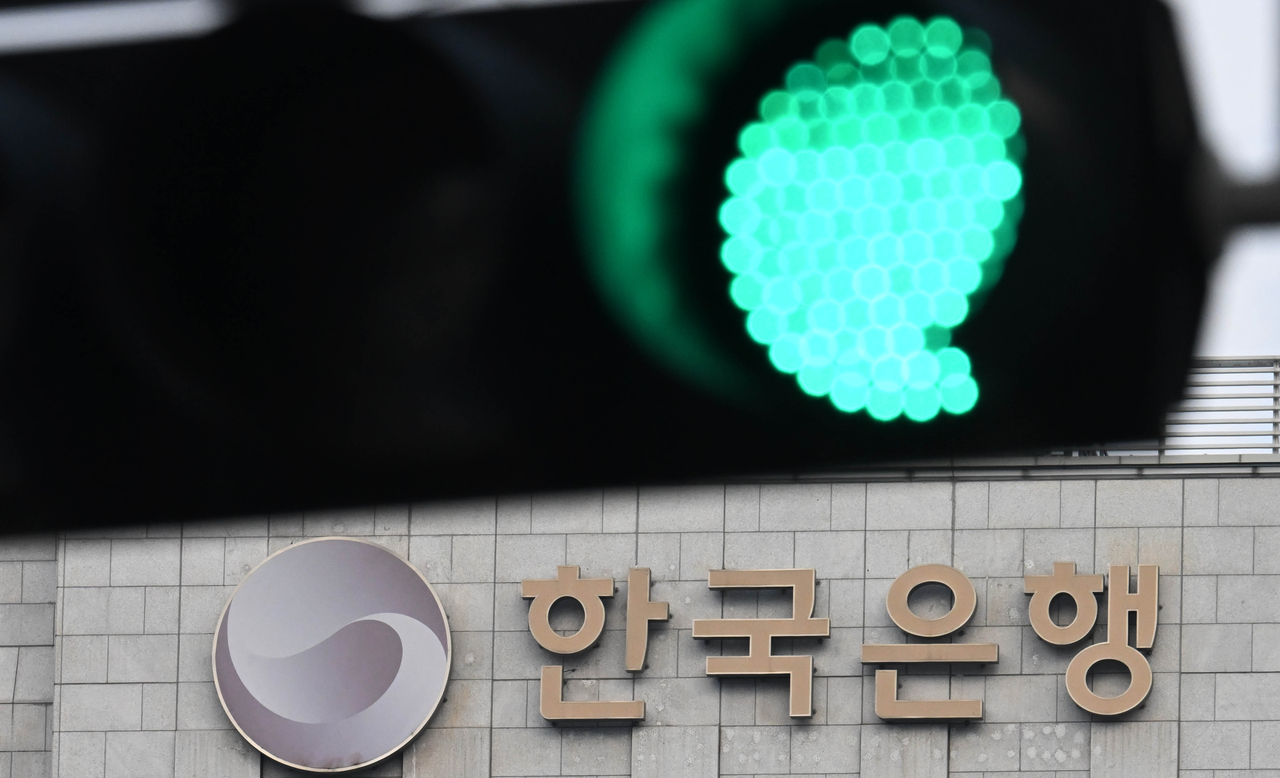
The Bank of Korea raised its benchmark interest rate to 3.25 percent per annum Thursday, as major economic indicators — from inflation to growth — pointed uniformly toward tightening. The central bank's growth forecast for next year surged from 2.9 percent to 4.1 percent, marking the first projection above 4 percent in roughly six years.
The move is widely interpreted as a preemptive effort to rein in credit before robust economic growth begins pushing prices higher in earnest.
Concerns about consecutive rate hikes are not small, however. If the warmth of growth fails to spread beyond the semiconductor sector, inequality could deepen and consumption could contract. Some analysts warn that if the semiconductor cycle turns, growth momentum could deteriorate rapidly — and a preemptive rate hike could turn from medicine into poison.
Next year's growth forecast jumps to 4.1%, up 1.2 percentage points in three months
The rate increase is closely tied to a sweeping upward revision of next year's growth outlook, according to financial industry sources. The Bank of Korea had set its forecast for next year's growth at 2.9 percent in August, but revised it up by 1.2 percentage points to 4.1 percent just three months later — the largest single revision since the central bank began forecasting the following year's growth rate in December 2008.
Annual growth above 4 percent would be the first since 2021, when the economy expanded 4.7 percent as exports and domestic demand rebounded from the COVID-19 shock.
Normally, a high-growth year is followed by a slowdown due to base effects — as happened in 2022, when growth fell back to 2.9 percent. The expectation that Korea will post strong growth in consecutive years reflects the explosive expansion of the economy, driven primarily by semiconductors.
With such an unusually strong growth trajectory in view, the Bank of Korea raised rates preemptively to ease demand-side inflationary pressure before it builds further.
The central bank's own calculation methodology also contributed to the sharp upward revision. The Bank of Korea measures next year's real GDP using the previous year's prices — a so-called chain-weighting method. As semiconductor prices rose this year, the sector's share of nominal GDP expanded, giving semiconductors a much larger weight in next year's growth calculation and pushing the overall figure sharply higher.
Other major domestic and international institutions have also raised their forecasts significantly. The IMF recently lifted its projection for next year from 2.8 percent to 3.3 percent, while the Korea Development Institute raised its estimate from 2.2 percent to 3.9 percent.
Several economic indicators already confirm the strong growth momentum. Real GDP in the third quarter grew 1 percent quarter-on-quarter, more than three times the August forecast of 0.3 percent, driven by semiconductor-led exports and facility investment. The cumulative current account surplus from January through August reached $279.2 billion, nearly four times the figure for the same period last year. Some forecasters project the full-year current account surplus will exceed $500 billion. Cumulative exports this year crossed the $1 trillion mark, making Korea the fourth country in the world to join the "trillion-dollar export club."
Bank of Korea Governor Shin Hyun-song said the domestic economy had sustained strong growth on the back of solid exports and investment, with employment also rising steadily, led by the services sector. "Going forward, the domestic economy is expected to maintain high growth in exports and investment, driven by the favorable semiconductor cycle, while consumer spending is also projected to gradually recover as income conditions improve and fiscal expenditure expands," Shin said.
Inflationary pressure also remains elevated. Consumer prices rose 2.8 percent last month, exceeding the 2 percent target by 0.8 percentage point. Excluding the effect of the government's petroleum price cap, the figure is estimated to have reached as high as 3.6 percent. Core inflation, which strips out highly volatile items, held steady at 2.8 percent. The Bank of Korea expects semiconductor-driven income growth to amplify demand-side price pressure going forward — a view reflected in its decision to raise next year's inflation forecast by 0.1 percentage point, from 2.3 percent to 2.4 percent.
"Inflation is expected to remain above target for a considerable period, as the pass-through of higher cost pressures continues and demand-side pressure gradually intensifies alongside stronger growth," Shin said.
The won-dollar exchange rate is another variable. After peaking in June, the rate fell for four consecutive months before recently stabilizing in the mid-1,300 won range as upward and downward pressures balanced out. If the Federal Reserve raises rates next month, the Korea-US rate gap could widen again, adding further upward pressure on the exchange rate. US personal consumption expenditures for October rose 3.8 percent year-on-year, accelerating from the prior reading. According to the CME Group's FedWatch tool, as of Wednesday (local time), the probability of a 0.25 percentage point Fed rate hike next month stood at 98.1 percent.
Thursday's hike narrowed the upper-bound Korea-US rate gap from 1 percentage point to 0.75 percentage point, but a Fed move next month would push it back to 1 percentage point.
Financial imbalances also point toward tightening. Housing prices in the Greater Seoul area remain elevated. According to the Korea Real Estate Board, the apartment sale price index for Gyeonggi Province rose 0.21 percent in the third week of November (as of the 16th), led by southern districts including Suwon's Gwonseon-gu (up 0.62 percent), Anyang's Dongan-gu (up 0.61 percent) and Yongin's Giheung-gu (up 0.55 percent). Seoul prices edged up 0.03 percent, extending a streak of 93 consecutive weeks of gains, though the pace of increase fell to roughly half the prior week's 0.07 percent.
Household credit outstanding surpassed 2,000 trillion won ($1.49 trillion) for the first time at the end of the second quarter, reaching 2,019.8 trillion won, and climbed further to 2,030.5 trillion won at the end of the third quarter — a 10th consecutive quarterly increase.
"Household lending expanded as both housing-related loans and other loans increased," Shin said. "Although the pace of housing price gains in the Greater Seoul area has slowed somewhat, expectations for further price increases remain high."
Will 'semiconductor money' open wallets? K-shaped growth warnings grow louder
Concerns are also mounting over what some see as an overly rosy growth outlook built on semiconductor dependence. The dissenting votes for a rate hold cast Thursday by Monetary Policy Board members Hwang Geon-il and Lee Su-hyeong are seen in the same light — the first time two dissenting votes have emerged since May.
Behind the third quarter's surprise growth figures lie the shadows of semiconductor concentration and weak private consumption. The drivers of third-quarter growth were semiconductor exports and facility investment centered on semiconductor manufacturing equipment, with the latter contributing 0.4 percentage point to the quarter's growth rate. Semiconductors accounted for 42.7 percent of cumulative exports from January through October.
The structure of the economy is such that a downturn in the semiconductor cycle could severely destabilize Korea's growth path — and in that scenario, the current preemptive tightening could become a trigger for recession. Bloomberg Economics recently estimated in a report that, holding other export volumes constant, a 10 percent drop in semiconductor prices would reduce total export value by roughly 4.3 percent.
The sluggish recovery in private consumption is another obstacle. Private consumption fell 0.2 percent quarter-on-quarter in the third quarter — its first decline since the first quarter of 2022. Private consumption's contribution to GDP growth swung from positive 0.2 percentage point in the second quarter to negative 0.1 percentage point in the third, meaning consumer spending actually dragged on growth.
The Korea Development Institute had already cut its forecast for private consumption growth this year from 2.3 percent to 1.8 percent, projecting 2.4 percent for next year. The diagnosis is that income gains driven by semiconductors are concentrated in specific sectors, creating a gap between lived economic experience and headline growth figures — a so-called K-shaped recovery, in which inequality deepens even as the overall economy expands. In this environment, raising interest rates risks sharply increasing the debt-servicing burden on small and medium-sized enterprises, the self-employed and vulnerable borrowers, potentially deepening the domestic demand slump and driving up delinquency rates.
A sharp recent drop in share prices has compounded the problem, further souring consumer sentiment. The Consumer Composite Sentiment Index this month fell for a second consecutive month following October's decline, weighed down by the stock market correction, hitting its lowest level in seven months.
Household purchasing power has also stagnated. According to a KDI report, average real wage growth for all workers in the first half of this year was limited to 0.3 percent on a per-worker total compensation basis. Regular wages, excluding special bonuses, actually fell 0.3 percent in real terms.
Governor Shin acknowledged at a panel discussion during last month's IMF annual meetings that "Korea is showing a clear K-shaped economic pattern." Even so, Shin suggested that tighter monetary policy was necessary even for the sake of vulnerable groups, saying "the most important thing a central bank must keep in mind is that inflation hits low-income households hardest."
The Bank of Korea expects private consumption to revive next year as chipmakers begin paying out performance bonuses in earnest. Whether that additional income will flow into consumption, however, remains uncertain. If bonuses are channeled into real estate and other asset accumulation rather than spending, the stimulus effect on consumption would be limited — and financial imbalances could worsen further.
kimstar@heraldcorp.com