- Joint study by IBS's Kim Eun-joon and KAIST's Jung Chang-wook
- Overexcited neurons in anterior cingulate cortex identified as key driver

Korean researchers have uncovered a key clue to why people with autism spectrum disorder react with extreme sensitivity to mild touch or pain.
The Institute for Basic Science said a joint research team led by Kim Eun-joon, director of its Center for Synaptic Brain Dysfunctions, and Jung Chang-wook, a professor at KAIST's Graduate School of Medical Science and Engineering, has identified the brain neural circuit and molecular mechanisms underlying autism-related sensory hypersensitivity.
Autism spectrum disorder is a neurodevelopmental condition characterized by difficulties in social communication and restricted, repetitive behaviors. More than 90 percent of patients are known to experience sensory abnormalities — reacting with either excessive sensitivity or reduced responsiveness to sensory stimuli. The precise neural circuit mechanisms behind sensory hypersensitivity, however, had not been fully understood.
The research team focused on the ADNP gene, which regulates the expression of multiple genes during brain development. Mutations in this gene are among the most well-established single-gene causes of autism.
Mice with one copy of the ADNP gene deleted showed heightened sensitivity to mild physical and heat stimuli, as well as excessive defensive responses to electrical stimulation. By contrast, mice in which the gene was deleted only in the spinal cord and peripheral tissues did not exhibit sensory hypersensitivity.
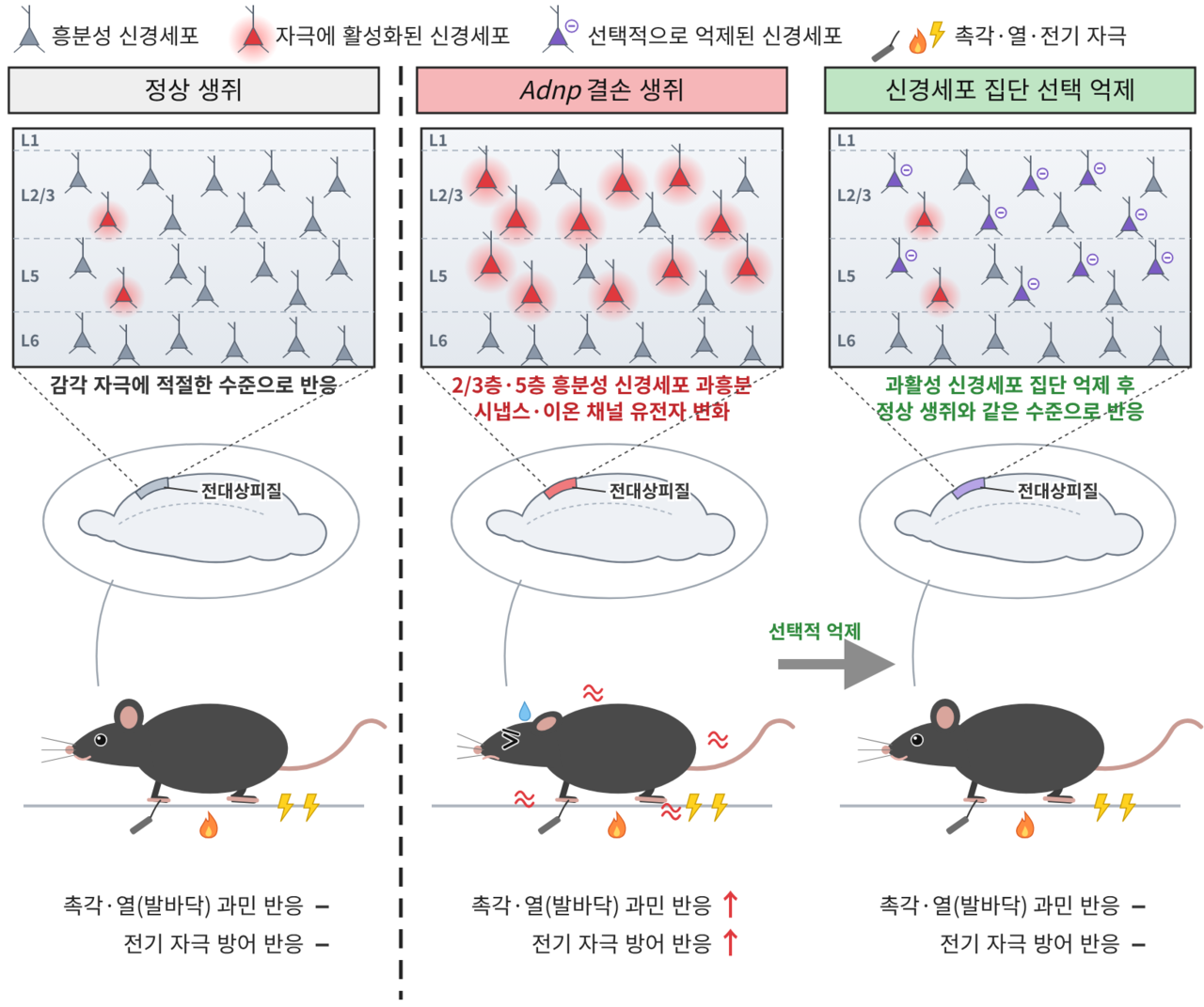
Using ultra-high-field functional MRI and electrophysiological analysis, the team found critical evidence of sensory hypersensitivity in the anterior cingulate cortex, the brain region that processes emotional responses to pain. The researchers confirmed that excitatory neurons in a specific layer of the anterior cingulate cortex were easily activated even under normal conditions, and that signal transmission between neurons had also changed.
The team also found that precisely targeting only the problematic neurons was effective in alleviating sensory hypersensitivity.
When all excitatory neurons in the anterior cingulate cortex were suppressed, hypersensitive reactions to touch and heat stimuli were partially reduced — but defensive responses to electrical stimulation actually increased.
In contrast, selectively inhibiting only the neurons that responded to electrical stimulation brought hypersensitive reactions to touch and heat back to normal levels, and some defensive responses to electrical stimulation also decreased.
Molecular-level analysis further revealed changes in the expression of genes related to synapses and ion channels, which are responsible for signal transmission between neurons.
The study is significant for proposing a new treatment strategy that precisely targets specific neuronal populations involved in sensory hypersensitivity, rather than suppressing activity across an entire brain region.
"This research clarifies, at the behavioral, cellular, synaptic and molecular levels, that tactile and pain hypersensitivity commonly seen in autism patients is deeply linked to the overexcitation of specific neuronal populations in the brain — particularly in the anterior cingulate cortex," Kim said. "A precision approach targeting the problematic neuronal populations will serve as an important clue in developing future treatment strategies for autism-related sensory hypersensitivity."
The team plans to investigate interactions between other brain regions and neural circuits involved in sensory hypersensitivity, and to validate the functions of candidate molecules related to synapses and ion channels in order to identify specific therapeutic targets.
The findings were published online Wednesday (local time) in the international journal Molecular Psychiatry.
nbgkoo@heraldcorp.com