
- Hanyang University develops bone regeneration technology combining stem cells and nanomaterials
- Findings expected to aid treatment research for intractable bone injuries and osteoporosis
South Korean researchers have developed a technology that creates an optimal environment for stem cells to survive, enabling severely damaged bone to be regenerated using only a small number of cells. In animal experiments, the technique successfully filled about 90 percent of a damaged bone area with new bone within eight weeks of implantation.
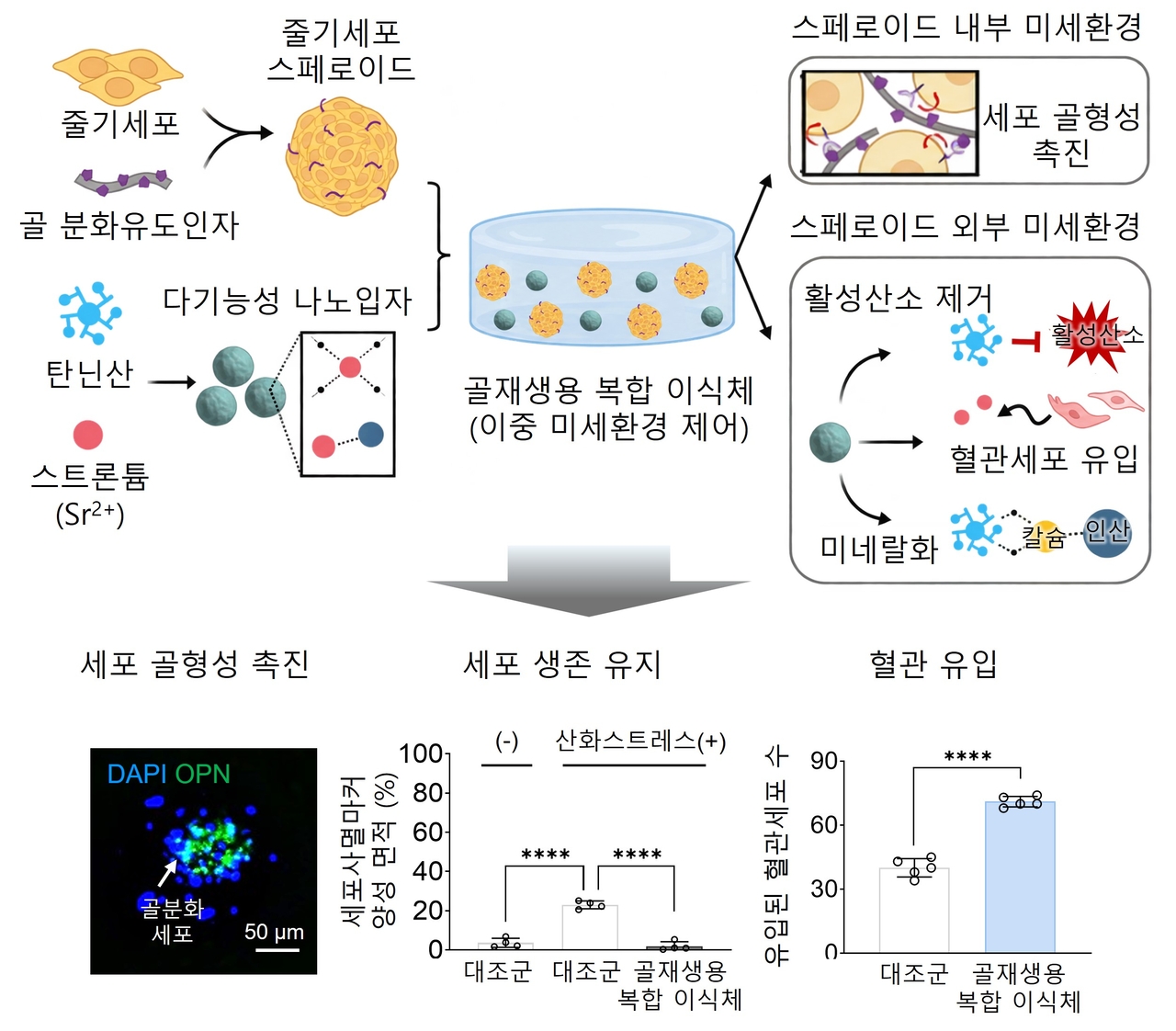
The National Research Foundation of Korea announced that a research team led by Professor Shin Heung-soo of the Department of Biotechnology at Hanyang University developed the technology, which places biomaterials with different functions inside and outside stem cell clusters to simultaneously promote cell survival, blood vessel formation and bone regeneration.
Tissues such as bone, cartilage and the heart are difficult to heal naturally once severely damaged. When bone damage exceeds a certain size, reduced oxygen supply from vascular injury and excessive reactive oxygen species sharply lower the survival rate and regenerative capacity of transplanted stem cells.
Transplanting large numbers of stem cells has been a common approach to overcome this limitation, but the time and cost involved in obtaining and mass-culturing cells have restricted clinical application.
Rather than increasing the number of stem cells, the research team focused on building an optimal environment in which the cells could survive and perform their regenerative function.
Stem cells extracted from human adipose tissue were formed into three-dimensional spherical clusters called spheroids, then encased in hydrogel, a water-rich biomaterial.
Inside the spheroids, the team placed nanofibers carrying a bone-formation-promoting protein (BMP-2), while multifunctional nanoparticles were positioned on the outside to reduce cell damage from reactive oxygen species and support blood vessel formation. The design promotes bone formation from within while protecting the cells from the outside and drawing in blood vessels to supply oxygen and nutrients.
Cell culture and animal experiments confirmed reduced stem cell damage and improved bone-forming capacity. The team also observed surrounding tissue cells and blood vessels growing into the interior of the implant.

When applied to a skull defect site in mice, about 90 percent of the defect area was filled with new bone eight weeks after implantation using only a small number of stem cells, and the regenerated bone was found to connect with existing bone tissue.
The technology is expected to aid development of new stem cell implants for patients who struggle with bone regeneration due to large-scale bone defects or osteoporosis. By adjusting the types of growth factors and nanoparticles used, the approach could also be applied to regenerative treatment of various tissues including cartilage, skin and cardiac muscle.
However, clinical application will require verification of long-term in vivo safety and therapeutic efficacy, as well as mass-production technology capable of yielding implants of consistent quality.
Shin said the research confirmed that the environment in which transplanted cells live is just as important as the inherent capabilities of the stem cells themselves, and expressed hope that the findings would improve the efficiency and cost-effectiveness of stem cell therapy, opening new treatment opportunities for patients.
The findings were published online Nov. 18 in the international academic journal Science Advances.
nbgkoo@heraldcorp.com





