Busan International Population Forum held at BEXCO on Thursday
City became first metropolitan city to enter super-aged society in 2021
Greater Seoul concentration, deteriorating housing cited as key drivers
Experts call for policy priorities aligned with population and development needs
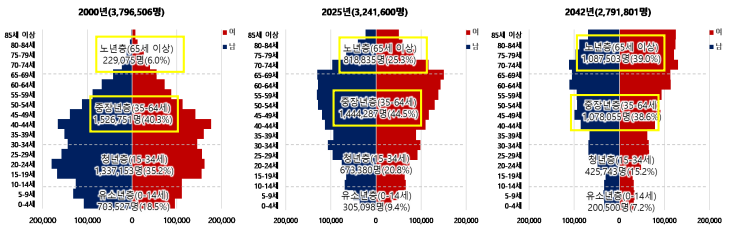
Busan's population peaked at about 3.88 million in 1995, has since fallen consistently to about 3.24 million in 2025, and is projected to decline a further 13.9 percent to about 2.79 million by 2042, according to a new assessment. Researchers proposed improving quality of life through urban planning and expanding youth employment opportunities tied to the city's global maritime capital ambitions as the key responses to the decline.
The findings were presented Thursday at the Busan International Population Forum, held at BEXCO in Busan starting at 2 p.m. Park Bong-cheol, a senior research fellow at the Busan Research Institute, delivered a presentation titled "Diagnosing Busan's Population Decline and Regional Policy Responses," laying out the current state of the city's demographic structure.
According to the presentation, Busan became the first metropolitan city in South Korea to enter super-aged society status in 2021. The share of residents aged 65 and older has grown more than fourfold — from 6.0 percent in 2000 to 25.3 percent in 2025 — and is forecast to reach 39.0 percent by 2042. Meanwhile, the youth population aged 15 to 34 is projected to fall from 35.2 percent to 20.8 percent and then to 15.2 percent, while the share of children aged 14 and under is expected to drop from 18.5 percent to 9.4 percent and then to 7.2 percent. The data point to a rapid disappearance of future generations.
Park identified the concentration of population and resources in the Greater Seoul area as a primary driver of the demographic shift. Some 51.2 percent of the national population lives in the metropolitan area, along with 92 percent of the headquarters of the country's top 50 companies and 81 percent of credit card spending. The imbalance stands out even against major advanced economies — the metropolitan population share is 34.8 percent in Japan, 20.9 percent in the United Kingdom and 18.2 percent in France. Park warned that a low birth rate combined with aging will further accelerate regional population loss and migration toward the capital area.
Park also pointed to problems in the city's urban fabric. Busan's growth-era expansion — including hillside roads and coastal land reclamation — and port-centered development left residential infrastructure and housing welfare underdeveloped, and the subsequent population decline has worsened aging housing conditions and expanded blighted areas. Park cited 53 school closures, including 40 elementary schools, and high vacancy-risk levels in Dong-gu, Seo-gu and Yeongdo-gu as evidence of the deterioration.
Park proposed a future vision centered on quality-of-life-driven urban planning. The concept of "urban carrying capacity" — evaluating the capacity of land, roads, parks, and water and sewage systems — would guide the allocation of zoning, road networks and housing in line with population and development demand, and set policy priorities accordingly.
Park also put forward Busan's "Global Maritime Capital" initiative as a demographic strategy from a youth employment perspective. Industry-academia partnerships with maritime companies, along with education and hiring programs in smart ports and marine services, could create more opportunities for young people to stay in or return to the city, Park said. Busan ranked seventh in the 2026 World's Leading Maritime Cities assessment by Menon Economics and DNV — up from 10th in 2024 — released Nov. 12, and the city has set a target of breaking into the top five by 2030.
The forum, hosted by the Busan city government and organized by the Busan Research Institute, was convened to share domestic and international population policy cases and explore sustainable solutions for the city's future. The opening keynote session featured Stuart Gietel-Basten, a professor at the Hong Kong University of Science and Technology, speaking on "Demographic Transition and Urban Choices." The academic session that followed included presentations by Ryu Young-jin, a professor at Fukuoka University; Millard Andrew Stanley, a professor at Changwon National University; and Kim A-ran, a researcher at the Cooperative Institute for Community and Welfare Research, covering youth migration and settlement and strategies for attracting foreign talent. A roundtable discussion moderated by the head of the Busan Research Institute concluded the event.
Meanwhile, Busan released its second basic plan for population policy (2026–2030) in March. The plan selected 107 projects under nine action tasks built around three pillars: inclusive support across the life cycle, creating an attractive residential and living environment, and strengthening the foundation for supra-regional innovation and growth.
Mayor Jeon Jae-soo said demographic change is a challenge facing not only Busan but cities around the world. "What matters is building a city where young people and talented individuals choose to come on their own, seeking new opportunities," he said.
kaf2002@heraldcorp.com