
Ministry of Land finds 1,457 suspected violations in lease transactions registered last year
Authorities have flagged 88 suspected jeonse fraud transactions and referred 22 individuals to the Korean National Police Agency for investigation. When violations of the Licensed Real Estate Agents Act are included, the total number of people referred rises to 64.
The Ministry of Land, Infrastructure and Transport announced Thursday the results of its "2026 Jeonse Fraud Planned Investigation," which examined lease transactions registered between January and December last year. Investigators used an AI-based anomalous transaction detection system to identify suspected jeonse fraud cases and conducted a comprehensive review of the relevant landlords' sale transactions over the preceding three years. The probe is part of the pan-government special crackdown on jeonse fraud that the ministry has been conducting jointly with the Korean National Police Agency and the Supreme Prosecutors' Office since July 2022.
Of the 2,083 transactions reviewed, 1,457 were flagged as suspected violations. By category, the breakdown was: false reporting and similar offenses, 959 cases; irregular gift transfers and related violations, 278 cases; misuse of loan funds, 89 cases; suspected jeonse fraud, 88 cases; Licensed Real Estate Agents Act violations, 39 cases; and suspected title trust arrangements, 4 cases.
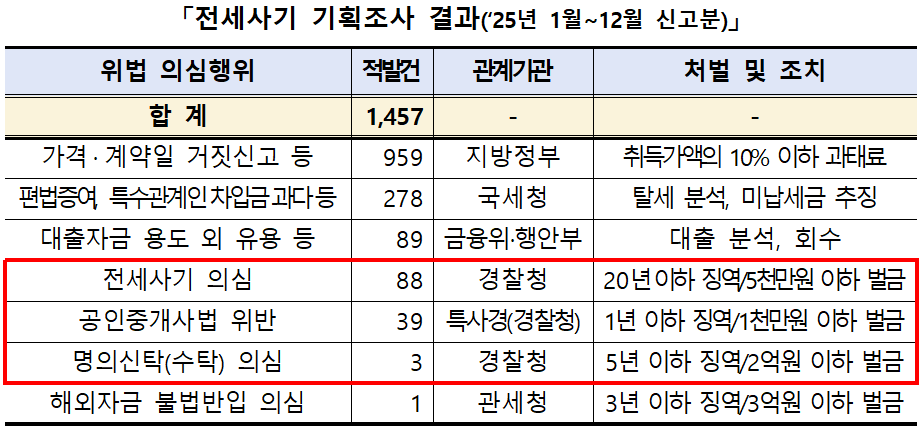
In addition to the 22 individuals suspected of jeonse fraud — including two alleged co-conspirators — the ministry also referred 39 people for Licensed Real Estate Agents Act violations and three for suspected title trust arrangements. The 959 cases of false reporting of prices or contract dates were forwarded to local governments, while the 278 cases involving irregular gift transfers and transactions between related parties were reported to the National Tax Service. Cases involving misuse of loan funds were referred to the Financial Services Commission and the Ministry of Interior and Safety, and one suspected case of illegal inflow of overseas funds was handed over to the Korea Customs Service.
Penalties by violation type are as follows: jeonse fraud carries up to 20 years in prison or a fine of up to 50 million won ($37,200); Licensed Real Estate Agents Act violations carry up to one year in prison or a fine of up to 10 million won; title trust arrangements carry up to five years in prison or a fine of up to 200 million won; and illegal inflow of overseas funds carries up to three years in prison or a fine of up to 300 million won. False reporting of prices or contract dates is subject to an administrative fine of up to 10 percent of the acquisition value. The National Tax Service will analyze suspected irregular gift transfers for tax evasion and pursue collection of unpaid taxes, while cases of loan fund misuse will be reviewed and the funds recovered.
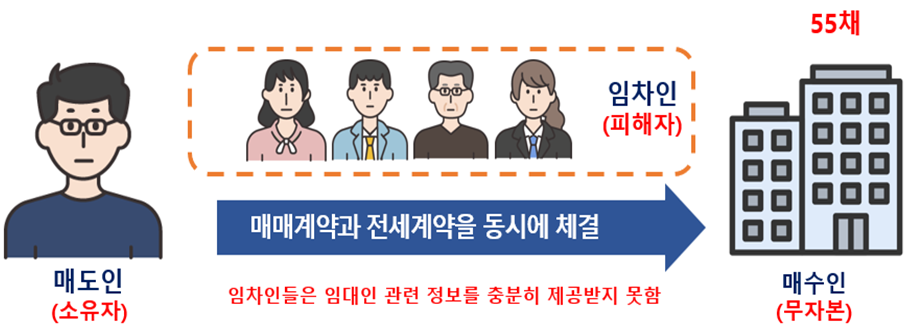
Among the notable cases uncovered, one buyer — identified only as A — purchased 55 apartments and officetels across the Greater Seoul area. The acquisitions were made either by assuming existing jeonse deposits or by entering into jeonse contracts simultaneously with the purchase. In some cases, the assumed deposit exceeded the sale price, and in most cases the jeonse deposit-to-sale price ratio was 90 percent or higher.
Of the 55 properties purchased, lien registration orders were confirmed on nine. A also failed to submit supporting documentation for a funding plan, making it impossible to verify any income. The ministry classified the case as suspected zero-capital gap investing-type jeonse fraud, citing serious doubts about the ability to return deposits.
In another case, a developer identified as B built 49 officetels and sold them to front landlords — known colloquially as "baji" landlords. The front landlords signed jeonse contracts with tenants at 95 to 100 percent of the pre-sale price and used the deposits received to pay B the remaining balance on their purchases. B's transaction records showed multiple withdrawals for fees and rebates, and real estate commission payments were also found to be excessive. Lien registration orders were recorded in this case as well.
The ministry suspects the scheme involved organized collusion among the developer, a pre-sale company, tenant recruiters, real estate agents, front landlords and front landlord recruiters — a pre-sale company-type jeonse fraud centered on the developer and the pre-sale firm.
A third suspect, identified as C, was also caught having purchased 27 apartments and officetels across the Greater Seoul area using the same method. The jeonse deposit-to-sale price ratio was 90 percent or higher in most cases, and seizure orders, provisional seizures, compulsory auction proceedings or lien registration orders were confirmed on 18 of the 27 properties. C also failed to submit supporting documentation for a funding plan, raising doubts about the ability to return deposits, and the case was classified as suspected zero-capital gap investing-type jeonse fraud.
Kim Young-guk, director general of the ministry's Housing and Land Bureau, said the ministry would work with relevant agencies to crack down effectively on illegal activity and do its best to create a safe residential environment for the public. "Eradicating jeonse fraud requires sustained and systematic action," Kim said.
smh@heraldcorp.com





