Union says 40,000 members joining; meal disruptions being tallied
Workers demand 105,000-won monthly base pay raise; talks stalled
Rally at Yeouido calls for education funding, end to wage discrimination
Education authorities activate situation rooms, arrange alternative meals
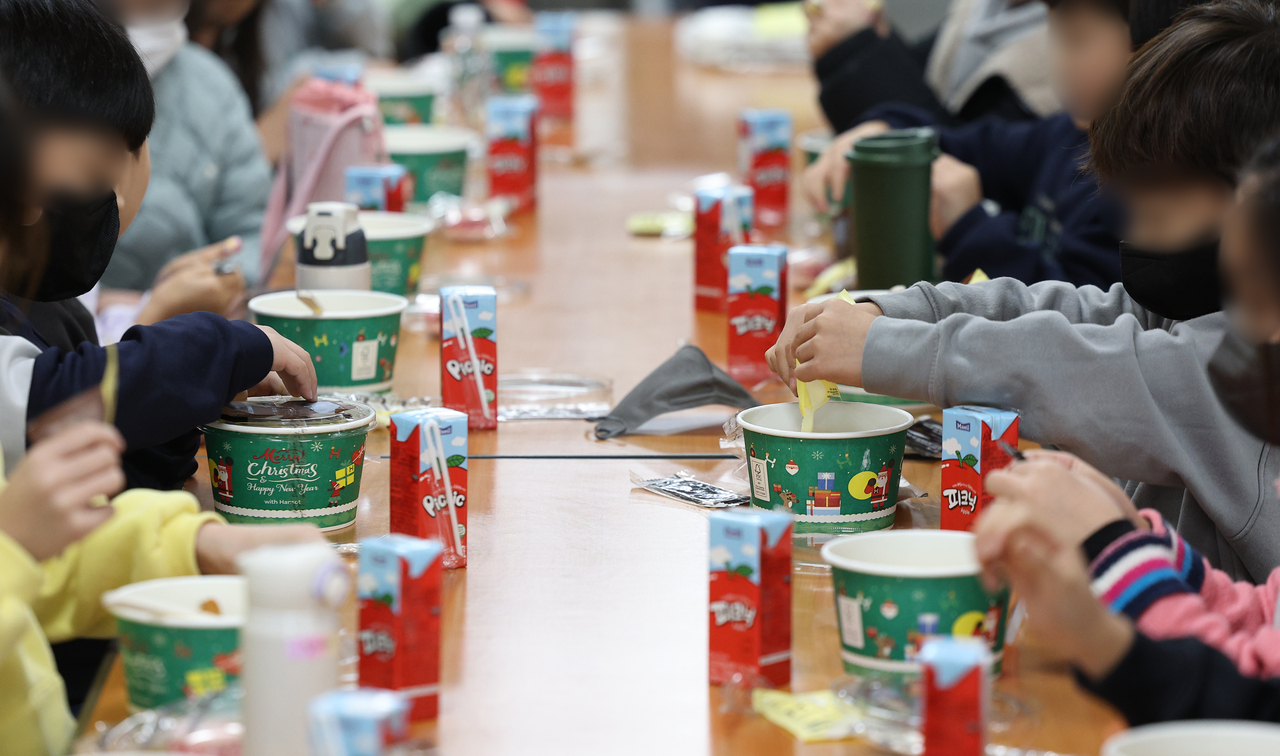
Non-regular workers responsible for school meals and after-school care launched a nationwide one-day general strike Friday, disrupting cafeteria and childcare operations across the country. Schools unable to serve regular lunches offered bread and milk as substitutes or asked students to bring their own dosirak, while education authorities activated situation rooms and moved to minimize gaps in meal and care services.
The National School Non-Regular Workers Solidarity Council — an umbrella body comprising the National Education Public Service Workers Union, the Korean Women Workers Association, and the National School Non-Regular Workers Union — launched the strike Friday. The council expected about 40,000 of its roughly 94,000 members to participate.
Cafeteria workers are expected to bear the brunt of the strike, accounting for roughly 30 to 40 percent of the council's membership. During a series of regional rolling strikes in November and December last year, 3,872 schools were unable to serve regular meals. Meal disruptions had also hit 3,181 schools in 2022, 3,293 in 2023 and 3,910 in 2024.
Around 3,000 schools are expected to face meal-service difficulties this year as well. Depending on how many workers join the strike, schools will either simplify their menus or provide alternative meals such as bread and milk. Some schools advised students to bring their own lunches.
Gaps are also expected in elementary after-school care, kindergarten extended programs, and special education support. During last year's strike, more than 117 after-school care classrooms shut down.
The Ministry of Education and provincial and metropolitan education offices are operating strike-response situation rooms to monitor conditions at individual schools. Schools experiencing care disruptions were directed to run alternative programs, while special education classes will be supported with shortened school days or flexible curricula depending on each school's circumstances.
The strike was triggered by the breakdown of collective wage negotiations between the Ministry of Education, 16 provincial and metropolitan education offices, and the council, which began in September. The council is demanding a monthly base pay increase of 105,000 won ($78), an annual bonus raise of 1 million won, and the creation of new job-assistance and duty allowances for permanent positions. Management has countered with a monthly base pay increase of 64,300 won and a 500-won raise per seniority bracket.
Workers held a general strike rally in Yeouido, Seoul, that afternoon. Participants called for a halt to proposed reforms of the local education finance grant system, expansion of education welfare budgets, an end to wage discrimination against non-regular school workers, and the establishment of a fair wage structure. They also urged the government to secure staffing budgets required under amendments to the School Meals Act.
The Seoul branch of the Korean Teachers and Education Workers Union also issued a statement Friday expressing support for the strike. The branch said workers handling essential duties — including school meals, after-school care, and special education support — suffer from wage gaps and income shortfalls during school vacations. It added that demand for education welfare services continues to grow even as student enrollment falls, and pledged to join efforts to secure education funding.
The general strike is scheduled for one day, though further action remains possible depending on the outcome of subsequent negotiations. A council official said the union planned to return to the bargaining table after the one-day strike. "If management shows no willingness to negotiate, we may consider a second or third strike," the official said.
Choi Eun-ok, acting minister of education, said Thursday that the ministry would work to reach a reasonable agreement quickly through labor-management consultations to protect students' educational activities and health and to avoid inconveniencing parents. "The Ministry of Education and provincial and metropolitan education offices will closely monitor and support schools to ensure stable operations," Choi said.
brunch@heraldcorp.com