Bank of Korea raises benchmark rate from 3.00% to 3.25% in third hike this year
Rate-sensitive mid- to low-priced homes in Greater Seoul area expected to slow
Experts: sub-1 billion won segment less exposed, end-user demand remains solid
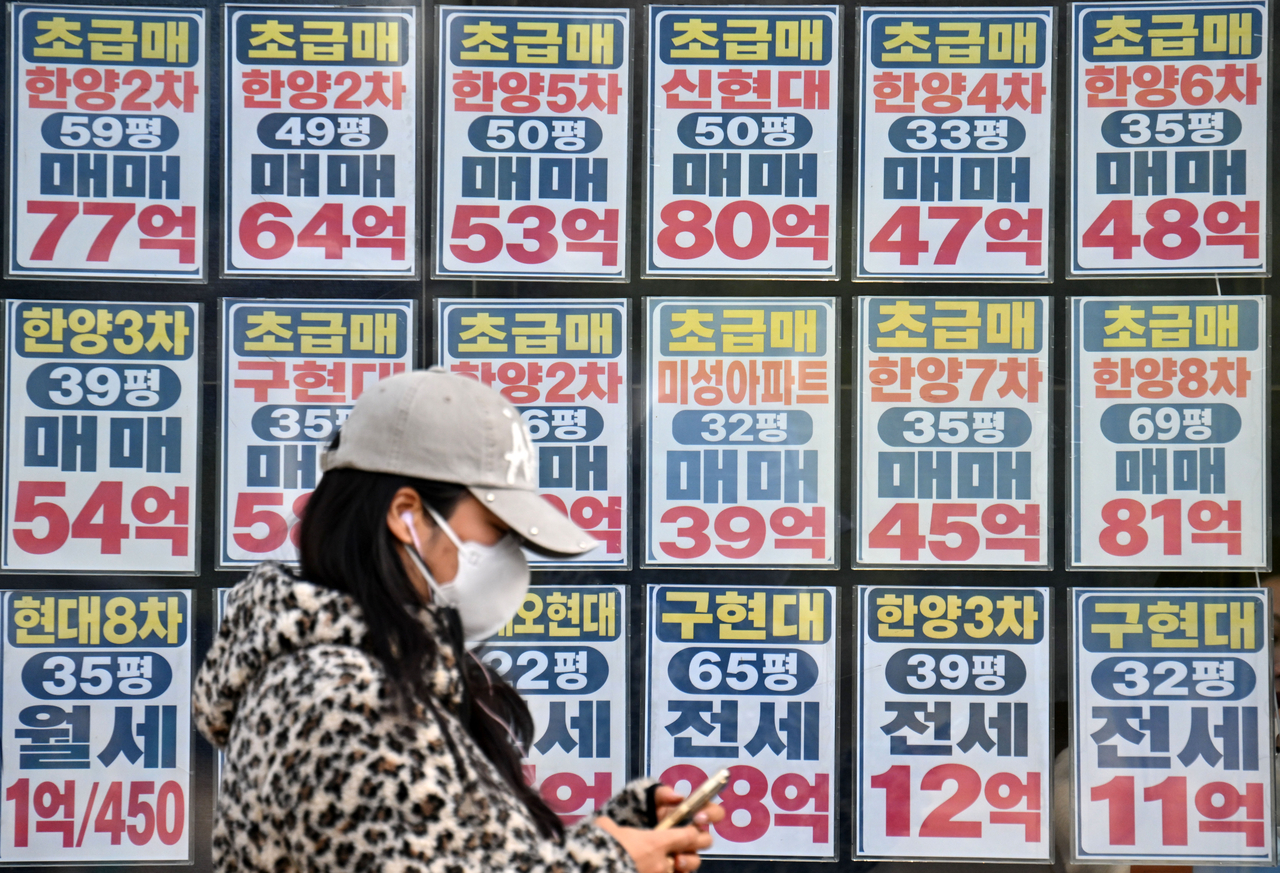
The Bank of Korea's third benchmark interest rate hike this year is expected to dampen buying activity in outer Seoul's housing market, where many purchases rely heavily on loans. Yet experts say apartments priced below 1 billion won ($745,000) could actually see a surge in demand. Buyers scaling back their budgets due to rising loan costs, and renters worn down by the tight jeonse market who are switching to purchases, are both expected to converge on mid- to low-priced complexes in that price range.
According to the real estate industry on Friday, the Bank of Korea raised its benchmark interest rate by 0.25 percentage points — from 3.00% to 3.25% — on Thursday, deepening concerns about the financial burden on the housing market. The central bank first raised rates in July, its first hike in three and a half years, and has now lifted the rate a total of 0.75 percentage points across three moves this year. The rate is now at its highest level since October 2024.
The market widely expects buying momentum to weaken in mid- to low-priced housing in outer Seoul and Gyeonggi Province, where loan dependency is high. Ham Young-jin, head of the real estate research lab at Woori Bank, said homes priced below 1.5 billion won in outer Seoul rely heavily on loan-backed end-user purchases, making them directly vulnerable to the squeeze on purchasing power that comes with rate increases. "As the burden of loan interest and principal repayments grows, the price buyers can afford falls," Ham said. "There could be a decline in transactions, a slowdown in price gains, and price correction pressure in some areas."
Seo Jin-hyung, a professor in the real estate law department at Kwangwoon University, said the Gangnam housing market is relatively insulated because transactions there are driven by asset-rich buyers with cash, thanks to loan regulations. "It is rather outer Seoul and parts of Gyeonggi Province, where leveraged buying has been most prominent, that will feel the impact of the rate hike more acutely," Seo said.
Still, many analysts believe end-user demand will continue to support prices in complexes priced below 1 billion won, even as rates rise. Yang Ji-young, a specialist at Shinhan Premier Pathfinder, said two distinct groups of buyers are likely to concentrate on transit-oriented, large-scale, small- to mid-sized apartments in that price range: buyers who have lowered their budget from higher-priced areas, and renters redirecting their jeonse deposits toward a purchase. "Complexes where these two demand streams overlap could see rising transactions and prices even as the broader outer-Seoul market slows," Yang said.
Homes priced below 900 million won — the threshold for government-backed loan programs such as the newborn special loan (up to 900 million won) and the Didimol loan (up to 600 million won) — are seen as particularly sheltered from market rate movements. Yoon Su-min, a real estate specialist at NH NongHyup Bank, said the rate hike would have little impact on properties eligible for policy loans. "That segment of the market includes buyers who are already weighing a purchase because of the tight rental market," Yoon said. "If the market shifts in favor of buyers, there is room for them to move toward buying at any time."
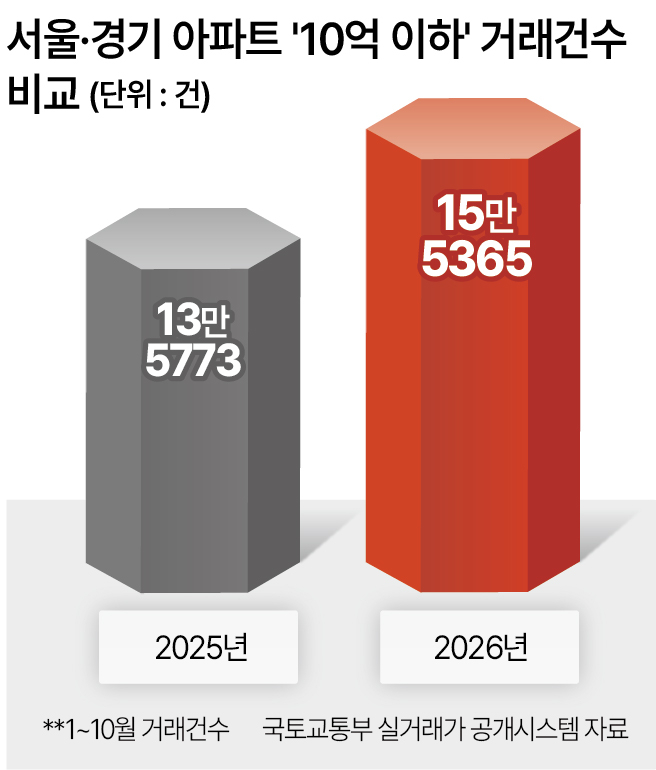
Transaction data supports this picture. According to the Ministry of Land, Infrastructure and Transport's actual transaction price disclosure system, the number of apartments priced below 1 billion won sold in Seoul and Gyeonggi Province from January through October this year reached 155,365 — up 19,592 transactions, or 14.4 percent, from 135,773 in the same period last year. Looking at volumes after the rate hike in July and August, transactions in Seoul actually rose from 2,066 in September to 2,433 in October, while Gyeonggi Province saw an increase from 9,732 to 11,760. Buying activity in the sub-1 billion won segment showed no sign of cooling despite the rate increases.
Rising jeonse prices are also cited as a factor supporting sale prices in mid- to low-priced complexes. Yang said that as the gap between sale prices and jeonse prices narrows, it becomes easier for some renters to switch to buying, which in turn supports sale prices in popular sub-1 billion won complexes. If Seoul's jeonse instability persists, demand from renters converting to buyers is expected to continue flowing into mid- to low-priced apartments in Gyeonggi Province with good access to Seoul.
Against this backdrop, analysts say a significant price decline in mid- to low-priced complexes is unlikely. Nam Hyeok-woo, a real estate researcher at Woori Bank, said demand for homes below 1 billion won remains firm in price-accessible areas such as Nowon and Gangbuk, partly due to a shortage of jeonse and monthly rental listings. "The conditions for a sharp short-term price drop are not in place," Nam said.
Ham also noted that the volume of Seoul apartments set for completion in 2027 is more limited than in a typical year, and that jeonse and monthly rental supply remains tight, which would constrain any sharp price correction.
Looking ahead, analysts say the pace of future rate hikes will be the key variable. Yang warned that if hikes come in quick succession and the cumulative increase grows larger, buying activity could weaken first and most sharply in outer Seoul and Gyeonggi Province, where loan dependency is highest. Nam said it will be worth watching whether buying momentum revives once bank loan limits are reset next year and spring moving-season demand picks up.
hwshin@heraldcorp.com