Seoul SCIO director Kim Jeong-hwan, police commissioner Kang Il-gu to serve as co-chiefs; agency to handle cases involving police suspects in separate office
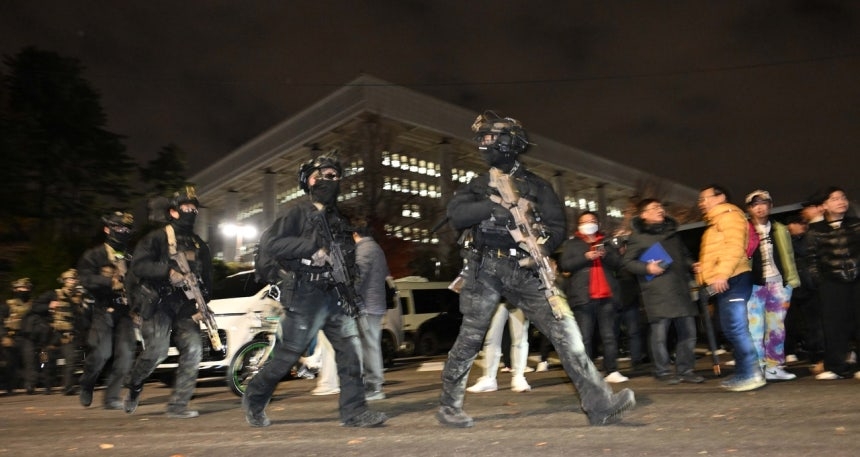
A special investigative task force probing the Dec. 3 emergency martial law crisis is set to launch as early as the first week of next month, with more than 60 police officers and about 10 investigators from the Serious Crimes Investigation Office to be deployed.
The Serious Crimes Investigation Office and the Korean National Police Agency have agreed to establish the insurrection special task force during the first week of December. Kim Jeong-hwan, director of the anti-corruption investigation bureau at the Seoul branch of the Serious Crimes Investigation Office, and Kang Il-gu, a police commissioner heading the agency's dedicated team for cases transferred from the three special prosecutors, will serve as co-chiefs.
The task force will investigate remaining cases related to the Dec. 3 emergency martial law handed over by the three special prosecutors — covering insurrection, Kim Keon Hee and the marine corporal's death in the line of duty — as well as cases from the second comprehensive special prosecutor led by Special Prosecutor Kwon Chang-young, and will pursue the broader investigation into the crisis. The Serious Crimes Investigation Office will primarily handle cases in which police officers are suspects, while the police will take on the remaining cases. Serious Crimes Investigation Office personnel will use their existing offices in Jung-gu, Seoul, while police personnel will move into a separate building in Seodaemun-gu, Seoul.
Kim, the co-chief designate and a former prosecutor, was commissioned at the Seoul Central District Prosecutors' Office in 2011 and went on to serve as a research prosecutor at the Supreme Prosecutors' Office and as head of the financial investigation second division at the Seoul Southern District Prosecutors' Office. Kim currently serves as director of the anti-corruption investigation bureau at the Seoul Serious Crimes Investigation Office, following the dissolution of the prosecution service and the launch of the Serious Crimes Investigation Office and the Public Prosecution Office on Oct. 2.
Kang, the other co-chief designate and a 10th-class graduate of the Korean National Police University, previously served as head of the anti-corruption and public crime investigation unit at the Seoul Metropolitan Police Agency and as chief of the Seoul Seongdong Police Station. Kang has most recently led the dedicated investigation team formed after the special task force handling cases transferred from the three special prosecutors was disbanded.
Earlier, Special Prosecutor Kwon Chang-young, who led the second comprehensive special prosecutor's office, said at a final briefing on the investigation's results in August: "I don't know how many pieces the war against the insurrection forces has, but the comprehensive special prosecutor's office has only put together the second puzzle piece." Kwon added, "The National Investigation Headquarters alone has its limits in handling the remaining cases. Various investigative agencies must join forces to establish a special task force and conduct a systematic, long-term investigation."
In September, President Lee Jae Myung was reported to be reviewing a directive to form the insurrection special task force. Since then, the Serious Crimes Investigation Office and the Korean National Police Agency, both under the Ministry of Interior and Safety, have held consultations on setting it up. The relatively smaller number of Serious Crimes Investigation Office personnel compared to police is attributed in part to the agency being newly established.
Among the most prominent cases the task force is expected to investigate is the so-called "No Sang-won notebook" — a notebook belonging to former Defense Intelligence Command chief No Sang-won that is widely regarded as a smoking gun containing evidence of preparations for the martial law declaration. The comprehensive special prosecutor's office examined areas near specific locations listed in the notebook, identified three sites suspected of having been intended for use as detention facilities, and executed verification warrants. It was unable to conclude the investigation, however, and transferred the cases to police.
Another key case involves a gathering at a safe house in Samcheong-dong. The comprehensive special prosecutor's office said it suspects that former presidential chief civil affairs secretary Kim Ju-hyeon and four others met at the Samcheong-dong safe house on Dec. 4, 2024 — the day after the martial law declaration — to discuss justifications for the martial law, and that the outcome was reported to former President Yoon Suk Yeol. That case was also transferred to police after the comprehensive special prosecutor's activities concluded.
The Democratic Party of Korea and other pro-government forces have called for an investigation into Chief Justice Jo Hee-dae, arguing that many aspects of his whereabouts during the martial law declaration remain unclear. Both the insurrection special prosecutor and the comprehensive special prosecutor, however, reviewed complaints filed against Jo and decided not to indict him.
bell@heraldcorp.com