Ruling and opposition parties remain at odds with four days until the legal budget deadline
Opposition calls for scrapping the fund; questions raised over funding sustainability
Government's power to reallocate spending draws challenge to National Assembly's budget authority
Ruling party members also push for larger share for local governments
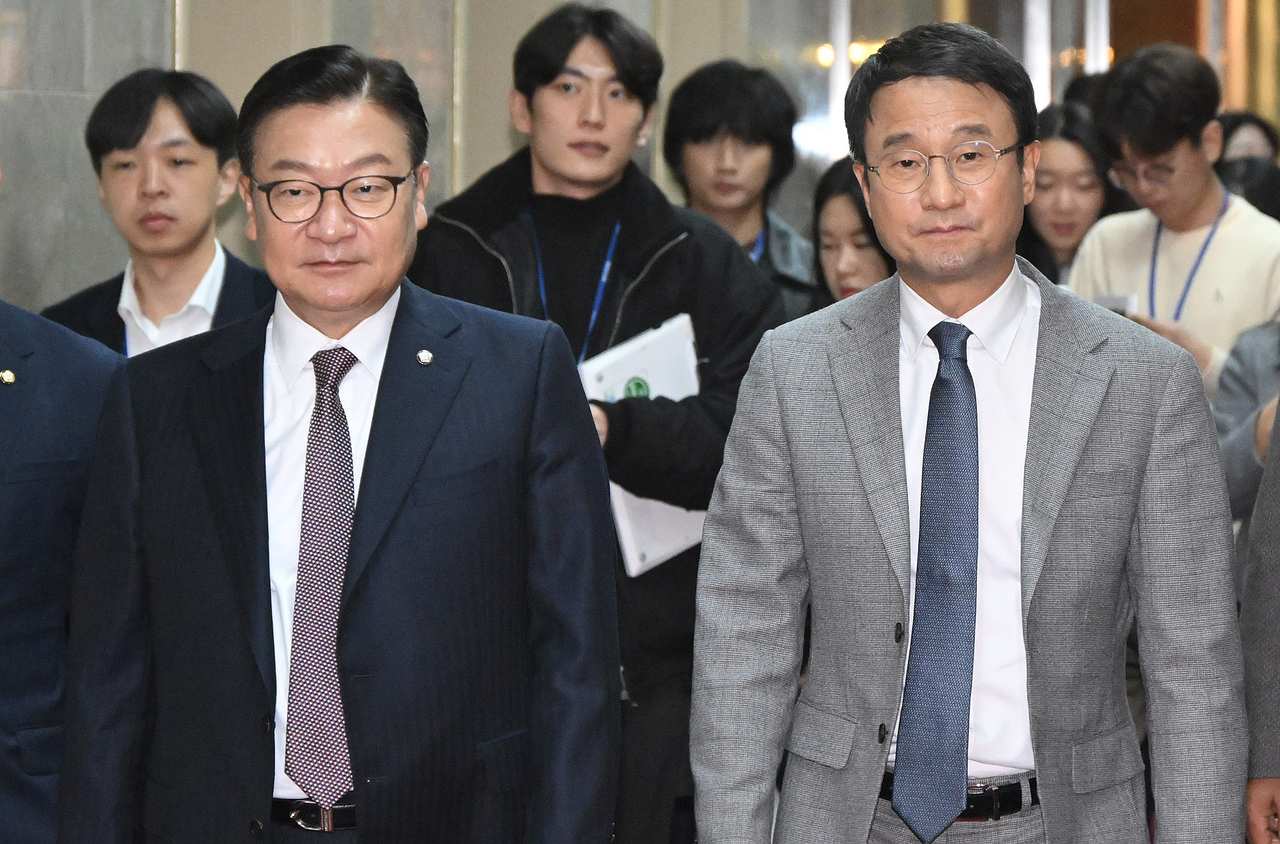
A proposed 45 trillion won ($33.5 billion) future response fund that the government wants to establish for next year's spending has emerged as the final flashpoint in the National Assembly's budget review. With the ruling and opposition parties unable to find common ground on whether to create the fund at all, ministry-level projects tied to it have been put on hold one after another. As the legal deadline for passing the budget bill closes to within four days, the question of the fund's size and structure has effectively been handed to party leaders to resolve through political negotiation.
Disagreements between the two sides run deep — from questions about the sustainability of the fund's revenue base to concerns that the government's proposed management powers would infringe on the Assembly's budget authority. Demands from within the ruling party itself for a larger allocation to local governments have added another layer of complexity, making a direct leadership-level showdown all but unavoidable.
According to the National Assembly, the ruling and opposition parties reviewed ministry-level projects earmarked under the future response fund over two days beginning Thursday at the Assembly's budget subcommittee. The government plans to channel 45.4 trillion won through the fund next year, with the stated aim of directing windfall tax revenues — driven in part by a semiconductor boom — into securing future growth engines and promoting balanced regional development.
The fundamental sticking point is that the two sides cannot even agree on whether the fund needs to exist. The People Power Party wants the fund scrapped and the projects it absorbed returned to the general account. The Democratic Party of Korea, by contrast, argues that temporarily swollen tax revenues should be put to work as a medium- to long-term investment pool and has pushed hard for the fund's creation.
The opposition's sharpest criticism has focused on the sustainability of the fund's revenue base. It argues that the government has loaded the fund with projects requiring annual fiscal outlays even though semiconductor-sector revenues — the primary source of the windfall — can fluctuate sharply.
People Power Party lawmaker Song Eon-seog said at the budget subcommittee on Thursday that expanding 45 trillion won in spending programs "when the revenue base is uncertain and unstable" was deeply problematic, noting that the projects would need continuous funding. "It is very dangerous to entrust the entire fiscal program of the Republic of Korea to a single industry — semiconductors," Song said.
PPP lawmaker Na Kyung-won also took issue with recurring projects — those requiring sustained annual funding — being included in the fund. "At the very least, ongoing projects should be excluded," Na said.
In practice, several programs under the Ministry of Science and ICT were put on hold due to the impasse, including an AI-focused university initiative, a research stipend program for science and engineering graduate students, and a project to build the country's sixth national supercomputer. The graduate student support program carries a budget of 83 billion won both this year and next, but from 2028 onward it would require more than 110 billion won annually.
The government has acknowledged uncertainty over future windfall revenues but argues that the fund's investment returns and the broader tax base expansion from advanced-industry growth must also be factored in. Vice Minister of Planning and Budget Jo Yong-beom said it was premature to conclude that "the revenue will run dry in 2029 or 2030."
The controversy over the Assembly's budget oversight powers has also intensified. The opposition argues that allowing the government to revise up to 30 percent of the fund's major spending plans without separate Assembly review could place trillions of won in fiscal outlays beyond parliamentary control.
PPP lawmaker Lee Jong-wook called for at least half of the windfall revenues to be used first to pay down national debt. He also demanded that the Assembly secure control over fund management, asking, "Can the National Assembly not stop the government from spending 13.5 trillion won as it pleases?"
Even within the Democratic Party, which supports creating the fund, calls have emerged for adjustments to how the money is distributed. Members have argued that local governments — whose finances have deteriorated following past revenue shortfalls — should receive a larger share of the fund.
Democratic Party lawmaker Kim Seong-hoe said the fund should direct "a somewhat larger portion" toward grants supporting local future growth. Fellow Democratic Party lawmaker Lee Yeon-hee said she agreed on the need for the fund but called for discussions on replenishing local government grants that went unpaid due to past revenue shortfalls.
Ultimately, the disputes surrounding the future response fund cannot be resolved through line-item budget adjustments alone. The overall size of the fund, whether projects should revert to the general account, how much goes to local governments, and how much oversight the Assembly retains — in effect, the entire architecture of the fund — will need to be renegotiated between the two parties. Even after individual project reviews wrap up, further talks between party leaders over the fund's scale and structure appear unavoidable.
thanks@heraldcorp.com