DC conversions surged on first-half market rally, but volatility since July has savers rethinking asset defense
When to switch hinges on your own wage-growth rate vs. expected investment returns
Lock in rates now with 3- and 5-year principal-guaranteed products
Starting pension payouts after age 55 cuts retirement income tax by 30–40%
The average South Korean pays about 5.15 million won a year in insurance premiums. This series — "Iboso" — is about making every won count.

Kim Min-su (42, pseudonym), a 14-year employee at a large South Korean conglomerate, switched his defined-benefit (DB) pension plan to a defined-contribution (DC) plan in June, ending an arrangement he had maintained for years. Markets had been strong since the start of the year, and a growing number of colleagues were actively investing their retirement funds through ETFs — prompting Kim to seek better returns on his nest egg.
Kim put 70 percent of the retirement funds transferred into his DC account into domestic and overseas equity ETFs, and placed the remaining 30 percent in bond-mixed ETFs that carry some equity exposure. Then, in July, global market volatility surged and share prices at home and abroad pulled back, causing his account balance to drop sharply in a short period. Kim found himself at a loss over how to manage money he would need to grow for decades.
Park Jun-young (43, pseudonym), a colleague who had been weighing a DC switch around the same time, took a different path. After consulting a retirement pension specialist and carefully assessing his promotion prospects and future wage-growth potential, Park decided to time the switch around his own salary trajectory rather than rush into it. Even after switching, he plans to avoid investing a lump sum all at once — anchoring his core holdings in long-term principal-guaranteed products while rates are high and committing only a portion of funds to investments in stages. Markets have been choppy in the second half of the year, but Park has stayed the course.
The retirement pension market this year has felt markedly different in the first and second halves. Among workers who have lived through the recent volatility, a more cautious view is spreading: check the right timing and investment approach for your own circumstances before rushing into a DC conversion. The pace of DB-to-DC switches has also visibly slowed in the second half compared with the first. So what should workers weigh before converting, and how should they manage their retirement funds once they do?
Q: DC conversions jumped in the first half — why are so many savers now having second thoughts?
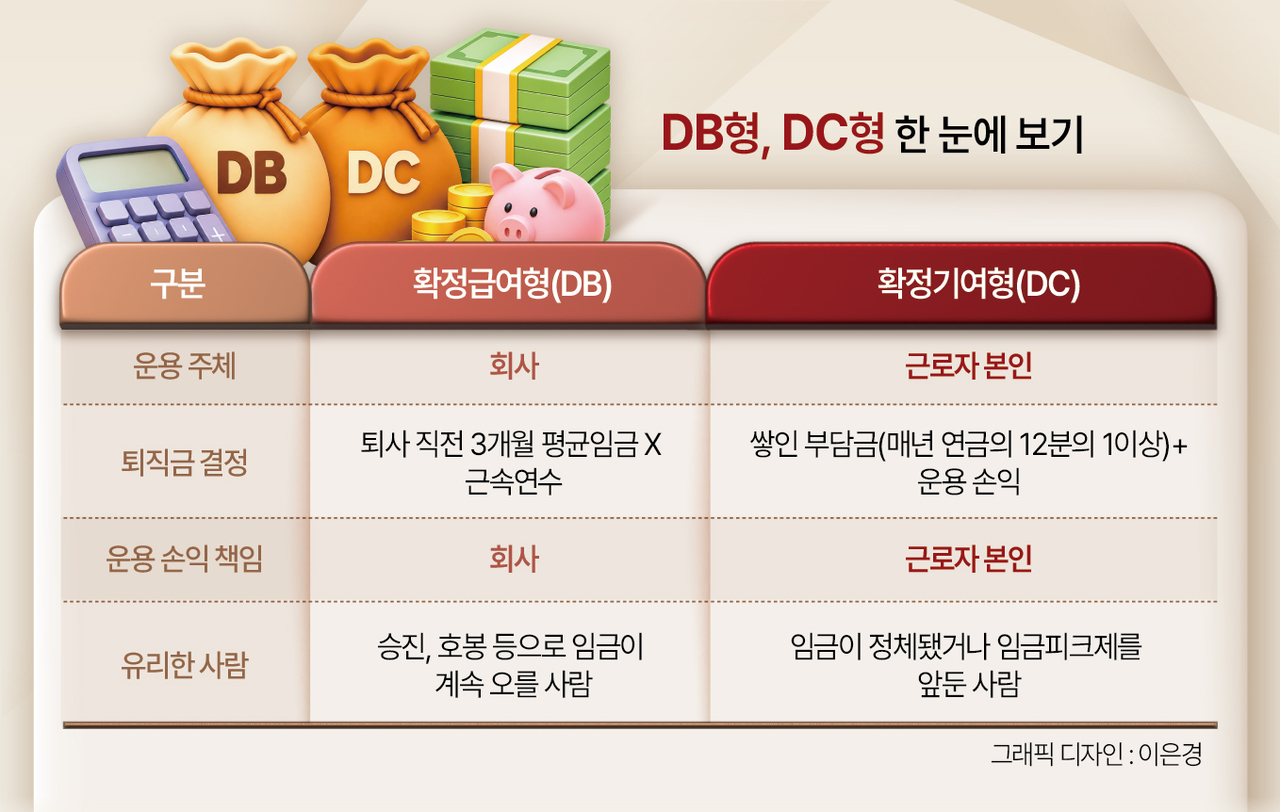
A: Retirement pensions come in two main types. Under a DB plan, the company manages the reserve fund and the employee receives a retirement payout calculated by a predetermined formula upon leaving. Under a DC plan, the company deposits a fixed annual contribution into the employee's account, and the employee chooses how to invest it. With DB, the company bears the investment risk regardless of performance. With DC, gains belong to the employee — but so do the losses.
The biggest difference between DB and DC is what determines the size of the retirement payout. Under DB, it is the employee's salary in the months just before retirement multiplied by years of service. Under DC, it is the accumulated contributions plus investment returns. That means DB tends to favor workers whose salaries rise consistently, while DC tends to favor those whose wages have plateaued or who are confident in their ability to generate returns.
In the first half of this year, strong markets drew a large wave of savers into DC plans in pursuit of higher returns. The problem is that retirement pension money must be managed over decades, yet many of those who switched had not built in adequate buffers against short-term downturns.
DC accounts may hold equity funds and ETFs — classified as risky assets — up to 70 percent of the balance, with the remaining 30 percent required to stay in safe assets such as deposits or bond-type products. However, bond-mixed products that carry some equity exposure (typically 40 percent or less) are also classified as safe assets. When a saver fills 70 percent of the account with equity and thematic ETFs and uses the remaining 30 percent for bond-mixed ETFs — as Kim did — the overall equity exposure in the account can exceed 80 percent. That amplifies gains in a rising market, but when equity corrections and exchange-rate swings hit simultaneously, as they did from July onward, the account is fully exposed to the downside.
The recent market turbulence has broadened the consensus that retirement pension funds are long-term retirement assets to be managed with patience, not short-term return vehicles. A more deliberate habit of reviewing the plan structure and portfolio before switching is also taking hold.
Q: What criteria and 'golden windows' should workers consider before switching to DC?
A: The core question is how your expected future wage-growth rate compares with the investment returns you could realistically generate by managing a DC account yourself.
A DB retirement payout is calculated by multiplying one month's average salary — based on the three months immediately before retirement — by total years of service. In simple terms: final monthly salary times years worked. Because a higher final salary retroactively inflates the payout for every year of prior service, staying in DB is effectively equivalent to earning a stable return equal to your wage-growth rate — provided your salary keeps rising through promotions, seniority increments or performance bonuses.
Conversely, if your wage growth has slowed or stalled and you are confident you can consistently beat that growth rate through your own investment decisions, DC becomes the better option. One important caveat: switching from DB to DC is, in principle, irreversible, so the decision warrants careful deliberation.
Experts identify two main golden windows for switching. The first is just before entering a wage-peak arrangement, where pay begins to decline. Staying in DB after wages start falling means the lower average salary gets multiplied across all years of service, potentially shrinking the total payout. Locking in the retirement benefit at peak salary by switching to DC at that point is considered the textbook move.
The second window is when promotion prospects diminish and wage growth decelerates. If future pay raises are expected to fall below the interest rate on principal-guaranteed products, a switch is worth considering. On the other hand, when markets have surged sharply in a short period and investment sentiment is running hot, expectations tend to get ahead of reality — making it all the more important to assess the timing and fund-allocation plan with extra care.
Q: How much of a difference does DB vs. DC actually make in numbers?
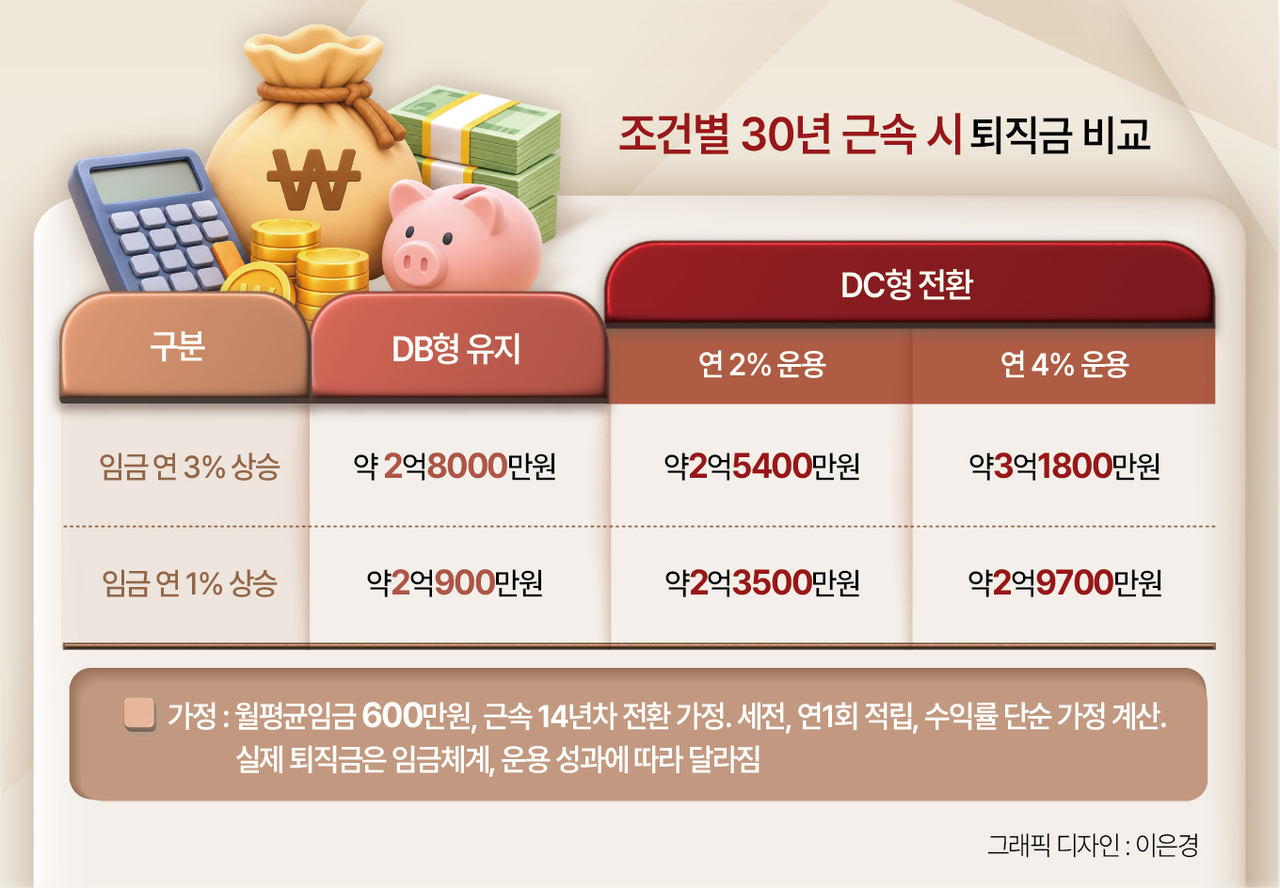
A: Consider a hypothetical based on a worker like Kim. Assume a monthly average salary of 6 million won ($4,470), 14 years of service, and 16 more years until retirement. Switching to DC now would transfer the accumulated retirement benefit of about 84 million won into a DC account, after which the company would deposit one month's salary each year going forward.
If wages rise 3 percent annually, the DB payout at retirement would be about 280 million won. Under DC, a 2 percent annual return would yield about 254 million won — less than DB — but a sustained 4 percent return would produce about 318 million won, surpassing DB. If wages grow only 1 percent a year, the DB payout falls to about 209 million won. In that scenario, even a 2 percent DC return would generate about 235 million won, more than DB. Ultimately, the deciding question is whether you can consistently outperform your own wage-growth rate over the long run.
Q: Once you have switched to DC, how should you navigate a volatile market and a high-rate environment?
A: When market interest rates are relatively elevated, as they are now, a balanced approach is to first lock in the higher rates available on long-term principal-guaranteed products, then layer in diversification and tax-efficiency strategies.
Principal-guaranteed products often bring to mind one-year fixed deposits, but 3- and 5-year products currently offer higher rates than their shorter-term counterparts in many cases. A prime example is the insurer's "guaranteed-rate insurance" product, which locks in a promised rate for a set period. Because retirement pension funds are not needed immediately, securing a long-term fixed rate while rates are high allows savers to keep earning that rate until maturity even if market rates fall later — a rate lock-in effect. Choosing a product with annual compound interest amplifies this benefit over time.
That said, early redemption of long-term principal-guaranteed products typically incurs a rate penalty, so tying up all funds in one go is inadvisable. A two-track strategy is useful here. Of the lump sum transferred into the DC account, the core funds that must be protected go into 3- or 5-year long-term products to fix the rate. Funds earmarked for investment are parked temporarily in short-term principal-guaranteed products with maturities of one year or less, then deployed gradually in fixed installments as market conditions develop. This approach preserves liquidity when needed, maintains return potential, and avoids the risk of buying in all at once at a peak.
Principal-guaranteed products held within a retirement pension account — such as deposits and guaranteed-rate insurance — are covered by deposit protection of up to 100 million won per financial institution, separately from ordinary deposits. For larger sums, spreading funds across products at multiple institutions is a practical safeguard.
Q: What should workers focus on as retirement approaches?
A: One of the most common blind spots in retirement pension management is concentrating entirely on the accumulation phase — how much to grow the fund — while neglecting the drawdown phase: how to withdraw it safely.
Even a long track record of strong returns can be undone if markets fall sharply one or two years before retirement, leaving too little time to recover and forcing a worker to retire with less than expected. As retirement nears, it is therefore important to gradually reduce exposure to performance-based assets such as funds and ETFs and shift toward safe assets such as long-term principal-guaranteed products.
Tax planning and cash-flow design around the withdrawal method also matter. Receiving the retirement benefit as a pension in installments after age 55 — rather than as a lump sum — reduces the retirement income tax owed by 30 percent (rising to 40 percent from the 11th year of pension receipt onward), provided annual withdrawals stay within the prescribed limit. Beyond that, longevity risk — the possibility of outliving one's savings — should factor into the design: savers need to decide in advance whether to concentrate payouts in the early retirement years when living expenses tend to be higher, or to structure a lifelong income stream such as a lifetime annuity. Retirement pension funds are, in the end, the mechanism that must cover living expenses for the decades after retirement.
Q: What is the 'guaranteed IRP' product drawing attention lately?
A: As demand grows among retirees who want both investment upside and principal stability, major life insurers have begun offering guaranteed individual retirement pension (IRP) products — formally known as guaranteed performance-linked insurance — tailored to the drawdown phase. These products guarantee a minimum pension payout while still pursuing investment returns. They address the dilemma facing retirees who worry that keeping retirement funds entirely in principal-guaranteed products leaves them exposed to inflation and longevity risk, yet fear that performance-linked products could erode their pension base in a down market.
A guaranteed IRP continues to invest the pension reserve — typically through a globally diversified asset-allocation fund — while guaranteeing a minimum annual payout for a set period (commonly 20 years) based on the principal contributed. Even if the reserve is depleted early due to poor market performance, the guaranteed payout continues until the end of the contract period. Conversely, if strong investment returns leave a balance remaining after the full guaranteed period has elapsed, payouts continue until those remaining funds are exhausted. Savers should note, however, that early cancellation can alter the guarantee terms, so it is important to review the conditions for starting pension payments and the specifics of the guarantee before signing up.
Q: What should workers look for when choosing a financial institution to handle a DC conversion and retirement fund management?
A: Rather than chasing short-term return rankings or one-off promotional events, savers should evaluate three things holistically: whether the institution offers a well-rounded lineup of both short- and long-term principal-guaranteed products alongside investment options; whether it provides ongoing management support after enrollment; and whether it has genuine expertise in post-retirement pension planning.
As the recent volatile market demonstrated, portfolios concentrated in a single asset class are vulnerable when conditions shift. The first priority is confirming that the institution offers a balanced mix — rate-competitive principal-guaranteed products such as 3- and 5-year guaranteed-rate insurance, alongside proven performance-linked options including target-date funds (TDFs, which automatically reduce equity exposure as the target retirement date approaches), ETFs, and default options (a system that automatically invests in a pre-designated product when the account holder gives no investment instruction). Above all, in a DC plan where the employee bears full investment responsibility, expert guidance that helps savers review and adjust their accounts in response to market changes is what elevates the quality of account management.
Large life insurers with long track records in retirement pension management have been moving beyond simple trading platforms, establishing dedicated asset management centers and assigning dedicated staff to individual corporate clients to strengthen one-on-one consulting. The scope of that consulting spans the full life cycle — from diagnosing whether a DB-to-DC switch makes sense, to rebalancing asset allocations as interest rates and markets shift, to designing a post-retirement pension drawdown strategy.
For anyone weighing a DC conversion, the first step is to assess how much your salary is likely to grow from here. After switching, the planning work continues: balancing long-term principal-guaranteed products with diversified investments, capturing available tax benefits, and mapping out a post-retirement pension withdrawal strategy. A retirement pension is not money to be swayed by short-term market moves — it is the financial foundation of your later years, one that must be tended steadily in step with the arc of your own life.

won@heraldcorp.com