
Toss Insight analyzes 580 US tech and financial firms
Patents and executive AI mentions point to different leaders in 5 of 6 sectors
Half of financial firms made no AI mention in 2024 earnings calls
Researchers urge focus on actual business outcomes
Holding a large number of AI patents or having executives who frequently mention AI is not enough to gauge a company's AI competitiveness, according to new research. An analysis of 580 US technology and financial firms found that in five of six sectors, the top patent holder and the company whose executives spoke most about AI were different firms. The researchers said investors and analysts should look beyond accumulated technology and stated strategy to examine what results companies are actually delivering in their businesses.
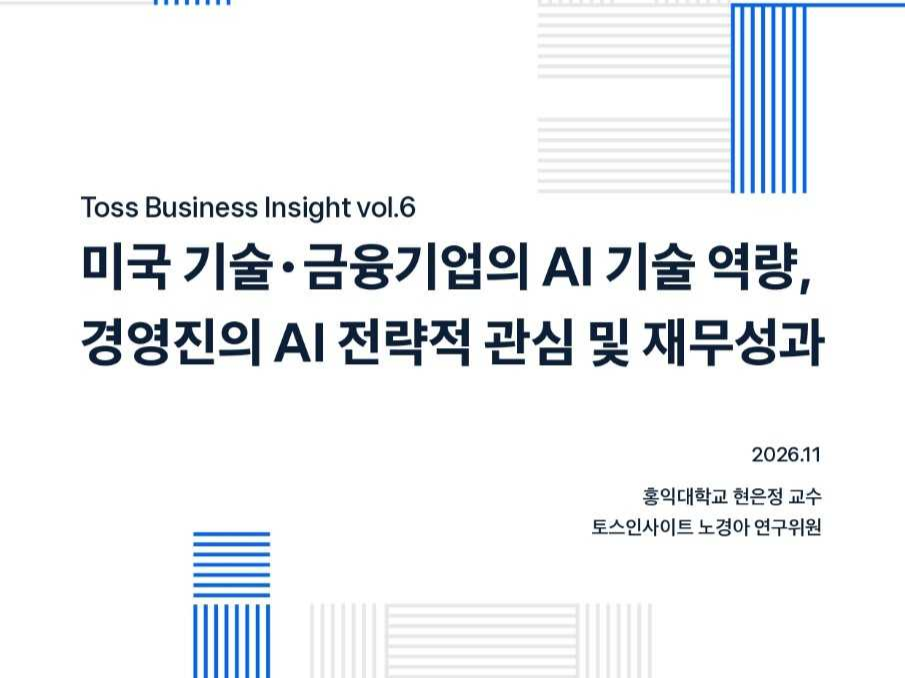
Toss Insight, the financial research arm of fintech firm Toss, published the findings Friday in a report titled "AI Technology Capabilities, Executive Strategic Attention to AI, and Financial Performance of US Technology and Financial Firms." The report was written by Hyun Eun-jung, a professor at Hongik University, and Noh Kyung-ah, a research fellow at Toss Insight. It draws on AI patent data from 2016 to 2023 and executive earnings-call statements and financial results from 2016 to 2024 for listed US technology and financial companies.
The researchers divided the firms into six sectors: cloud and digital platforms, AI computing devices and hardware, IT services and enterprise software, banking and consumer finance, fintech and payments, and insurance. The only sector where the same company ranked first in both AI patent registrations and the share of executive AI mentions was fintech and payments.
The concentration of AI patents among a small number of firms was also identified as a factor that complicates cross-company comparisons. A significant share of AI patents held by financial firms was clustered among a handful of companies, and a similar pattern appeared in the technology sector. Because a few outliers can pull up a sector's average, the researchers said industry-wide averages should be read alongside the patent profiles of individual companies.
Executive commentary on AI has grown rapidly, but a gap emerged between the technology and financial sectors. Among technology firms with 2024 earnings materials available, the vast majority mentioned AI at least once, while roughly half of financial firms made no mention of AI at all.
The researchers also examined the relationship between AI capabilities, executive attention and financial performance. At some technology firms, years with more AI patents or AI-related statements also tended to be years of higher profitability. However, the researchers cautioned that strong earnings years may themselves have prompted greater AI investment and more AI commentary, making it difficult to conclude that AI drove the profitability gains.
"Patents and executive statements each reflect a company's accumulated technology and the direction it intends to emphasize, but neither alone is sufficient to assess AI competitiveness," Hyun and Noh said. "To judge a company's AI capabilities more accurately, similar businesses should be compared on both indicators together, and it is also necessary to verify whether AI has actually reduced working hours and costs, and whether it has improved service quality."
Meanwhile, Toss Insight, which launched in September 2024, has been studying the impact of AI on the financial industry from multiple angles. Since June this year, it has been releasing a five-part research series titled "AI Finance" covering the themes of history, competition, talent, risk and strategy. In September, it published the second installment, which analyzed how AI is reshaping the competitive landscape among financial firms.
snsd@heraldcorp.com





