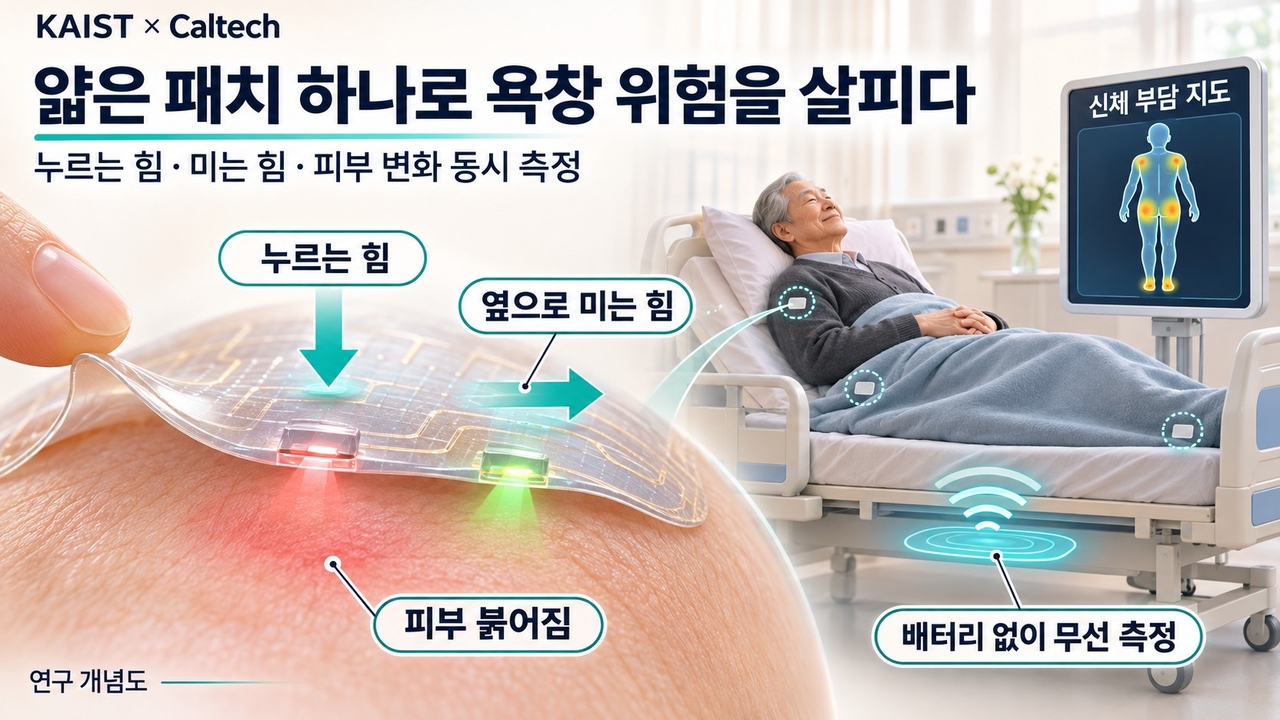
- Developed jointly with Caltech, the sensor measures pressure, shear force and erythema simultaneously
- Thin, flexible patch monitors at-risk areas on the body in real time
Researchers have developed a technology that can monitor bedsore risk in real time using a single thin patch placed on patients who are bedridden for extended periods.
KAIST announced Sunday that a research team led by Distinguished Professor Park In-kyu of the mechanical engineering department, working jointly with a team led by Professor Wei Gao of the California Institute of Technology (Caltech), has developed a wireless, battery-free optoelectronic multimodal skin sensor.
Bedsores, also known as pressure ulcers, occur when prolonged compression damages the skin and underlying tissue. The condition is caused not only by pressure applied perpendicularly to the skin but also by shear force — the lateral sliding of skin against deeper tissue. Erythema, or reddening of the skin caused by changes in blood flow, is also considered a key warning sign.
Conventional sensors have struggled to measure all of these risk factors simultaneously, and the use of rigid components, batteries and wiring has made it difficult to keep them attached to the skin for long periods.
The research team addressed these limitations using light-emitting diodes (LEDs) and optical sensors. The patch exploits the principle that the path light travels inside it changes when the patch is pressed or shifted sideways. An artificial neural network then analyzes the complex mixed optical signals to determine the magnitude and direction of forces applied to the skin.
By analyzing the difference in reflected red and green light based on the light-absorption properties of hemoglobin in the blood, the sensor can also detect changes in skin erythema.

The sensor uses near-field communication (NFC) technology to receive power wirelessly from an antenna installed beneath the bed mattress and to transmit measurement data without wires. Only a thin, flexible patch needs to be attached to the patient's body.
When patches are placed on multiple parts of the body, the system can generate a real-time map showing where pressure and shear force are concentrated depending on the patient's position. It can also confirm whether the load on a given area has actually decreased after the patient changes position.
The research team plans to conduct long-term validation in clinical settings and develop the technology into a bedsore management platform for use not only in hospitals and care facilities but also in the home.
"Bedsores often begin as internal tissue damage before any outward signs appear, which is why it is important to monitor pressure, shear force and blood flow changes together," Park said. "This technology has the potential to develop into a next-generation monitoring platform for early detection of bedsore risk in elderly or bedridden patients with limited mobility."
The findings were published in the October issue of Nature Communications.
nbgkoo@heraldcorp.com