
Attempted arson at facility rated same security level as presidential office, spy agency
Serial security failures reveal how intruder reached heart of complex unchallenged
Government orders sweeping review, including unified visitor center and separated traffic flows
In September last year, a man in his 50s identified only as A, frustrated that a complaint he had filed with the Ministry of Labor and Employment had not been resolved to his satisfaction, arrived at Building 11 of the Government Sejong Complex carrying roughly 6 liters of gasoline, butane gas canisters and a blowtorch. He doused a corridor outside the minister's office with the flammable materials and attempted to set it alight, but staff intervened and police arrested him about 30 minutes later — the attack falling short of its intended target.
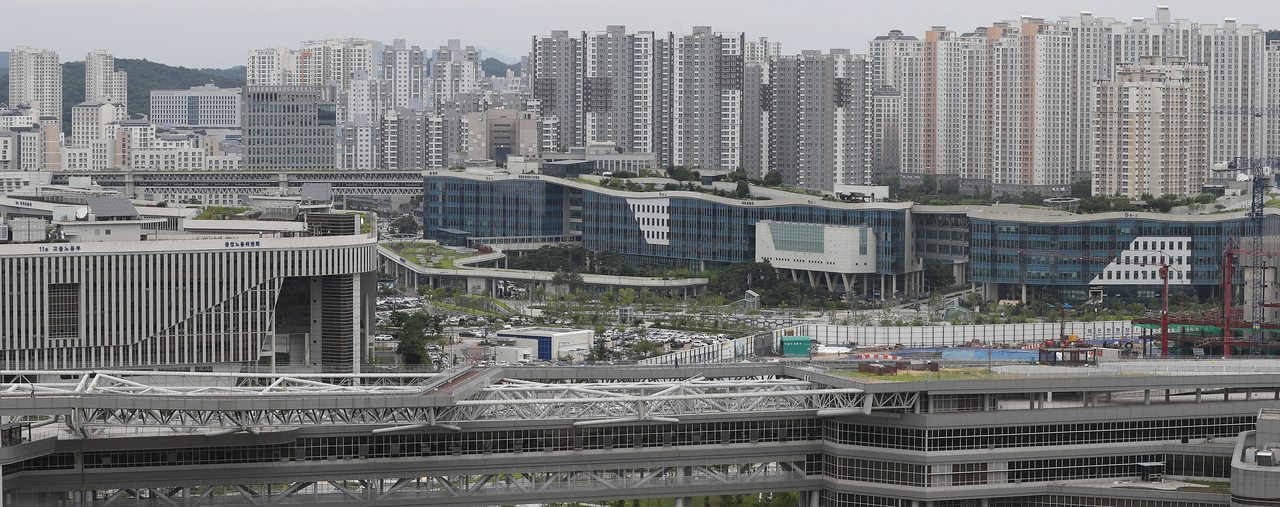
The attempted arson, which brought an intruder within reach of a minister's workspace, has laid bare serious security vulnerabilities at the Government Sejong Complex — and prompted the government to order a comprehensive overhaul of its access control systems.
The Ministry of Interior and Safety's Government Complex Management Headquarters recently commissioned a research project titled "Plan to Strengthen Access Security at the Government Sejong Complex," according to government sources Sunday. The study will comprehensively analyze visitor traffic flows, building layouts and entry procedures, and produce a set of improvement measures and an implementation plan.
The Government Sejong Complex holds a "Class A" national security designation — the highest tier, shared with the presidential office and the National Intelligence Service. The incident was a failure of perimeter security, but what drew particular concern was that an outsider was able to move deep into the complex's most sensitive spaces without being stopped.
A's route through the complex illustrates the problem. Carrying a bag filled with flammable materials, he climbed over a fence beside the main gate and walked into the building, reaching the first-floor lobby without being challenged. He then bypassed the security screening checkpoint by using a nearby water bottle as a step to vault over a glass railing, passed through an entrance and took an elevator to the sixth floor, where the minister's office is located.
The complex management headquarters said nearby structures had blocked the sightlines of security personnel at the time, preventing them from immediately detecting the unauthorized entry. A's prior visits to file complaints also appear to have given him familiarity with the internal layout and entry procedures.
Under the current setup, a visitor need only show identification at the main gate to enter the first-floor lobby of a major ministry building; visitor passes are issued and bags searched only after that point. The complex verifies identity only after a person has already entered the building, rather than at the outer perimeter. Security experts say this means that if an outsider is not stopped at the building entry stage after entering the grounds, little prevents them from reaching upper floors.
This stands in contrast to the government complexes in Seoul, Gwacheon and Daejeon, where visitors must pass through identity checks and security screening at a separate outer reception building before they can enter the main premises. The Sejong complex, by comparison, has a relatively weak secondary filter at the building entry stage for people who have already entered the grounds.
The Sejong complex is also an enormous structure — 15 ministry buildings connected in a single chain stretching roughly 3.5 kilometers. The open, interconnected design was intended to make it easy for staff to move between ministries and for the public to access government services, but that same layout has been identified as a factor that could allow an unauthorized intruder to move widely through the complex once inside.
Earlier incidents point to a pattern. In 2021, a person under the influence of narcotics wandered the complex for about three hours and reached the vicinity of a minister's office. In 2023, a person carrying a gas gun was caught inside the complex on the way out.
The government itself, in the terms of reference for the research project, identified the current entry procedure — under which visitors confirm their identity at the main gate before walking unchecked to the lobby — as a security vulnerability.
The research project will first analyze security threats arising from the complex's open, elongated layout and its bridge-connected buildings, as well as structural vulnerabilities in the architecture. Based on those findings, it will develop proposals covering the construction of a unified visitor reception building with an external public service counter, the placement of security screening checkpoints and visitor pass issuance desks, the separation of staff and visitor traffic flows, the elimination of CCTV blind spots, and improvements to access control systems including speed gates.
The government plans to use the findings to draw up a short-term action plan executable within three years, alongside a medium- to long-term security roadmap.
y2k@heraldcorp.com





