Interview with Ryu Sam-young, Dongjak-gu district mayor-elect
'Police background in field administration gives me unmatched problem-solving skills'
'Redevelopment will be driven by residents, not the district office'
'Opening every floor of district office — returning the keys to the people'
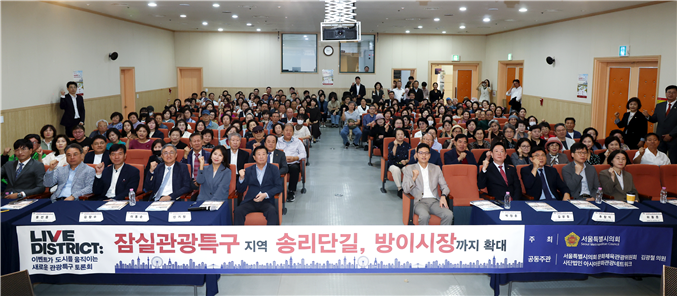
![Ryu Sam-young, Seoul's Dongjak-gu district mayor-elect, speaks during an interview at the transition committee office set up at the former Dongjak-gu district office building in Noryangjin on June 19. [Provided by transition committee]](https://wimg.heraldcorp.com/news/cms/2026/06/23/news-p.v1.20260622.0d13a3d16b614a71ae67050ea02276c3_P1.png)
Ryu Sam-young, Seoul's Dongjak-gu district mayor-elect, said he plans to build a Dongjak Tower at Yongyangbongjeojeong and connect it to Nodeul Island by cable car, calling it "a win-win project for both Seoul and Dongjak-gu." The tower was one of five campaign pledges Ryu put forward during the election, and the cable car concept took shape during the transition committee process. On redevelopment, Ryu said he would pursue projects "driven by what residents want, not what the district office or the district mayor wants." He also pledged to open every floor of the district office to residents, saying he would "give the district office back to the people."
The Herald Business sat down with Ryu on June 19. In July 2022, he led a nationwide meeting of police superintendents opposing the Yoon Suk Yeol administration's creation of a police bureau within the Interior Ministry, for which he received a three-month suspension. He later resigned after a demotion to inspector rank. He subsequently entered politics through a talent recruitment drive by the Democratic Party of Korea. He ran in the 2024 general election in the Dongjak-B constituency but lost. He then ran for Dongjak-gu district mayor in this month's local elections and won, becoming the second police-veteran district mayor in Seoul after Jin Kyo-hoon of Gangseo-gu. The following is a question-and-answer interview.
— You spent a long career in the police. What do you see as your strengths?
Police officers are always doing field administration. Problem-solving ability and speed are exceptional. Police-veteran local government heads — such as Namhae-gun County Chief Jang Chung-nam (seventh and eighth elected terms), Pohang Mayor Lee Kang-deok (sixth through eighth terms) and Chungju Mayor Jo Gil-hyeong (sixth through eighth terms) — have all won re-election or even third terms. We are also morally disciplined.
— Your first executive order was to establish a "Redevelopment Promotion Task Force." How will redevelopment under your ninth elected-term administration differ from the eighth?
Under the eighth term, things were turned upside down. In the decision-making process — designating zones, setting methods, determining public contributions — the needs of the district mayor and the district office took priority over what residents wanted. My No. 1 campaign pledge was "redevelopment that residents want." Decisions on public contributions will not be made internally; they will go through residents and civic groups. Public contributions should meet residents' needs and raise the value of the area — not serve the political interests of the district mayor. We need swimming pools and libraries, but traffic is gridlocked and there is nowhere to park. In that situation, what exactly is the point of building a world-class museum, as the previous administration announced?
— You said you would accelerate the pace of redevelopment projects.
Projects stall when conflicts of interest create disputes among residents. The district office will play a role in mediating those disputes. When it comes to civil complaints, civil servants tend to use up the full processing deadline. I will encourage faster turnaround by rewarding staff who handle cases closer to the minimum processing time rather than the maximum.
![Ryu Sam-young, Seoul's Dongjak-gu district mayor-elect, speaks during an interview at the transition committee office set up at the former Dongjak-gu district office building in Noryangjin on June 19. [Provided by transition committee]](https://wimg.heraldcorp.com/news/cms/2026/06/23/news-p.v1.20260622.3bfa822ebc7e45628a064cd214da461f_P1.png)
— What changes are needed?
I will open the entire district office building to residents and set aside time on the first floor to hear their voices directly. I will also pursue AI-driven administrative innovation so that staff can respond to residents' needs in real time.
— Your pledge to build a Dongjak Tower in the Yongyangbongjeojeong park area stands out. Tell us more.
From Yongyangbongjeojeong, you can sit and take in a 180-degree panoramic view of the Han River and its bridges. The idea had been floated before but never acted on. There is already a two- or three-story observation deck there, but the location deserves better. I want to build it as tall as possible. I particularly want to connect Dongjak Tower and Nodeul Island by cable car. The Seoul Metropolitan Government is pouring enormous money into developing Nodeul Island as a global destination. We need to link up with that plan — it is a win-win for both Seoul and Dongjak-gu. We have to persuade the city. I am convinced that if a pedestrian bridge connecting Dongjak Tower all the way to Nodeul Island is also built, it will become a landmark to rival N Seoul Tower on Namsan. In Heukseok-dong, Dongjak-dong and Sindaebang-dong, I will connect walking paths to the Han River and Dorimcheon stream, fill the area with cultural facilities such as media art installations and small performance venues, and make it a place where people can enjoy the waterfront scenery to the fullest.
— Your first field visit as mayor-elect was to the Sinnorangjin Fish Market, completed in 1968.
It shows that safety is my top priority. The Sinnorangjin Fish Market could collapse at any moment. It received a safety rating of E in 2010. An E rating means it should be demolished immediately. I was told there are required procedures that take time. I have instructed them to put safety measures in place so that it does not collapse.
— What was your first directive?
To open every floor of the district office to residents.
— What does that mean in practice?
The owners of the district are the residents, not the district mayor or the civil servants. There is a community service center inside Sungdae Market. The restrooms are open to the public, but civil servants lock the doors when they leave for the day. That is unacceptable. I asked a staff member, "Why did we spend money changing the name from 'dong office' to 'dong community center'?" They said, "A dong office is a place that handles the dong's affairs, while a dong community center is a place where residents are at the center." (Holding up a key from his pocket.) The difference between an owner and a servant is who holds the key. Civil servants use access cards to move freely through every floor, while residents are kept out. Opening every floor is a symbolic statement of who the real owner is.
— Are there not security concerns?
Security is a red herring. You cannot refuse to make soybean paste just because you are afraid of maggots — that would be putting the cart before the horse. If you give the key to the servant and stop the owner from entering, the servant is acting like the owner. That said, this is different from disclosing documents — that goes through formal information disclosure requests. The way work gets done stays exactly the same; the only difference is whether the door is locked or not. Anyone should be able to meet the district mayor. The same should apply to civil servants.
— There will surely be difficult or persistent complainants.
There may be many chronic and collective complaints — especially around redevelopment. But I see that, too, as the process of an owner holding a servant accountable.
— Your first field visit as mayor-elect was also to the old Noryangjin Fish Market.
It shows that safety is my top priority. The old Noryangjin Fish Market could collapse at any moment. It received a safety rating of E in 2010, which means it should be demolished immediately. I was told there are required procedures. Since it must not collapse, I have instructed them to take safety measures first.
— What projects will you pursue in the early days of your term?
I need to conduct an organizational review. The organizational structure is quite tangled. I intend to change the way we work and how the organization is set up.
cook@heraldcorp.com