District targets 123 locations with heavy foot traffic or frequent accidents; AI-powered walk-time extension added near schools
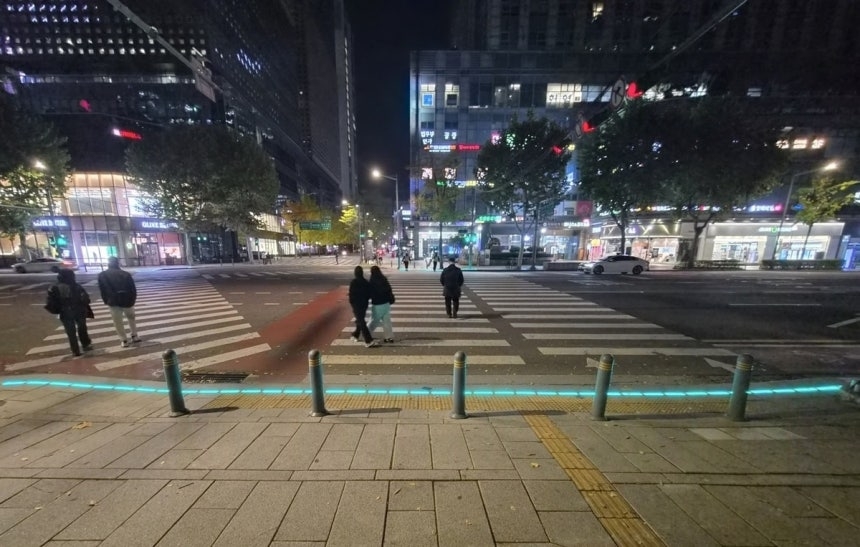
Jongno-gu announced Tuesday that it has installed ground-level pedestrian signals and voice-guidance auxiliary devices at key intersections across the district.
The auxiliary device installation project covers 123 locations on roads with four or more lanes in both directions, targeting crossings with heavy pedestrian traffic or a history of accidents.
The ground-level pedestrian signal is a traffic safety device embedded in the crosswalk surface that displays the same signals as the overhead light — green, flashing green and red — directly underfoot. The system was developed in response to a rise in pedestrian accidents caused by distracted walking, particularly among people looking down at smartphones. Pedestrians with their heads bowed can check the signal from the light at their feet, and the device also marks the crosswalk boundary in rain or low-visibility conditions.
Research has found that ground-level signals, which emit light directly from the road surface, help drivers maintain visibility and draw pedestrians' attention, contributing to accident prevention.
A study published in July in Volume 33, Issue 2 of the Korea Transport Institute's Transport Research journal — titled "Analysis of Traffic Safety Effects of Road Environment Design Facilities" — found that the devices are effective at preventing accidents. Researchers analyzed accident data and changes in user behavior at 572 ground-level signal installations nationwide.
Comparing accident records from one year before and one year after installation, the study found that locations without ground-level signals saw an average increase of 0.17 accidents, while locations with the signals saw a decrease of 0.06. The devices were particularly effective at reducing serious injuries, and the casualty-reduction effect was more pronounced at intersections — where traffic volume and hazards are greater — than on single-lane roads.
The voice-guidance auxiliary device uses an infrared sensor to detect pedestrians waiting at the stop line and alerts them by voice when they attempt to cross against the signal. When the light turns green, the device announces that it is safe to cross.
Product development and performance testing for the project ran through August, and construction was completed last month. Final inspection will be finished by the end of this month, with full operation beginning Dec. 1.
By Dec. 31, the district will add an AI-powered automatic walk-time extension system to a crosswalk inside the child protection zone at Seonjae Children's Center. The system uses AI video recognition technology to detect pedestrians still in the crosswalk as the signal is about to end, automatically extending the walk time by up to 10 seconds. Because it activates only when extra time is needed, it balances pedestrian safety with vehicle flow.
Jongno-gu developed the system in cooperation with the Seoul Metropolitan Government and the Seoul Metropolitan Police Agency, and first introduced it in December last year at two crosswalks — in front of Tapgol Park and near Unhyeon Elementary School and Gyodong Elementary School. The aim is to prevent traffic accidents by focusing on areas frequented by elderly residents who walk slowly and child protection zones prone to sudden hazards. A two-week analysis of operating records from June showed that walk times were automatically extended a combined 6,147 times at the two locations.
In front of Tapgol Park alone, extra time was granted in more than four out of every 10 pedestrian signal cycles, which the district says has provided meaningful help for slow-moving residents such as the elderly. The district plans to review further expansion, focusing on stretches with long crossing distances and heavy use by vulnerable road users including children and senior citizens.
"We will continue expanding smart traffic infrastructure tailored to residents' eye level and pace — from ground-level signals to AI walk-time extension systems — and pursue traffic policies that make a real difference in residents' daily lives and safety," said Jongno-gu District Mayor Yoo Chan-jong.
cook@heraldcorp.com