A Jeju Island gas station trade association and two agricultural cooperatives have been sanctioned by the Korea Fair Trade Commission for allegedly colluding to fix retail prices of light petroleum products, including gasoline, diesel and kerosene.
The Fair Trade Commission said Monday it would issue corrective orders and impose a combined fine of 2.05 billion won ($1.33 million) on the Jeju chapter of the Korea Gas Station Association, Jeju Agricultural Cooperative and Seogwipo Agricultural Cooperative for violations of the Monopoly Regulation and Fair Trade Act.
The fines break down as follows: 30 million won for the Jeju Gas Station Association, 987 million won for Jeju Agricultural Cooperative and 1.03 billion won for Seogwipo Agricultural Cooperative. The commission levied the largest penalty on Seogwipo Agricultural Cooperative because its relevant sales volume was the greatest.
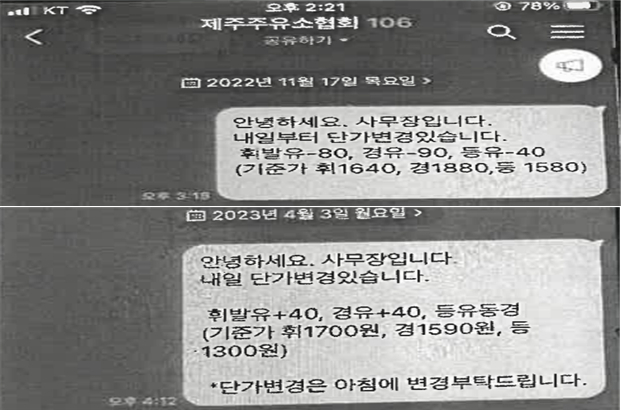
The Jeju Gas Station Association is accused of receiving next-day light petroleum retail prices in advance from the two cooperatives between September 2022 and July 2024, setting those figures as benchmark prices and distributing them to member stations via KakaoTalk group chats and text messages, with instructions to comply.
The commission determined that the association was aware the practice could constitute a violation of fair trade law. When news broke of separate cartel investigations, the association suspended its group-chat announcements and instead relayed benchmark prices by phone, text or in-person visits.
In addition, the association instructed members to delete price-related messages and not share them externally, and repeatedly asked both member and non-member stations to observe the benchmark prices.
Jeju Agricultural Cooperative and Seogwipo Agricultural Cooperative were also found to have actively participated in the price-fixing by sharing their next-day retail prices with the association before posting them on the government's Opinet fuel-price platform. The cooperatives also reported member stations selling below the benchmark to the association, which then pressed nearby non-member stations to fall in line.
As of late 2024, the Jeju Gas Station Association had 116 member stations, accounting for about 60 percent of all gas stations on the island. Jeju Agricultural Cooperative operates three stations and Seogwipo Agricultural Cooperative two; all five are discount "thrifty stations" that sell fuel below standard market prices.
The commission said the collusion took hold because the interests of ordinary gas stations and the cooperative stations aligned. Regular stations, unable to compete if priced above the cooperatives, sought advance knowledge of cooperative prices; the cooperatives, in turn, had an incentive to share prices early to prevent rivals from undercutting them further.
Jeju's geographic isolation as an island, which makes it difficult for outside operators to enter the market, was also cited as a factor that allowed the collusion to persist.
The commission said the price-fixing pushed Jeju's average retail fuel prices above mainland levels by as much as 83 won per liter for gasoline, 150 won for diesel and 53 won for kerosene.
Kim Hyeon-cheol, head of the Fair Trade Commission's Gwangju regional office, said that while Jeju's fuel prices are inherently higher than on the mainland due to shipping costs, "had this collusion not occurred, actual retail prices would have been about 10 to 60 won per liter lower."
The commission said it would continue to monitor trade associations and other operators in the light petroleum market — which directly affects people's daily lives — for cartel behavior, and would respond strictly to any competition-restricting conduct it uncovers.
y2k@heraldcorp.com