An amendment to the Act on Promotion of Information and Communications Network Utilization and Information Protection — aimed at curbing the spread of false and manipulated information online — took effect Tuesday. The People Power Party, which opposed the Democratic Party-led legislation, vowed to file a constitutional complaint and push for a full revision.
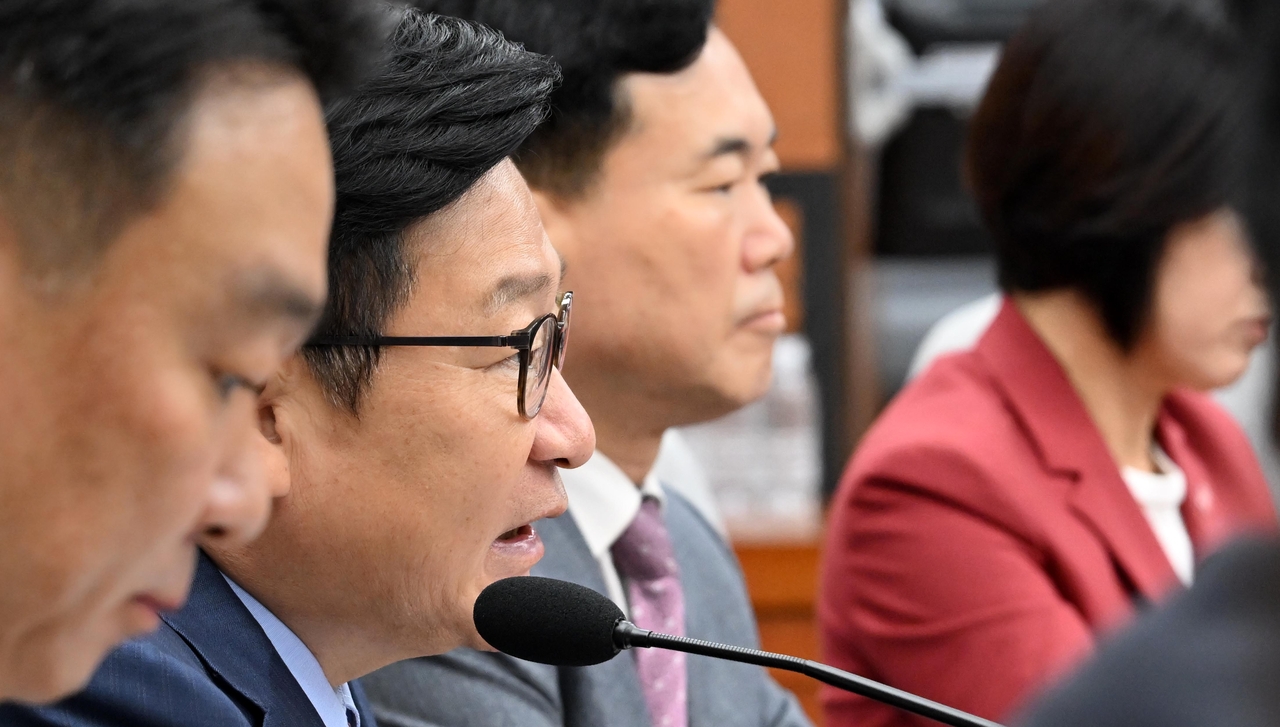
PPP floor leader Jeong Jeom-sik said at a floor strategy meeting Tuesday that the Democratic Party "infringed on corporate freedom with the yellow-envelope bill and is now suppressing freedom of expression with the 'gag law.'" He warned the legislation would "normalize witch-hunt-style violence and create a social atmosphere of fear and silence." Jeong said the party would file a constitutional complaint against the law and pursue a party-line bill to revise it by removing what he called toxic provisions.
The amended law, which took effect Tuesday, is commonly referred to as the "7·7 law." It requires platforms to pay up to five times the actual damages caused by distributing false or manipulated information online and allows regulators to impose fines of up to 1 billion won ($653,000) on those who spread such content maliciously or repeatedly.
Democratic Party floor leader Han Byung-do pushed back at his own floor strategy meeting the same day, asking, "Where exactly is the gagging or the dictatorship in this law?" He said the PPP was "distorting the facts by portraying this law as a censorship tool of the government." Han shrugged off the PPP's plan to file a constitutional complaint, saying it reflected "a petty mindset of reflexively opposing everything the Lee Jae Myung government and the Democratic Party do."
Criticism also came from outside the ruling party. Independent lawmaker Han Dong-hoon said on his YouTube live stream Monday that the law "allows the government to use major platforms like mercenaries to restrict freedom of expression," adding that its real purpose was "to make platform operators delete content on their own out of fear of government retaliation."
Rep. Noh Jong-myeon of the Democratic Party, who led the push for the amendment, appeared on broadcaster Kim Eou-joon's YouTube channel and said the revised law represented progress by classifying hate speech, incitement to violence and similar content as illegal information. He said the law contained no criminal penalty provisions, calling claims that "writing the wrong post will land you in jail" false. He also shrugged off concerns that ordinary community posts, comments and KakaoTalk messages would fall under the law's scope, saying they were not subject to regulation.
Meanwhile, online communities were divided from the law's first day in force, with users posting both criticism and support. A user on DCInside — which has more than 1 million daily active users and is therefore required under the law to establish procedures for reporting and handling false information and to set its own content policies — expressed concern that people could face punishment "just for criticizing a particular country, ethnicity or gender." Another user voiced support, saying the law "would be meaningless if it cannot even be implemented because of censorship concerns."
thanks@heraldcorp.com