Ministries of SMEs and Land expand interest-rate subsidy programs
Direct loans cut by 1.2 trillion won as 20 billion won subsidy scheme added
Lawmakers question why loans are being cut as budget resources grow
Concerns mount over reduced support for vulnerable borrowers and rising costs
The government's move to scale back direct lending programs in favor of interest-rate subsidies on private bank loans — a mechanism known as "icha bojon" — is drawing repeated criticism in the National Assembly. Lawmakers have raised concerns that the funds freed up by cutting direct loans may have been channeled excessively into other programs, and that accumulating interest-rate subsidy costs could become a significant long-term fiscal burden.
The controversy surfaced during the Assembly's budget and audit review process, centering on the Ministry of SMEs and Startups' policy funds for small business owners and the Ministry of Land, Infrastructure and Transport's Housing and Urban Fund. Interest-rate subsidies allow the government to sustain loan supply with a smaller budget outlay — a tool typically used when fiscal resources are tight — but questions are now being raised about whether converting direct loans to such subsidies is appropriate even as the overall budget is expanding.
The Ministry of SMEs and Startups eliminated a 1.22 trillion won ($906 million) direct loan program for small business general operating stability funds in next year's budget and replaced it with a 20 billion won interest-rate subsidy scheme. Under the new arrangement, private banks lend directly to small business owners while the government covers a portion of the interest, rather than supplying the loan principal itself. The change reduces the program's budget by 1.2 trillion won.
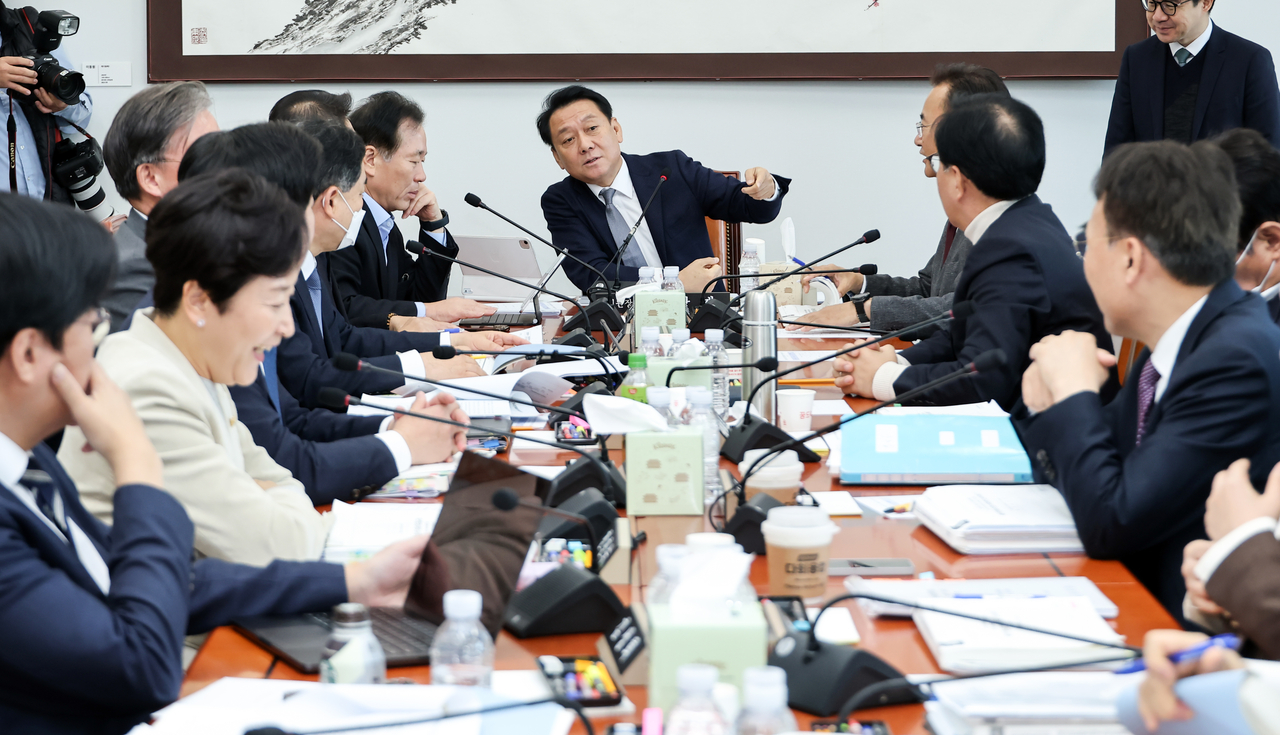
At the National Assembly Budget and Accounts Committee's budget subcommittee on Friday, People Power Party lawmaker Song Eon-seog said the government had previously cut direct loan support and shifted to interest-rate subsidies when funds were scarce, using the freed-up resources for other programs. "Next year, fiscal resources are set to increase enormously — I cannot understand why we need to cut 1.2 trillion won in direct loans, convert them to interest-rate subsidies, and squeeze out resources all over again," Song said.
People Power Party lawmaker Lee Jong-wook also took issue with the scale of the ministry's budget increase. Lee said that while the Ministry of SMEs and Startups' budget for next year rises by 1.5 trillion won — a 9.4 percent increase — factoring in the reduction in direct loans means the ministry's spending power has in effect grown by around 2.7 trillion won. "This method is originally meant for structural adjustment, not as a tool to free up money for other programs," Lee said.
Converting direct loans to interest-rate subsidies allows the government to maintain the same volume of loan supply while reducing the immediate budget requirement, creating room to allocate more funds elsewhere. The opposition argues that the actual increase in individual program budgets must therefore be scrutinized more carefully.
The Ministry of SMEs and Startups maintains that the change allows it to expand loan supply with a smaller budget. However, a review report by the National Assembly's Trade, Industry, Energy, SMEs and Startups Committee warned that "opportunities to receive policy fund support may decrease for small business owners who have low credit ratings or insufficient collateral and would struggle to pass private financial institutions' loan screening."
The existing general operating stability fund lent small business owners up to 70 million won over five years. The new interest-rate subsidy program, by contrast, provides annual interest support of 2 percent on private bank loans of up to 100 million won — or 3 percent for small business owners recognized as having growth potential. Because borrowers must pass a bank's credit screening to qualify for government support, lawmakers have called for supplementary measures to protect financially vulnerable groups.
Concerns about the fiscal burden of expanding interest-rate subsidies have also been raised in connection with the Housing and Urban Fund under the Ministry of Land, Infrastructure and Transport. With direct loans, the principal and interest repaid by borrowers flow back into the fund as reusable resources. With interest-rate subsidies, however, banks issue the loans and the government covers the interest differential, meaning costs continue to accrue for as long as the loans remain outstanding.
An analysis by the office of Democratic Party of Korea lawmaker Jang Jong-tae found that the Housing and Urban Fund's interest-rate subsidy budget reached 1.69 trillion won in 2025. Even as interest rates fell in 2024 and 2025, actual spending rose 49 percent and 22 percent year-on-year, respectively. Costs have accumulated as interest support on existing loans continues while new loans are added on top.
The National Assembly Budget Office estimates the outstanding balance of loans covered by interest-rate subsidies at around 138 trillion won. If interest rates rise, the government's interest support obligations could grow substantially.
The Ministry of Land, Infrastructure and Transport says the expansion of interest-rate subsidies was unavoidable as the Housing and Urban Fund's available reserves have dwindled. Jang has argued that as interest-rate subsidy programs multiply, it becomes increasingly difficult for the Assembly to accurately gauge the long-term costs the government will have to bear, and in August introduced a bill to amend the National Finance Act. The proposed amendment would require the government to attach to any budget proposal or fund management plan a projection showing the outstanding loan balance by program and projected fiscal requirements for at least five fiscal years ahead.
thanks@heraldcorp.com