

"New K-Industry is an innovation project that looks 30 years ahead and redesigns the industrial structure from the ground up."
The Federation of Korean Industries has launched the "New K-Industry Forum," a platform to present a new industrial growth strategy built around AI, energy and service innovation. The initiative aims to transform South Korea's industrial base by shifting away from a manufacturing-led growth model toward a structure that combines AI, green transition and service competitiveness.
The FKI held the forum's inaugural ceremony Thursday at the FKI Tower Conference Center in Yeouido, Seoul. Co-chairs Ryu Jin, FKI chairman, and Moon Seung-wook, former minister of Trade, Industry and Energy, attended alongside Ryu Je-myung, vice minister of Science and ICT, and representatives from industry, academia and research institutions.
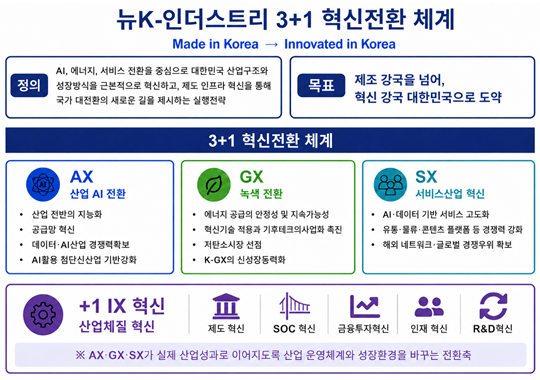
"New K-Industry" is the FKI's flagship future industrial strategy this year. It is based on a "3+1" growth model combining three pillars — AI transformation (AX), green transformation (GX) and service innovation (SX) — supported by institutional and infrastructure innovation (IX).
The FKI said traditional "K-Industry," which has long driven the Korean economy, is showing signs of structural stagnation. With domestic manufacturing output — excluding semiconductors — flatlining and service export growth lagging behind major economies, the group said a growth strategy centered solely on manufacturing has reached its limits.
Ryu said the forum "begins with a sense of mission to lead the great industrial transformation of South Korea," adding: "Just as Samsung Chairman Lee Byung-chull announced the birth of a semiconductor powerhouse with the '2.8 Tokyo Declaration' in 1983, I hope our forum will become the cornerstone of a new era."
Ryu said a competitive institutional and infrastructure foundation is essential for South Korea to move beyond catch-up growth and achieve innovation-driven growth. He also called for swift infrastructure support for investment in future key industries — including semiconductors, AI data centers and physical AI — in connection with the government's three major mega-projects.
Moon said the global economy is shifting from a free-trade-centered order to a new competitive paradigm focused on economic security, where technology and supply chains have become national survival strategies. "This period of upheaval is both a threat and an opportunity to create new leverage in global markets," he said. "New K-Industry represents the will to act — to elevate industrial competitiveness to a new level and change the dynamics of the market."
The forum also presented a range of action items to strengthen industrial competitiveness, with particular emphasis on energy security and green transformation as critical foundations for the AI era. Nam Hoon, president of the Korea Institute for Industrial Economics and Trade, said GX should be discussed from the perspective of building an energy supply system that underpins industrial competitiveness in the AI age. Yoon Eui-joon, chairman of the National Academy of Engineering of Korea, said stable electricity supply has become both a national competitiveness issue and a matter of national security, calling on South Korea to develop K-GX technologies as a new growth engine and emerge as a leading exporter of energy technology.
Participants also offered recommendations on talent development and infrastructure investment to translate AI transformation and service innovation into tangible results. Lim Hye-sook, former minister of Science and ICT, said industrial competitiveness in the AI era hinges on cultivating workers who build hands-on experience in productivity innovation and creating an ecosystem where they can continue to grow domestically. "Investment in talent will determine corporate sustainability just as much as investment in facilities," she said.
The need for institutional reform and bold deregulation to allow future industries to take root was also discussed. Choi Jae-sik, a KAIST professor, proposed that AI transformation be expanded beyond domestic productivity gains into an industrial strategy targeting global markets. He called for deregulation to create a testing and innovation environment that meets international standards, and for incentives for companies that generate results overseas. Kwon Nam-hoon, also president of the Korea Institute for Industrial Economics and Trade, said regulatory reform and resolution of conflicts among stakeholders are essential for technological innovation to be smoothly adopted.
The FKI plans to use the forum's discussions as the basis for a long-term New K-Industry roadmap, which it will propose as policy to the government and industry.
go@heraldcorp.com





