
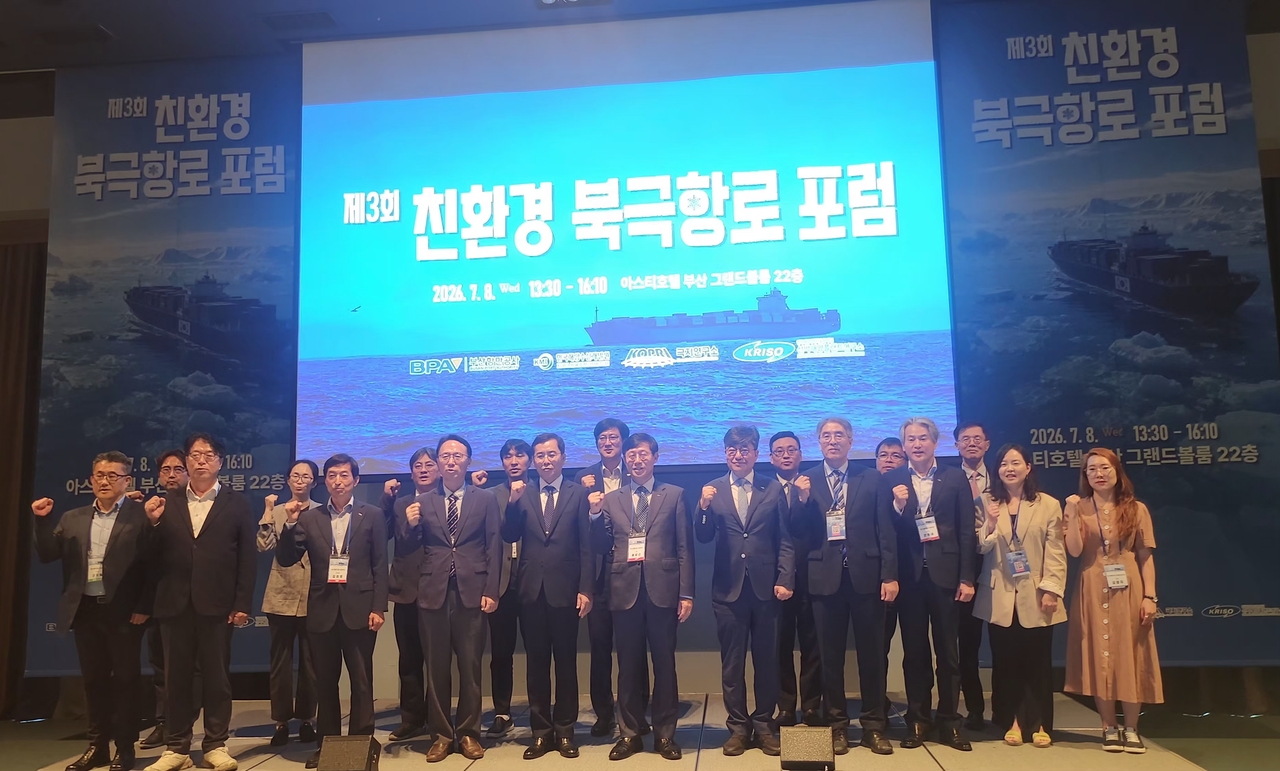
South Korea's plans to position Busan Port as a hub for the emerging Arctic shipping era are taking on sharper form.
The Third Eco-friendly Arctic Route Forum, co-hosted by the Busan Port Authority (BPA), the Korea Maritime Institute (KMI), the Korea Polar Research Institute (KOPRI) and the Korea Research Institute of Ships and Ocean Engineering (KRISO), was held Wednesday afternoon at the Grand Ballroom of Asti Hotel in Busan. The forum, which first launched in June last year, drew a large turnout of officials from government, shipping, shipbuilding and academia for its third edition in just over a year.
In his opening remarks, KMI President Jo Jeong-hee cited the Special Act on Promoting the Use of Arctic Routes and Fostering Related Industries, which passed the National Assembly in May, saying it had "laid the groundwork for systematic, national-level preparation for the Arctic route." BPA President Song Sang-geun introduced a planned pilot voyage of a 3,000-TEU container ship on the Busan-Rotterdam route scheduled for September, adding that "the commercialization of the Arctic route is becoming a reality, not a distant future."
KRISO Director Hong Gi-yong pointed to the Strait of Hormuz crisis triggered by the recent US-Iran war, warning that "a supply chain overly concentrated on specific routes poses a risk to the national economy." He also cautioned that if Busan Port fails to transform itself into a forward-looking port amid the waves of AI adoption and decarbonization, it risks being reduced to a mere transit stop.
Two keynote presentations followed. KRISO researcher Jeong Seong-yeop introduced the eco-friendly icebreaking container ship development project — launched in April this year and running from 2026 to 2030 with 20 billion won ($13.2 million) in government funding — saying the goal is "a standard hull design for an ammonia dual-fuel container ship of 8,000 TEU or larger, rated Polar Class 3 and capable of breaking 2-meter-thick ice at 5 knots." Citing the 2021 Suez Canal grounding and the Red Sea Houthi crisis, he said the Arctic route "is emerging as a viable alternative," adding that competition among major nations is accelerating — including China, which successfully completed a trial voyage of a container ship via the Arctic route to the United Kingdom in September last year.
KOPRI Division Chief Ju Hyeong-min then presented the current status and operational plans for Araon 2, a next-generation icebreaking research vessel under construction with a target launch date of 2030. Built at a total project cost of 332.1 billion won, Araon 2 will have a 1.5-meter icebreaking capacity and a displacement of 16,560 tons, overcoming the limitations of the existing Araon, which struggled to reach high latitudes due to its 1-meter icebreaking ceiling. While Araon has been limited to roughly 60 days of Arctic research per year because it also handles Antarctic resupply and polar exploration, the addition of Araon 2 — with the two vessels dividing duties between the Arctic and Antarctic — is expected to extend research voyage days to as many as 277 per year.
Ku Ja-rim, head of BPA's global business division, assessed Busan Port's strengths and weaknesses and outlined five strategic priorities: developing hub port infrastructure, building an eco-friendly fuel supply chain, advancing AI-based digital logistics, expanding global partnerships, and creating a maritime metropolitan zone linked to the Arctic route. Key tasks identified included expanding berth capacity through the smart port at Jinhae New Port and building an LNG and methanol bunkering terminal at the southern logistics zone of Busan New Port, with completion targeted for 2032.
The open discussion that followed was moderated by KOPRI Director Shin Hyeong-cheol, with panelists from the Ministry of Oceans and Fisheries' Arctic Route Policy Division, KMI's Arctic Route Support Group, Korea Maritime University's Arctic Ocean Research Center, the Korea Ocean Business Corporation's Arctic Route Comprehensive Support Center, and LX Pantos. Particularly notable was a presentation by LX Pantos maritime marketing team leader Seong Gyeong-je, who argued that amid growing maritime freight rate volatility driven by external variables, the Arctic route holds "strategic value for transporting high-value cargo such as batteries and auto parts, or year-end seasonal freight."
kaf2002@heraldcorp.com





