More than 8 in 10 Koreans believe students need civic education that addresses real political issues and social problems, a new survey shows. The Korean Federation of Teachers' Unions urged authorities to create an environment where teachers can teach based on the curriculum without fear of political-bias complaints or the threat of being reported — rather than placing the burden of strengthening civic education on individual teachers.
The federation's policy research institute released the findings Thursday under the title "2026 National Survey on Democratic Civic Education in Schools." The survey was conducted from April 17 to 22 through Macromill Embrain and covered 5,000 men and women aged 16 to 69 across the country. The margin of error is plus or minus 1.39 percentage points at a 95 percent confidence level.
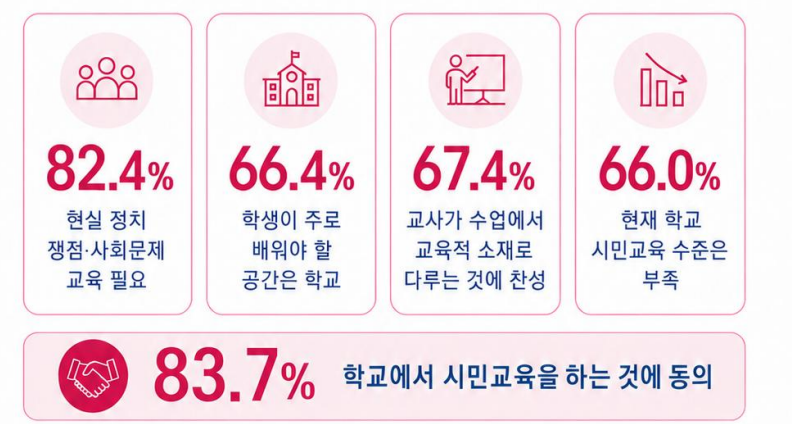
The results showed that 82.4 percent of respondents said civic education covering real political issues and social problems is necessary for students, while only 10.0 percent said it was not. When asked where students should primarily learn such content, 66.4 percent said school — the top response by far. Family came in at 14.6 percent, television at 6.3 percent and online sources at 5.6 percent.
A majority also supported teachers using real political and social issues as educational material in class, with 67.4 percent in favor and 20.8 percent opposed. Asked about the benefits of civic education that addresses political and social issues, 27.6 percent said it was better to handle such topics educationally than to leave students exposed to biased information on social media and YouTube — the top response. That was followed by "it allows thinking to develop in a balanced way through diverse perspectives" at 25.4 percent, and "it improves understanding of social issues and critical thinking skills" at 24.8 percent.
Agreement with civic education in schools overall reached 83.7 percent. However, 66.0 percent also said the current level of civic education in schools is insufficient. The federation said this means "while the public broadly agrees on the need for civic education in schools, the conditions to carry it out stably in actual classrooms have not been put in place."
The federation also cited a separate probe it conducted last year into cases where teachers' right to teach had been violated and politically motivated complaints had been filed. That investigation found cases in which history lessons, classes on social issues, occasion-based instruction and guidance on hate speech — all grounded in textbooks and the official curriculum — had led to political-bias complaints or threats of being reported. Topics that drew complaints included the pro-democracy movement, the May 18 Gwangju Uprising, the Jeju April 3 Incident, Sewol ferry disaster commemoration lessons, unification and Dokdo education, and hate speech instruction.
The federation outlined four priorities for strengthening civic education: establishing procedures for education authorities to protect legitimate civic education in schools; reframing political neutrality not as "silence" but as an educational principle that guarantees students' capacity for civic judgment; expanding civic education as a shared responsibility of the entire school community; and pursuing policies that respect and support classroom instruction.
"The problem is not that teachers refuse to teach, but that the more they try to teach, the more they must risk political-bias complaints and the threat of being reported," the federation said. "Before demanding more civic education, we must first create an environment where teachers can speak and teach based on the curriculum."
"Silence from schools does not separate students from political and social issues," it added. "What is needed is not silence, but school education that addresses the conflicts of real society in the language of civic education."
brunch@heraldcorp.com