Seoul's apartment market entered a bull run in the mid-2010s. Whether people born in the 1980s bought a home during that period largely determined how wide the wealth gap between them would grow. Prices have risen and fallen since, but the gains have far outpaced the losses — making it nearly impossible to keep up with rising home values on a salary alone.
The lesson has left a deep mark. Driven by a fear of being left behind, many buyers have stretched every resource they have — a phenomenon Koreans call "yeongkkul," or borrowing to the limit of one's soul — to snap up properties in a panic. That cycle has come to define the Seoul housing market.
The Herald Business's subscriber series "How Deputy Director Kim Bought a Home in Seoul" follows the real estate journeys of ordinary Korean office workers. The stories of those who managed to buy a home on a salary — caught between the home they want to own and the home they want to live in — may offer practical lessons for personal finance. The subjects' real names have been withheld to allow them to speak candidly.

Two colleagues who joined the company the same year as me had the same salary but made different choices. I bought an apartment through gap investment, one of them bought two officetels, and the other bought a foreign car. What happened? The wealth gap between us widened considerably, just as you'd expect.
Park Myeong-seok (pseudonym), born in 1992, is a securities firm sales employee who believes all roads in personal finance lead to real estate. Still only in his mid-30s, he owns an apartment in Mapo-gu with an asking price exceeding 2.2 billion won ($1.46 million). Having arrived in Seoul with nothing after graduating from a university outside the capital, how did Park manage to buy his own home?
Park's first foothold in Seoul was the studio apartment of his older brother, who had moved to the city ahead of him. Strapped for cash as a job seeker, he had little choice but to live with his brother and save on rent. Fortunately, the apartment was in Wangsimni. "Seongdong-gu has great transport links no matter where you're going — I always felt it was a great place to live," Park said. When he landed a job at a securities firm and was posted to its Incheon branch, he moved into company housing and saved aggressively.
A Geumho-dong apartment in the 600 million won range — the real estate agent told him it was too expensive
A year into his job, in 2017, Park resolved to buy his first home in Haengdang-dong or Geumho-dong in Seongdong-gu, the neighborhoods next to where his brother lived. He wanted to stay in Seoul for the rest of his life rather than return to his hometown. With an economics degree behind him, he believed excess demand would keep Seoul apartment prices on a steady upward trajectory.
Park began visiting properties. He toured virtually every real estate office in the area — Haengdang Hanjin Town, Haengdang Daelim, e-Pyeonhansesang Geumho Park Hills, Geumho-dong Daewoo and more. This was before the term "imjang" — scouting properties on foot — had entered everyday use.
"Nine years ago, an 84-square-meter unit at Geumho-dong Daewoo was going for 500 million to 600 million won," Park recalled. "When prices started creeping up and I was weighing whether to sign a contract, the head of the real estate agency tried to talk me out of it, saying the price was absurdly high." He still has the text message the agent sent urging him to think it over a little longer.
Park saw things differently. Taking into account domestic stock market conditions and market liquidity at the time, he believed Seoul home prices were still undervalued. Seongdong-gu's transport links in every direction struck him as nothing short of ideal.
Just as he had decided to buy the Geumho-dong Daewoo unit and was about to put down a deposit, the owner changed his mind and said he wanted 100 million won more. His first attempt to buy a home had ended in failure.
![[ChatGPT-generated image]](https://wimg.heraldcorp.com/news/cms/2026/07/10/news-p.v1.20260710.24e353447f544d6caa381b147695df56_P1.png)
He missed his first chance — then the media started talking about Gireum New Town
A year passed. In 2018, prices rose even faster than they had in 2017. According to the Korea Real Estate Board, Seoul apartment prices climbed 8.03 percent over the course of 2018 — the start of the sharp price surge in the early years of the Moon Jae-in administration. The Geumho-dong Daewoo unit Park had been watching jumped to an asking price of 800 million won. It was now out of his reach.
"Back then, the media ran stories almost every day about parts of Seoul where real estate prices had not risen yet," Park said. "Gireum New Town kept coming up as the most frequently mentioned area, so I went to scout it out." It was around the time the phrase "cho-pum-a" — an apartment complex that contains an elementary school — was just beginning to catch on. The area had a large cluster of apartment complexes and many schools nearby, and he decided to buy on his very first visit.
"Gireum New Town was remarkably clean the first time I ever went there," Park recalled. "There were hills, but the complexes had elevators throughout, so getting around was no trouble at all."
One development in particular caught his eye: Gireum New Town Complex 8 Raemian, a large complex of 1,497 units. Even if he eventually moved in himself, he could take Line 4 to and from his branch in Myeong-dong without any trouble. That complex became his first home.
He had just 50 million won in hand — here is how he bought a 700 million won home
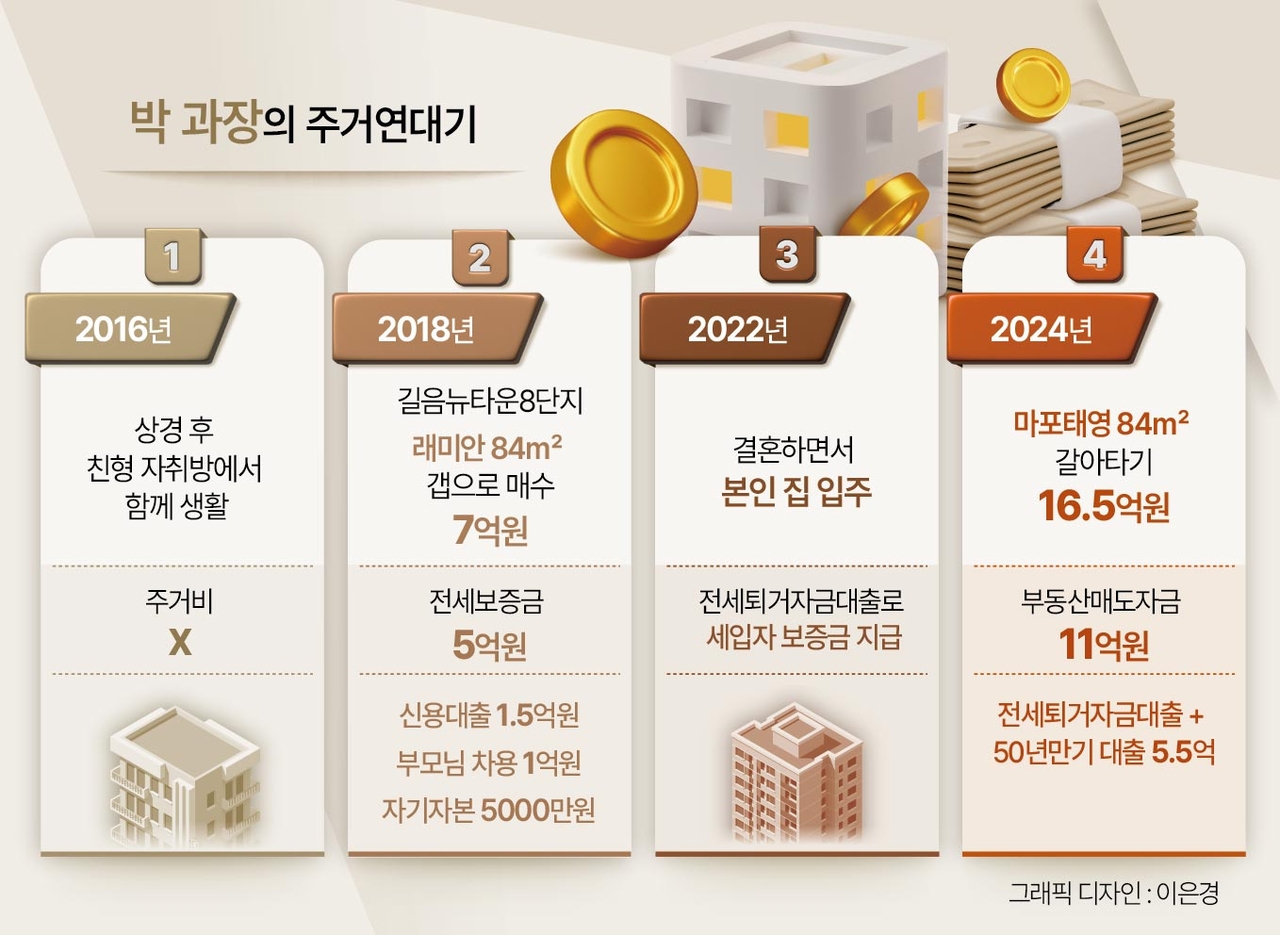
At the time, Park had saved about 50 million won from his years of working. But the asking price for an 84-square-meter unit in Gireum New Town was 700 million won. How did he buy it?
The first method was gap investment — buying a property with a jeonse tenant already in place. He brought in a jeonse tenant and raised 500 million won that way. Gireum New Town, with its convenient transport links and proximity to elementary, middle and high schools, was a popular area for newlyweds, so finding a tenant was not difficult. His first tenant was a newlywed couple.
Beyond that, he turned to an unsecured personal loan. At the time, borrowers could still take out personal loans of up to 1.5 times their annual salary. Three years into his career, his salary had risen enough that he was able to borrow 150 million won. It was, in every sense of the word, "yeongkkul" — borrowing to the absolute limit. "Making full use of loans was the masterstroke," he said.
Finally, he tapped what Koreans call the "mom-and-dad option" — money from his parents. He borrowed 100 million won from his parents, who live outside Seoul, drawing up a formal loan agreement and paying them interest every month. That brought the total to 750 million won — enough to cover the purchase price, acquisition tax and renovation costs.
He had simply bought a home — and two years later, the value had risen by 500 million won
After buying the apartment in 2018, Park rented it out on a jeonse basis for four years. He continued living in his brother's studio and put every spare won toward paying down his personal loan. It was a period of what he called "debt management" — shrinking his liabilities while growing his assets.
Paying off the debt never felt like a burden. The apartment's value was rising far faster than he could repay what he owed. Seongbuk-gu, which had been relatively quiet until early 2018, began to see prices surge sharply after that.
According to the Korea Real Estate Board, the monthly apartment sale price index for Seongbuk-gu had fluctuated through 2017, occasionally posting negative growth. From 2018 onward, it began rising 0.46 percent every month, and in March of that year it recorded a gain of 1.47 percent — the highest rate in Seoul after Mapo-gu, which rose 1.55 percent.
![[Newsis]](https://wimg.heraldcorp.com/news/cms/2026/07/10/news-p.v1.20260611.13b6a28b7a5942438a2e6233a846489d_P1.jpg)
Prices kept climbing. The 84-square-meter unit at Gireum New Town Complex 8 Raemian that Park bought for 700 million won in 2018 reached 940 million won in 2019, then hit a record high of 1.2 billion won in 2020.
Even when a market downturn began in 2022, prices in Seongbuk-gu held relatively firm. Park married that year and moved into the apartment when his tenant's jeonse contract expired. The price was still holding at 1.2 billion won at the time.
But Park had never intended to stay long. "From the moment I moved in, I was already thinking about trading up to another place within two years," he said. The instant he moved in, he was already planning his next move.
Park described his first home as a "dot" — a starting point. "Back then, there was not much of a social culture around paying attention to real estate, and when I bought the apartment most people asked why I was buying at that price," he said. "But I think moving quickly with the mindset of placing a dot and pushing forward from there was the single most decisive factor in building the assets I have today."
Staying constantly on the move was another key to how he was able to buy so quickly. "Good sunlight and the higher the floor the better," Park said. "If you do a lot of property scouting, you build up a picture of the views and sunlight for each building in a complex — so when a unit comes up at the price you want, you can put down a deposit without even needing to visit."
Two years after moving into his newlywed home, Park began thinking again about the Seongdong-gu apartment he had missed in 2017. He started scouting properties once more, with an eye toward trading up — and somehow made another 800 million won in just two years. (Continued in Part 2)
hss@heraldcorp.com