
![A Korea medical tourism briefing session held at the InterContinental Hotel in Tashkent, Uzbekistan [Kim Myung-sang]](https://wimg.heraldcorp.com/news/cms/2026/07/14/news-p.v1.20260713.5df47c334acc4613b1e961e3a6888dbc_P1.jpg)
The Korea Tourism Organization has set its sights on Central Asia as part of a push to diversify the inbound medical tourism market, targeting high-growth emerging economies in the region. The organization said it successfully held the "2026 Central Asia Emerging Market Korea Medical Tourism Roadshow," a circuit connecting Bishkek, Kyrgyzstan, and Tashkent, Uzbekistan, from July 10 to July 13.
The event was designed to showcase Korea's medical infrastructure directly to local audiences and build networks with buyers in the local medical and tourism industries, with the aim of expanding channels for attracting patients to Korea. More than 30 representatives from 17 domestic and overseas medical institutions and patient-recruitment agencies participated from Korea — including Korea University Guro Hospital and Soonchunhyang University Bucheon Hospital — with Busan joining as the only local government to take part in the market-development push.
Central Asia sees sharp rise in patients visiting Korea
![A Korea medical tourism travel mart held at the Sheraton Hotel in Bishkek, Kyrgyzstan [Kim Myung-sang]](https://wimg.heraldcorp.com/news/cms/2026/07/14/news-p.v1.20260713.21166072b0344f29a665d363920ccf1d_P1.jpg)
The roadshow opened July 10 in Bishkek, Kyrgyzstan, with a B2B consultation session and a Korea medical tourism briefing. About 60 representatives from more than 50 local organizations attended, demonstrating strong interest in Korean healthcare.
Kyrgyzstan, with a population of about 7.4 million, has been drawing attention as an emerging medical tourism market as the number of patients traveling to Korea has consistently grown. Bilateral health cooperation and medical personnel exchanges have deepened since the announcement of the Korea-Central Asia cooperation initiative in 2024, which spurred high-level exchanges between the two countries. Against that backdrop, the number of Kyrgyz medical tourists visiting Korea last year surpassed 1,200 — a rise of more than 20 percent from the previous year.
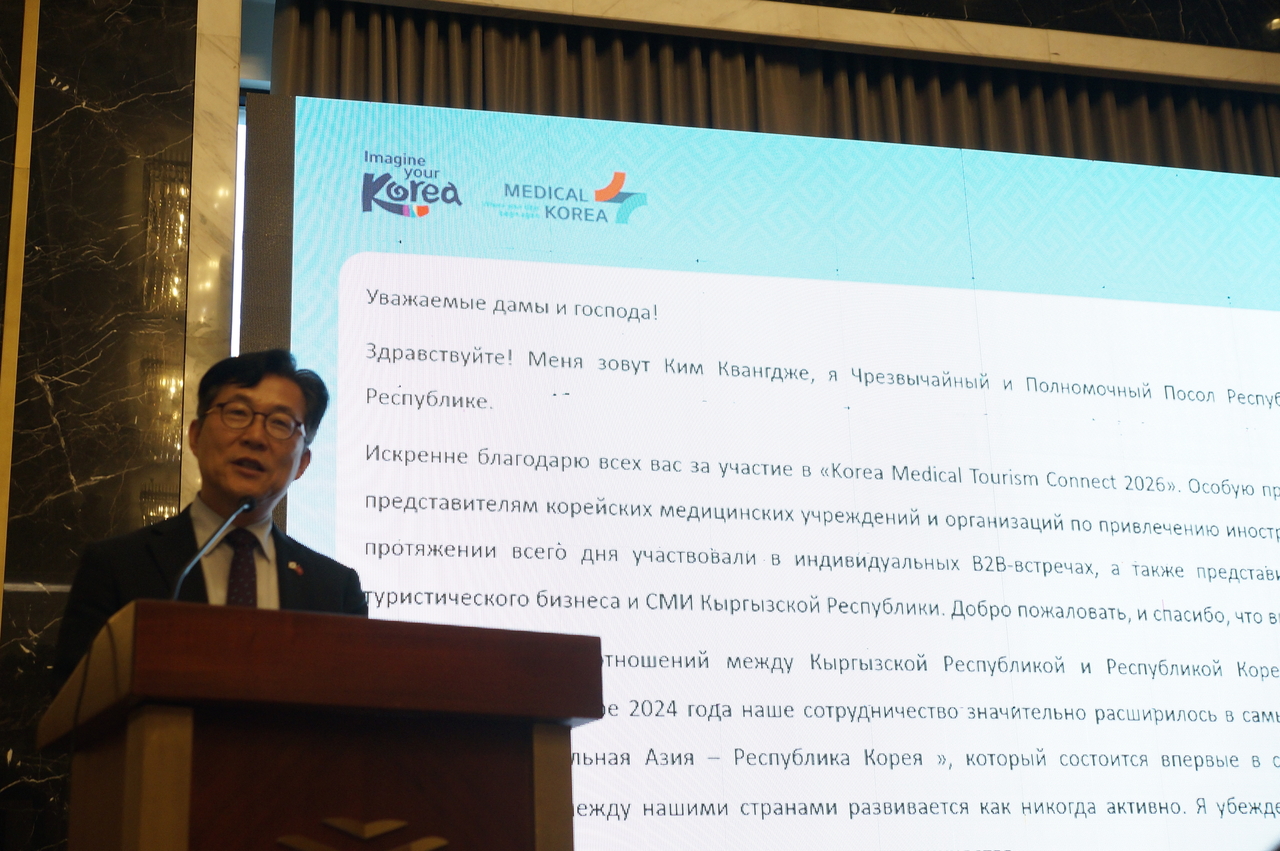
Ambassador Kim Gwang-jae, South Korea's envoy to the Kyrgyz Republic, said Korea has grown into a medical tourism destination recognized worldwide. "If Korea's accumulated medical capabilities meet Kyrgyzstan's development needs, we can build a cooperation model that delivers real benefits to the people of both countries," he said.
Localization strategy targets VIPs and serious illnesses
![A Korea medical tourism briefing session held at the InterContinental Hotel in Tashkent, Uzbekistan [Kim Myung-sang]](https://wimg.heraldcorp.com/news/cms/2026/07/14/news-p.v1.20260713.bf09e3ed46374610b5d4785f841455b8_P1.jpg)
The roadshow moved to the InterContinental Hotel in Tashkent on Monday, where a media conference and B2B consultation session drew about 70 representatives from more than 50 organizations, including local media outlets, medical institutions and travel agencies. Uzbekistan, Central Asia's most populous country with about 37 million people, is considered a market with significant growth potential — the number of Uzbek patients visiting Korea jumped roughly 43 percent year-on-year in 2025 to reach 4,766.
At the Tashkent event, the Korea Tourism Organization took a strategic approach tailored to local cultural and economic conditions. Current outreach focuses on attracting patients with serious conditions such as cancer treatment and comprehensive health screenings, but the organization plans to broaden its promotional efforts to include ophthalmology and dermatology and cosmetic procedures.
![Jeon Jun-hyeong (left), administrative director of Gangnam Grand Eye Clinic, being interviewed by Uzbek media [Kim Myung-sang]](https://wimg.heraldcorp.com/news/cms/2026/07/14/news-p.v1.20260713.29ac306ac53a44deb9f6fa94dad666a9_P1.jpg)
Korea's key competitive advantages in the Uzbek market include health screening costs roughly one-third of those in advanced medical markets such as Germany, a same-day screening system, world-class cancer survival rates and one-stop service. Taking into account Tashkent's high cost of living relative to its low average monthly income of about 700,000 won ($464), the organization has identified affluent residents and VIPs as its primary targets.
The organization also factored in the risk of patients being diverted to visa-free countries such as Turkey due to cumbersome visa procedures. Accordingly, it plans to build a B2B network centered on trusted agencies rather than broad public advertising, and to concentrate marketing efforts through mainstream local social media channels.
![Kim Su-jin (right), head of the Korea Tourism Organization's Almaty branch, being interviewed by Uzbek media [Kim Myung-sang]](https://wimg.heraldcorp.com/news/cms/2026/07/14/news-p.v1.20260713.1c0cde59c96f40f2a1969e790512633d_P1.jpg)
Kim Su-jin, head of the Korea Tourism Organization's Almaty branch, said localization strategies tailored to each country's characteristics and long-term trust-building are the keys to opening up the Central Asian market. "Now that the Kazakhstan market is firmly established, we are looking toward emerging markets, and this is the right time to focus intensively on Uzbekistan and Kyrgyzstan, which have high growth potential," she said.
Removing institutional barriers and diversifying recruitment channels
![A consultation in progress at the Elite Plastic Surgery booth [Kim Myung-sang]](https://wimg.heraldcorp.com/news/cms/2026/07/14/news-p.v1.20260713.8bd13fb6589346b397e5683a31b2a020_P1.jpg)
The Central Asia roadshow confirmed demand in the emerging markets of Uzbekistan and Kyrgyzstan beyond the existing Kazakhstan-centered focus, while also highlighting long-term challenges for Korea's medical tourism sector.
Participating organizations identified easing the cumbersome visa process and improving entry convenience as the most pressing issues to resolve. Busan, the only local government to take part, flagged the resumption of the suspended Busan-Tashkent direct flight route and the establishment of a cooperation model to secure seats on local carriers as prerequisites for progress.
![Kim Yeong-ae, senior manager of the global industry team at the Busan Economic Promotion Agency, and Baek Mi-hwa, an official with Busan Metropolitan City's tourism and MICE industry division, at the Busan medical tourism booth [Kim Myung-sang]](https://wimg.heraldcorp.com/news/cms/2026/07/14/news-p.v1.20260713.6def14ae51e340af92f0a96a93320de3_P1.jpg)
Baek Mi-hwa, an official with Busan Metropolitan City's tourism and MICE industry division, said resuming the currently suspended Busan-Tashkent direct route would significantly expand the foundation for attracting patients from the Yeongnam region. "We will conduct joint marketing with the Korea Tourism Organization to build a local network, and will actively pursue linkages with Busan medical institutions and familiarization tours going forward," she said.
The Korea Tourism Organization plans to refine tailored media promotion techniques that reflect each country's cultural conservatism and institutional constraints, and to concentrate on online marketing through partnerships with mainstream local social media accounts.
![Moon So-yeon, head of the Korea Tourism Organization's medical wellness team [Kim Myung-sang]](https://wimg.heraldcorp.com/news/cms/2026/07/14/news-p.v1.20260713.2e7c68f11cbc4350b31e7b8fe1e2f0c4_P1.jpg)
Moon So-yeon, head of the Korea Tourism Organization's medical wellness team, said the organization plans to establish a mid- to long-term strategy for medical tourism this year. "We will break down our approach to suit the characteristics of each Central Asian market and continue to pursue locally tailored marketing through close collaboration with overseas branches, sustaining the upward momentum in inbound tourism," she said.
The institutions and companies that participated in the roadshow were Gangnam Grand Eye Clinic, Korea University Guro Hospital, Nanoori Hospital, Rien Jang Plastic Surgery Clinic, BTMedi, Bright Eye Clinic, Sagwanamu Dental Hospital, Seoul Novus Hospital, Soonchunhyang University Bucheon Hospital, Ain Hospital, Elite Plastic Surgery, Jaseng Hospital of Korean Medicine, Jayeon-ane Korean Medicine Clinic Deokcheon branch, Jane DMC Korea, Premium Pass International, Hangil Eye Hospital and the Korea Institute of Medicine Gwanghwamun branch office.
terry@heraldcorp.com





