US President Donald Trump warned Tuesday that he would "strike 'Pickaxe Mountain' very powerfully, and soon," adding that "Iran has no way of stopping us." Trump said he would not normally make such a statement publicly, but that he would never have done so if he thought Iran could retaliate. Iran fired back, vowing to strike all US and allied assets across the Middle East if Washington attacks its nuclear facilities. So what exactly is Pickaxe Mountain, and why has Trump singled it out as his ultimate pressure card against Tehran?
Where is Pickaxe Mountain?
Pickaxe Mountain is a site that Western governments and Israel suspect is a new underground nuclear facility. It sits roughly 2 kilometers southwest of Iran's Natanz uranium enrichment complex in the country's central-western region. Locals call it "Kuhe Kolang" — meaning pickaxe mountain — after the shape of the peak, and the broader surrounding area is known as "Kuhe Kolang Gaz Ra."
According to the Institute for Science and International Security (ISIS), a US think tank, the summit of Pickaxe Mountain stands at roughly 1,608 meters above sea level, and the nuclear facility is believed to have been built more than 90 meters below the surface.
Based on that topographical data, the United States, Israel and the International Atomic Energy Agency (IAEA) suspect Iran has constructed a substantial nuclear facility some 80 to 100 meters beneath the mountain's granite bedrock.
Experts believe construction began around 2020 and that the facility has not yet begun operation. Satellite imagery shows work continued even after an airstrike in June last year, and a security perimeter wall around the site was recently completed. After US and Israeli strikes began, two tunnel entrances on the eastern side were reinforced with concrete and partially filled with soil — moves analysts interpret as preparations against future attacks.
Sam Lair, a researcher at the Foreign Policy Research Institute (FPRI), told Reuters that reinforcing the tunnel entrances "makes it much harder to attack with penetrating munitions like bunker busters."
Iran's government announced in 2020 that the site would become a centrifuge production factory. That July, an above-ground centrifuge assembly plant inside the Natanz nuclear complex was severely damaged in a fire of unknown origin — which Iranian authorities attributed to Israeli sabotage — prompting them to seek a more secure location.
![The aftermath of an Israeli strike on an underground nuclear facility near Natanz, Iran, in March. Comparing before-and-after satellite images, one building visible in the left photo — the fourth from the right — has disappeared in the right photo taken after the strike. Israel said the facility was used to produce nuclear weapons components. [Reuters]](https://wimg.heraldcorp.com/news/cms/2026/07/22/news-p.v1.20260308.24e81fe97c984e0aa7be866ec0e91ef4_P1.jpg)
Ali Akbar Salehi, then head of the Atomic Energy Organization of Iran, subsequently announced that a "more modern and larger centrifuge production facility" was being built inside a mountain near Natanz.
Centrifuges are devices that enrich uranium by spinning it at extremely high speeds and are essential for producing nuclear fuel for power generation. Producing a nuclear weapon, however, requires far higher levels of uranium enrichment and additional processing steps.
Iran insists its nuclear program is for peaceful purposes, but has so far refused to grant the IAEA access to the Pickaxe Mountain site.
IAEA Director General Rafael Grossi said in March last year that Iran "has long declared its intention to conduct nuclear-related activities at Pickaxe Mountain," describing it as part of a broader strategy to move all sensitive nuclear facilities underground.
Is it operational?
ISIS said in its latest report that "the facility has not yet begun operation, but construction is ongoing."
Satellite imagery alone, however, makes it difficult to determine when the site might become operational or whether Iran will actually install the large-scale centrifuge production equipment it originally planned, the institute said.
ISIS assessed that "if Iran rebuilds its centrifuge production capacity in the future, there is a possibility it could install a small assembly facility at Pickaxe Mountain capable of supporting a nuclear weapons program."
Trump first raised the possibility of a strike earlier this month, saying he saw "no special activity at the moment" but describing the site as "a potential target where we could drop a very large bomb through the window."
How could the US attack it?
![A satellite image taken June 21 showing the tunnel entrances at the site near Natanz, Iran, where an underground nuclear facility is believed to have been built inside the mountain known as 'Pickaxe Mountain.' [Reuters]](https://wimg.heraldcorp.com/news/cms/2026/07/22/news-p.v1.20260722.924fd64628324acc98edb46ed723d1d6_P1.jpg)
When US forces struck the Fordow uranium enrichment facility last June, they dropped a roughly 13.6-ton bunker buster that penetrated the mountainous terrain and disabled the centrifuge facility. Yet experts believe the Pickaxe Mountain site is buried so deep and the surrounding rock is so hard that even the US military's largest bunker-busting munitions cannot guarantee its complete destruction.
Airstrikes also carry the limitation of making it difficult to verify their precise effect. The Defense Ministry acknowledged after last year's strikes on Iranian nuclear facilities that while it estimated the attacks had set back Iran's nuclear program by one to two years, that conclusion carried significant uncertainty.
ISIS said the site "is better suited to ground infiltration or sabotage operations than to airstrikes," while also noting that "vulnerable points where deep-penetrating munitions dropped from the air could be used may exist." A sabotage operation is a covert mission to disrupt or destroy an adversary's facilities, equipment, supply lines, communications or production capabilities.
For now, Trump has in effect treated the deployment of ground troops as a red line, and despite the recent escalation in US-Iran tensions, there are no signs he is reconsidering that position.
"It seems clear that Iran continues to carry out some kind of work at Pickaxe Mountain," Lair said. "At the same time, it is also evident that Iran is continuously reinforcing its defenses out of concern over a possible attack."
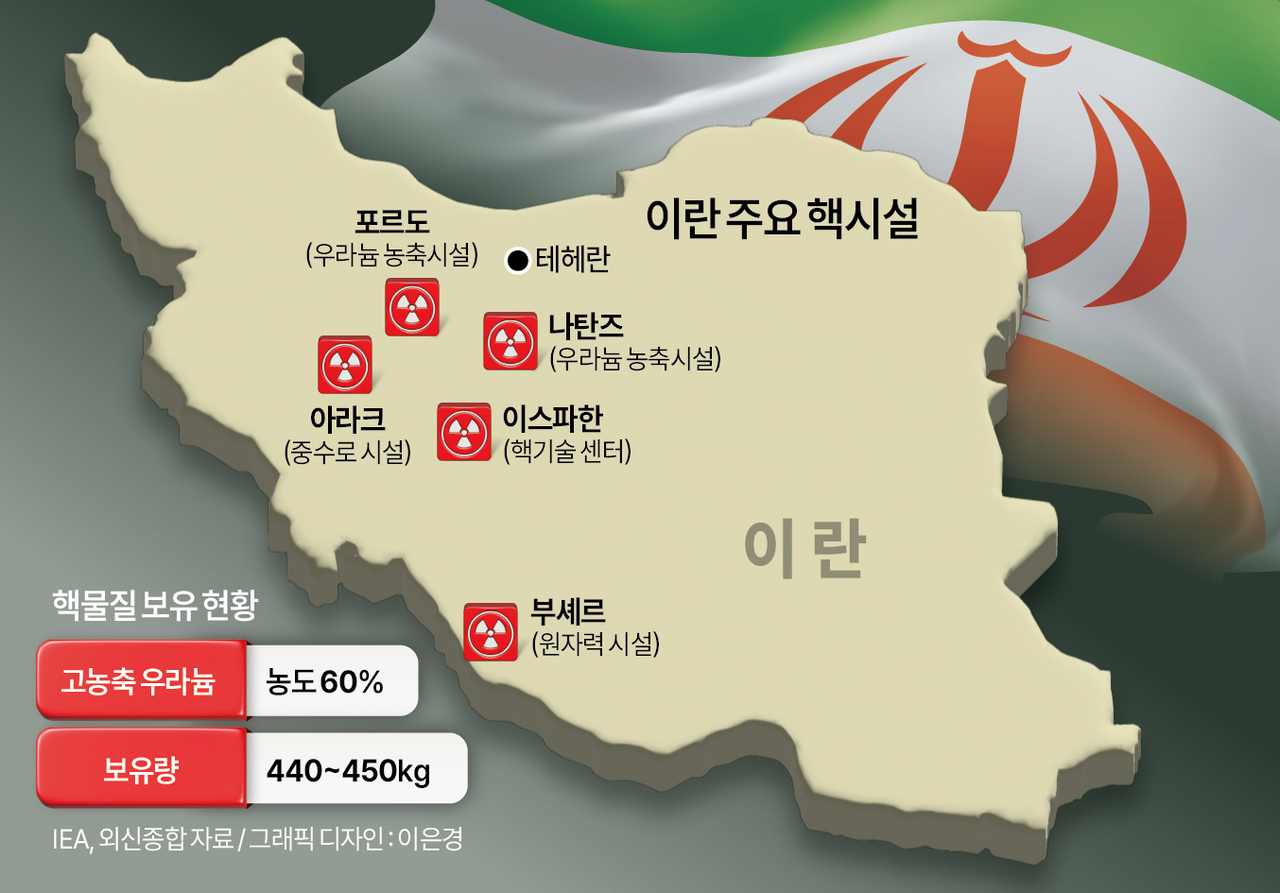
Iran's major nuclear facilities include Natanz, its largest uranium enrichment site; Fordow, a heavily fortified underground complex; and Bushehr, a commercial nuclear power plant. Fordow is known for producing highly enriched uranium at concentrations above 60 percent and is considered exceptionally well-protected. Bushehr, located on the Persian Gulf coast, is Iran's only commercial nuclear power plant.
According to IAEA estimates, Iran holds approximately 440 to 450 kilograms of near-weapons-grade uranium enriched to 60 percent purity through these facilities — enough, if further enriched, to produce nine to ten nuclear weapons.

mokiya@heraldcorp.com