![Kang Mu-gil, speaker of the first half of the 10th Busan City Council, said Tuesday he would cooperate on a bipartisan basis with Mayor Jeon Jae-soo's vision of completing Busan as a maritime capital. [Busan City Council]](https://wimg.heraldcorp.com/news/cms/2026/07/23/news-p.v1.20260722.841b512b6aa24edc9e9718b4d4bc21c2_P1.jpg)
Kang Mu-gil, speaker of the ninth directly elected Busan City Council, is just two weeks into his tenure and already navigating a minority ruling-party legislature — presiding over a 15-day extraordinary session running from July 14 to July 28. When he sat down with The Herald Business at his office in the Busan City Council on Tuesday, Kang summed up his first days in office simply: "Every day feels like a war."
The 10th Busan City Council is the first in 35 years — since 1991 — in which the ruling party holds fewer seats than the opposition. The council's formation was contentious from the start. The People Power Party, which holds 37 seats, completed its organization of standing committees, but the second vice speaker's seat — allocated to the Democratic Party — remains vacant. The impasse traces back to remarks Mayor Jeon made as mayor-elect, when he suggested the Democratic Party should receive standing committee chairmanships rather than what he called a "ceremonial" vice speaker post.
"I asked for an apology over those remarks, but it has not been forthcoming," Kang said. "I asked the Democratic Party to elect a second vice speaker by Wednesday, but whether that will happen is uncertain." He said, however, that with the People Power Party holding 77 percent of council seats, "we must pursue cooperative governance and move forward together." He also made clear that the new city administration should not unilaterally abandon policies pursued by former Mayor Park Heong-joon, including the 15-minute city initiative and the bid to host a Pompidou Center satellite.
The Democratic Party initially demanded the chairmanship of the budget and accounts special committee instead of the second vice speaker post — a request Kang said was difficult to accept. He said he hoped to receive an answer on the vice speaker question this week. He cited the precedent set during the eighth council, when the Democratic Party was given the second vice speaker post even when it held only six seats, and said the post carries symbolic weight for cooperative governance.
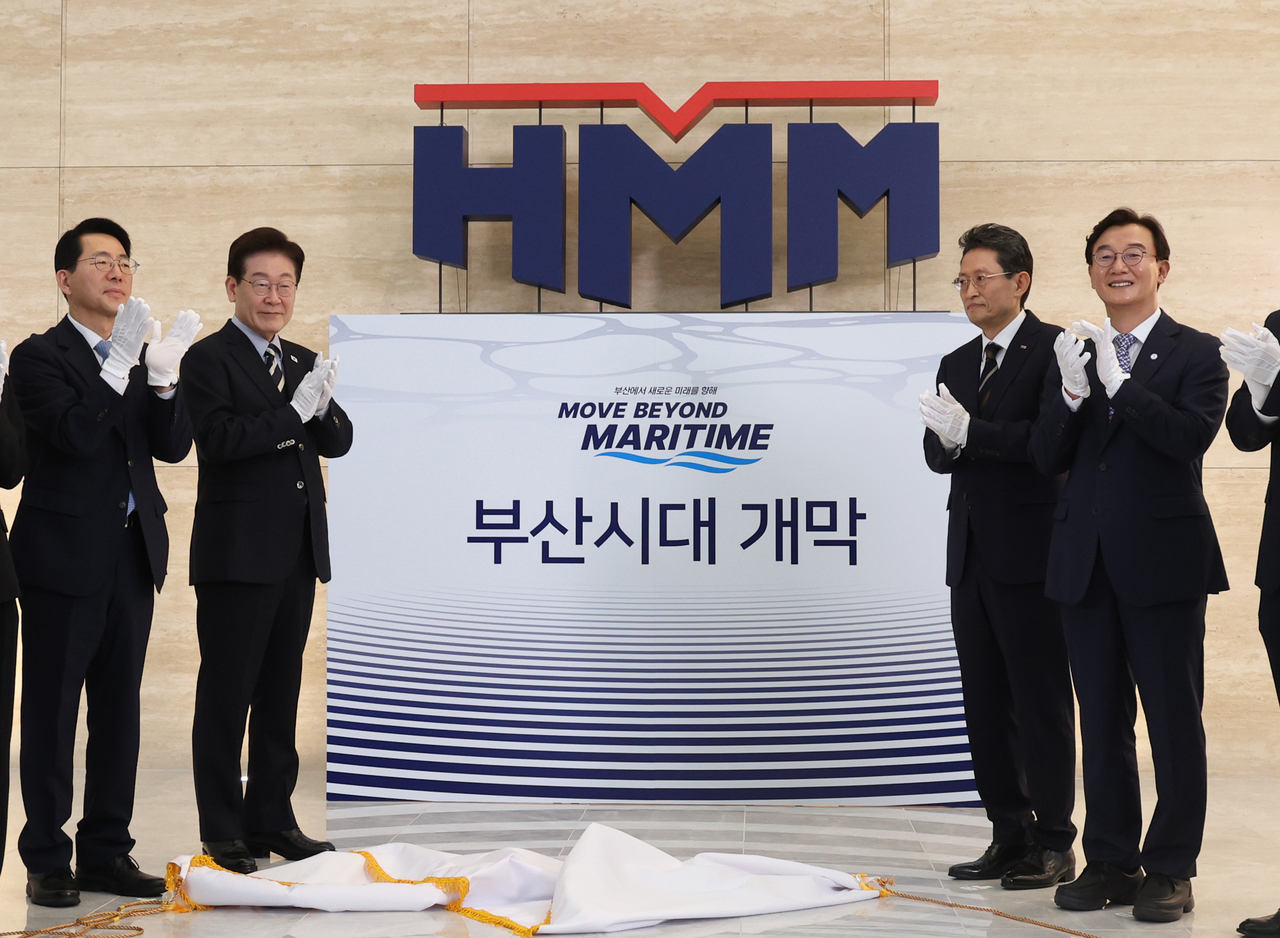
Kang said he would cooperate on a bipartisan basis with Mayor Jeon's flagship vision of completing Busan as a maritime capital. A special committee on the new marine airport, with a one-year mandate, began operations after electing its nine members — including chairperson Chae Chang-seop — on July 14. Kang also expressed support for a civic proposal to rename Gadeok New Airport as "Busan International Airport." He added that a separate special committee on corporate attraction, chaired by Ryu Do-hui, is also operating to draw new-industry infrastructure such as AI and data centers.
On the controversy over potential double investment — building a new dome stadium at North Port while also reconstructing Sajik Baseball Stadium — Kang urged caution. "The dome stadium's project cost has ballooned from the 1.3 trillion won ($878 million) estimated during the transition period to around 3 trillion won," he said. "I have doubts about whether private investment of that scale can be secured." The Sajik Stadium reconstruction, by contrast, has secured 29.9 billion won in national funding and is targeting completion in 2031, and Kang noted it is also directly tied to safety concerns. He drew a line against framing the two projects as an either-or choice, saying the North Port site could be developed "sequentially, in connection with attracting world-class companies for Busan's future tourism and cultural infrastructure — it is not too late to take that approach."
Asked about Mayor Jeon's plan — outlined when he was mayor-elect — to cover 630 billion won of the original 1.3 trillion won total cost through Busan Port Authority equity participation and fund the remaining 670 billion won through private investment, Kang said: "The project cost itself is under review, so this is a matter that needs to be discussed in depth."
On Mayor Jeon's first executive order — a "100-day emergency livelihood package" — Kang said he understood the intent but did not hide his reservations. "It is essentially a repackaging of existing support measures to secure funding, and it amounts to short-term prescriptions like point rewards and interest relief," he said. "As the saying goes, it is better to teach someone to fish than to give them a fish — attracting quality companies and future growth industries is the more fundamental and urgent priority." He also questioned the effectiveness of youth support measures, saying short-term job programs were "actually leading to frequent job changes and dependence on unemployment benefits," and called for a redesign of the underlying policy framework.
On the government's recent decision to designate a semiconductor specialized zone in the Honam region, Kang said: "What companies are really saying is that they will come once the infrastructure is in place. More aggressive investment should be concentrated in the Busan-Ulsan-South Gyeongsang Province area, where power grids and other infrastructure are already in place."
On the Global Hub City Act and the relocation of Korea Development Bank to Busan, Kang said he worried that time was slipping away. "A single amendment to the Korea Development Bank Act would complete the Munhyeon financial district — yet instead of taking that direct route, alternatives keep emerging and the clock keeps ticking," he said, adding that he would press the National Assembly for swift legislation. He declined to offer a direct assessment of Mayor Jeon's proposed alternative, a Southeast Investment Corporation.
Kang offered a cautious outlook on the recently launched special committee on Busan-Ulsan-South Gyeongsang Province metropolitan integration. "During the ninth council, all three regional heads were from the People Power Party and integration still did not happen," he said. "Now only South Gyeongsang Province has a People Power Party head, while Busan and Ulsan are led by the Democratic Party — the conditions are even harder." He cited the failed attempt during the seventh council, when then-Mayor Seo Byeong-su pushed to merge the old city-center districts of Jung-gu, Seo-gu, Dong-gu and Yeongdo-gu, only for the plan to collapse over the reduction in elected positions, and warned that political self-interest could be the biggest obstacle to any integration talks.
Kang said he deeply admires the late former Busan Mayor Ahn Sang-young. "Mayor Ahn was a Seoul National University civil engineering graduate who led major infrastructure projects 35 years ago — the urban expressway, Gwangan Bridge, a new airport," he said. "As an architect and a doctoral graduate in urban planning, I too want to contribute to preparing Busan for the next 35 years."
Kang said changing the reality of young Busan graduates leaving for Seoul because of a lack of local jobs would require bold corporate attraction policies — long-term free land leases and tax incentives modeled on US practice — rather than simply developing land and selling it off to companies. "I want to be a speaker who pursues policy with conviction for Busan's future, not one who just holds on to the seat," he said.
kaf2002@heraldcorp.com