'Naezip Pension': the only reverse mortgage for high-value homes
7 in 10 subscribers live in Gangnam's 3 core districts
Demand rising among retirees shut out of public housing pension
Payouts guaranteed for life, even if they exceed the home's value
Can serve as a retirement safety net for surviving spouses
Family consultation essential before signing up
We are all future retirees — are you prepared? Because life should be richer even after you stop working. Explore retirement planning content for everyone in our series, 'Useful Stories for Future Retirees.'
![[Created using ChatGPT]](https://wimg.heraldcorp.com/news/cms/2026/07/23/news-p.v1.20260722.11e6eec60e754b45a8a1f1768092d9b3_P1.png)
"I've been sending my mother an allowance every month, but with my own retirement just around the corner, I was at a loss."
Kim, a man in his 60s living in Seocho-gu, Seoul, found himself in a deepening bind as retirement approached. He had been supplementing his elderly mother's living expenses each month, but supporting a parent while facing his own retirement was becoming too much to bear. He owned a home and looked like a "property millionaire" on paper, but he had little cash set aside for his later years — and selling the house he had lived in his whole life, or moving elsewhere, was out of the question. On a neighbor's recommendation, he enrolled in a private housing pension product and secured a steady stream of more than 6 million won ($4,050) in cash every month.
For decades, owners of high-value homes widely held the view that a house was an asset to be kept and passed on to one's children — not sold. That was especially true of properties like Gangnam apartments, whose values rose year after year. Even when retirement income fell short, the prevailing culture was to prioritize inheritance over selling or leveraging the home.
Of late, however, that attitude has been shifting. Average life expectancy has risen, stretching retirement further than many anticipated, and a growing number of people find themselves in a "sandwich generation" — simultaneously supporting their own children and aging parents. Among baby boomer retirees who are asset-rich but cash-poor, demand is growing for ways to unlock the wealth tied up in real estate and secure a stable income in old age.
Against this backdrop, private housing pension products open to owners of high-value homes are drawing attention as a new alternative. Hana Financial Group launched what it says is the financial industry's first and only reverse mortgage product for homes with a publicly assessed value exceeding 1.2 billion won, introducing it last May. This article examines real enrollment cases and practical uses of the product with Kim Ju-hoe, executive managing director of Hana Life Insurance's management planning division.
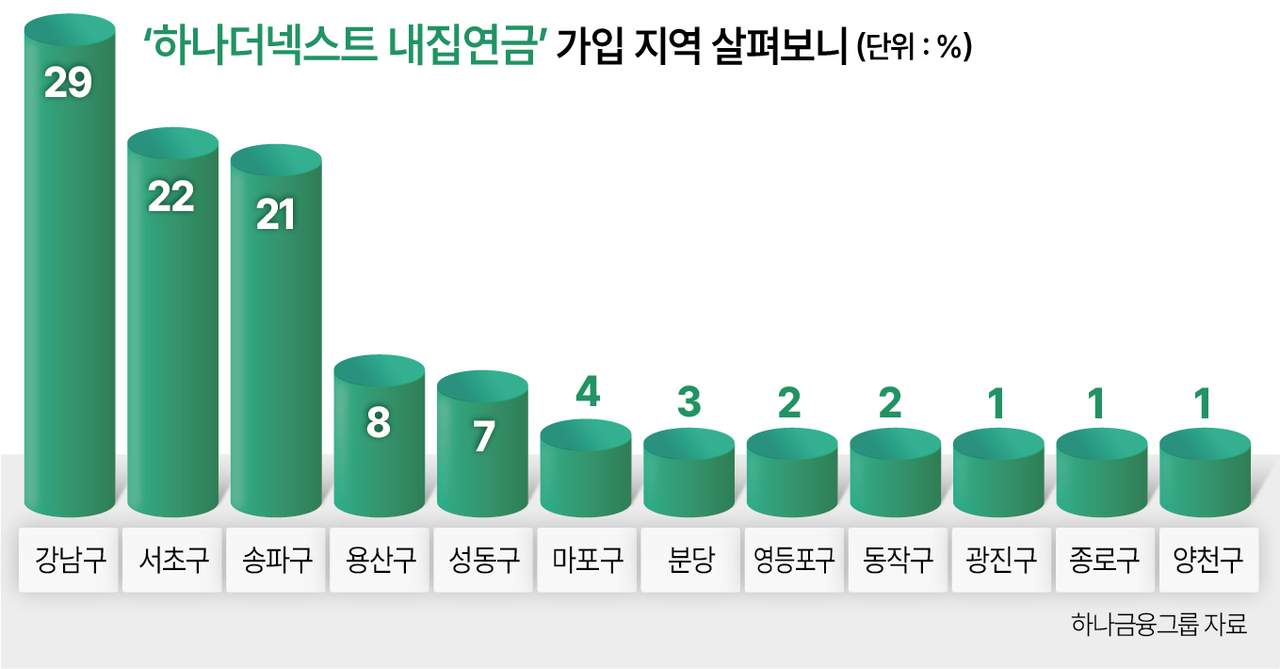
Seven in 10 subscribers live in Gangnam's 3 core districts. According to enrollment data for the "Hana The Next Naezip Pension" obtained through Hana Financial Group, subscribers in the three Gangnam districts — where high-value homes are concentrated — account for 72 percent of the total. Gangnam-gu leads with 29 percent, and adding Seocho-gu (22 percent) and Songpa-gu (21 percent) means roughly 7 in 10 subscribers live in those three districts. Yongsan-gu (8 percent), Seongdong-gu (7 percent), Mapo-gu (4 percent) and Bundang-gu in Seongnam, Gyeonggi Province (3 percent) follow.
The concentration reflects pent-up demand among retirees who own high-value homes but have been unable to join the public housing pension scheme. Homeowners whose property's publicly assessed value exceeds 1.2 billion won are barred from the public housing pension administered by the Korea Housing Finance Corp. Of Seoul's approximately 2.78 million apartment households, about 415,000 — or 14.9 percent — have publicly assessed values above that threshold, placing them in what is often called the "housing pension blind spot."
The Naezip Pension is a financial product for homeowners aged 55 or older who use a home with a publicly assessed value above 1.2 billion won as collateral, combining Hana Life Insurance's lifetime annuity with Hana Bank's collateral trust to provide monthly retirement income. Despite the word "pension" in its name, it is in effect a loan — one that uses the home as collateral and disburses funds in pension form. Within a year of launch, the product had attracted 260 subscribers, with the combined value of enrolled properties reaching around 330 billion won.
Given that the product targets high-value homes, the average monthly payout is around 7 million won. The lending rate is a fixed rate calculated by adding a 1.3 percentage-point spread to the previous month's one-month average yield on 10-year government bonds. Unlike a conventional loan, subscribers do not pay interest each month. Instead, interest accrues and is added to the principal, to be recovered by the bank. When the home is eventually sold, the subscriber receives whatever remains after that amount is deducted from the publicly assessed value.
Because monthly payouts increase the longer a subscriber waits to enroll, actual enrollment ages have been higher than expected. When the product launched, most subscribers were anticipated to be in their mid-60s, but in practice a notable share have enrolled in their mid-to-late 70s, with an average age of 76. Inquiry volumes also tend to rise when the perception spreads that real estate prices have risen sufficiently, or when the market turns volatile.
The product delivers its greatest benefit to retirees burdened by mortgage debt. The Naezip Pension is considered most effective when a subscriber uses it to pay off an existing home-backed loan. For owners of high-value homes who must continue servicing mortgage principal and interest after retirement, the product can ease that monthly burden and improve cash flow.
The pension comes in three payout structures, identical to those of the public housing pension: a fixed-amount type that pays the same sum every month; an early-increase type that pays more in the initial years before tapering off; and a regular-increase type that raises the monthly payout by 4.5 percent every three years.
One retiree who had been repaying 2 million won a month in mortgage principal and interest used a lump-sum withdrawal after enrolling in the Naezip Pension to pay off the loan upfront. With monthly pension payments coming in afterward, cash flow that had been negative swung to a positive 5 million won a month, restoring financial breathing room in retirement.
Subscribers can also tailor the monthly payout to match their own cost of living. Owners of high-value homes can receive up to 7 million to 8 million won a month, but in practice many choose a lower amount, saying an extra 2 million to 3 million won a month in living expenses is enough.
Given that Koreans consider around 3.5 million won a month an adequate retirement income, drawing only what is needed reduces the loan balance and interest burden while leaving more for heirs. Conversely, those who want a more comfortable retirement can opt for a higher monthly payout to secure a stable cash flow.
To that end, Hana Financial restructured the product in April, breaking the loan ceiling into tiers so subscribers can choose a monthly payout that fits their lifestyle. The total receivable pension amount — capped at 50 percent of the home's value — can be set at 500 million won, 700 million won, 1 billion won, 1.3 billion won, or 1.5 billion won.
Payouts guaranteed for life, even if they exceed the home's value. The product's biggest selling point is its non-recourse design: even if the total pension received exceeds the value of the home, payments continue for life. The questions subscribers ask most often are "What happens if I live long enough to receive more than my home is worth?" and "What happens to the house if I die early?"
If the home is sold after both spouses have died and the proceeds fall short of the outstanding loan balance, the shortfall is not passed on to the heirs. Any surplus remaining after the sale goes to the heirs. Nor does pledging the home as collateral mean giving it up entirely — if the heirs repay the outstanding loan balance after both the subscriber and spouse have died, they can inherit the property as-is.
One subscriber in his 70s who lived in Yongsan-gu, Seoul, reportedly asked during consultations several times whether his wife would continue to receive pension payments after his death. After being told that designating a spouse as the post-death beneficiary would keep the payments going for life, he enrolled — and died a few months later. His wife now receives monthly pension payments under the contract.
The Naezip Pension can thus serve as a retirement safety net for a surviving spouse. When a couple enrolls together, the husband typically becomes the primary subscriber and the wife is designated as the post-death beneficiary. Even after the subscriber dies, the spouse continues to receive pension payments for life, and children cannot unilaterally cancel the contract while it remains in force. Because heirs must give their consent at the time of enrollment, the product also helps prevent inheritance disputes. In that sense, it can function as a form of testamentary trust.
Consult the family before signing up. The one step that must come before enrolling in the Naezip Pension is a thorough conversation with family members. A significant share of cases in which consultations are abandoned midway are attributed to disagreements between parents and children. Children often expect to inherit a home that has appreciated in value, while parents want to use the property to fund their retirement — a tension that is far from uncommon.
The Naezip Pension carries no early-termination fee, so subscribers can cancel and re-enroll. However, re-enrollment requires paying the initial guarantee fee — roughly 1 percent of the home's value — again, just as with a new contract. While some may consider re-enrolling in hopes of receiving higher monthly payouts after their home has appreciated, it is important to weigh the additional pension income against the costs, including the initial guarantee fee, before making that decision.
forest@heraldcorp.com