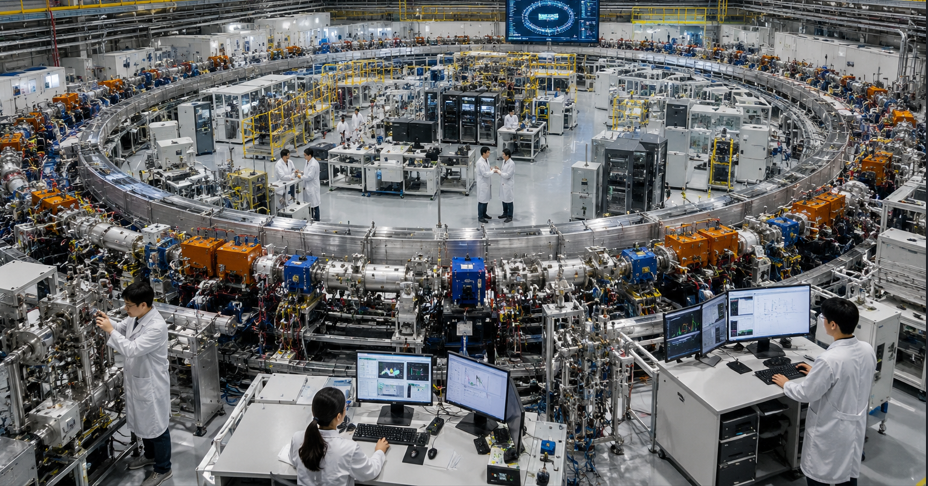
![An artist's rendering of the Korea Saevit Accelerator. [Korea Basic Science Institute]](https://wimg.heraldcorp.com/news/cms/2026/07/27/news-p.v1.20260727.19404c941bfb4ebca3abb292940351f5_P1.jpg)
The Korea Saevit Accelerator — a multipurpose synchrotron radiation facility in Ochang — has finally broken ground after contractor selection for its infrastructure construction failed four times last year, pushing the start of work back by more than a year. Doubts are now growing over whether the 2029 completion target can be met.
The Ministry of Science and ICT and the Korea Basic Science Institute (KBSI) held a ground-breaking ceremony Monday at the accelerator site in Ochang, Cheongju, North Chungcheong Province, marking the formal start of construction.
The Korea Saevit Accelerator is a fourth-generation circular synchrotron radiation accelerator designed to serve as a core research facility, enabling domestic researchers and industry to conduct world-class scientific work.
The multipurpose synchrotron accelerator project has been under way since 2021 with a total budget of 1.16 trillion won ($794 million). KBSI leads the project, with the Pohang Accelerator Laboratory participating as a joint research partner in the large-scale national research infrastructure initiative.
The facility was originally slated for completion in 2027, but a revision to the master plan in October 2024 pushed the target back two years to December 2029. The project then ran into further trouble when contractor selection for the infrastructure construction failed four consecutive times last year.
Construction was supposed to begin in the first half of last year, but the actual start has been delayed by more than a year, making further slippage in the completion schedule appear unavoidable.
An official from the multipurpose synchrotron accelerator project office said the team aims to finish construction and begin test operations by the end of 2029. "The delay from the original plan is real, but we will work to ensure there is no major change to the overall schedule," the official said.
In the scientific community, concerns are mounting that the project could follow the same troubled path as the heavy-ion accelerator being built by the Institute for Basic Science (IBS), which has been running more than a decade behind schedule.
The Korean heavy-ion accelerator project launched in 2011 with a 1.5 trillion won budget and a planned completion date of 2021, but it remains unfinished. The low-energy section has been built, but the full facility — including the high-energy section — still requires more time to complete.
A figure in the scientific community said the multipurpose synchrotron accelerator project had faced widespread skepticism about staying on track from the very beginning. "With the heavy-ion accelerator also running behind, the government needs to present a realistic plan and timeline," the person said.
Meanwhile, a synchrotron radiation accelerator is a device that accelerates electrons to near the speed of light and bends their path using magnets, generating high-speed, high-brightness light across a broad spectrum — including ultraviolet and X-ray wavelengths. The Korea Saevit Accelerator is a fourth-generation circular synchrotron designed to produce light more than 100 times brighter than existing third-generation circular accelerators. It is expected to support research across a wide range of fields, including semiconductors, displays, new drug and vaccine development, and advanced materials.
According to a technical feasibility study for the multipurpose synchrotron accelerator, the new facility is projected to generate 6.7 trillion won in production-inducing effects, create 2.4 trillion won in added value, and support 137,000 jobs.
nbgkoo@heraldcorp.com