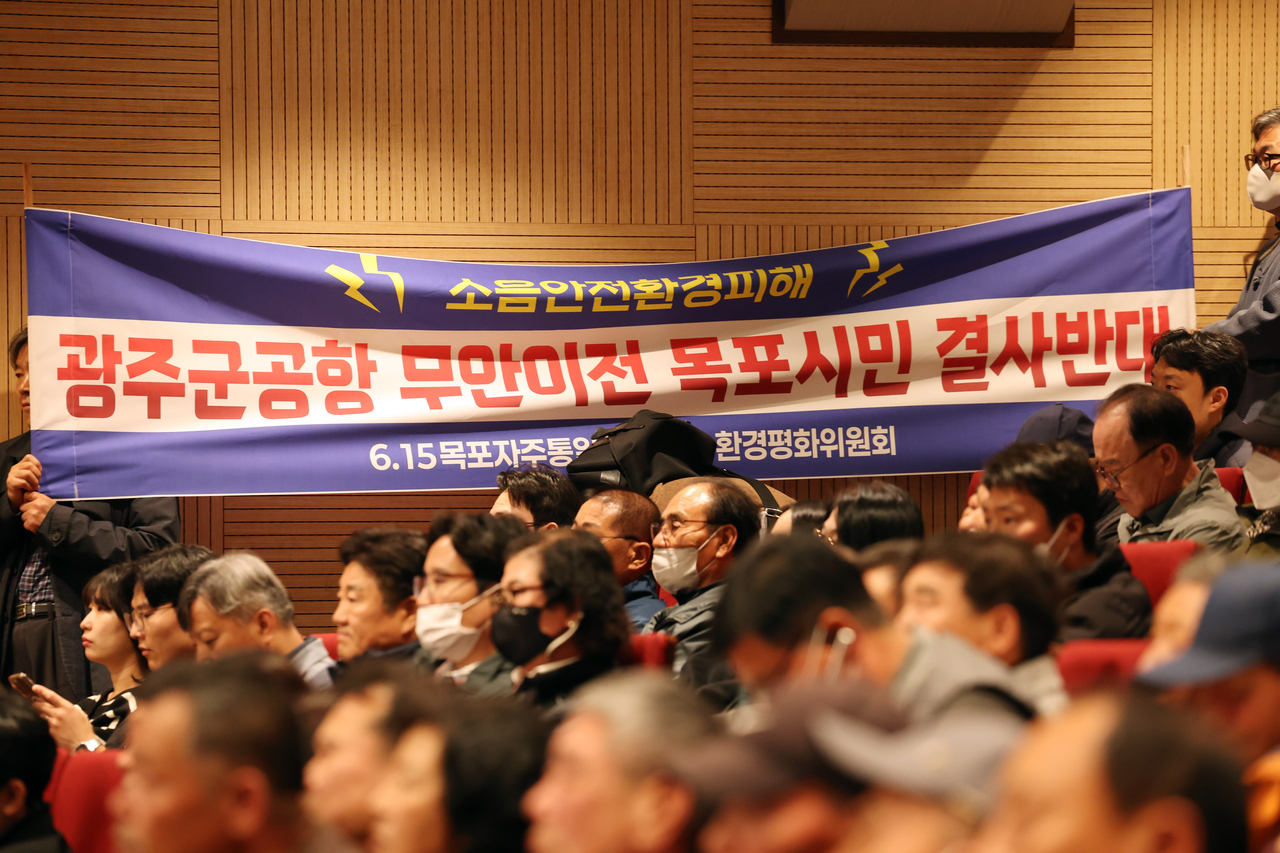
The standing special committee on semiconductor cluster development of the Jeonnam-Gwangju Integrated Special City Assembly said Tuesday that a site-selection committee tasked with identifying a candidate location for the Gwangju military airbase relocation has been unable to function properly because the government and other parties have been slow to respond to Muan-gun's demands. The panel said Muan-gun's call for substantive incentives and guarantees about its future "is a legitimate right."
The committee again urged all parties to the five-way joint agreement on the Gwangju military airbase relocation to honor their commitments and resume consultations to advance development of a Honam-region semiconductor cluster.
It added that the semiconductor cluster project is premised on the relocation of the Gwangju military airbase, and that all parties to the five-way joint agreement — including the central government, South Jeolla Province, Gwangju and Muan-gun — must take responsibility and follow through on what was agreed.
With lawmakers from Muan-gun and other South Jeolla Province constituencies making up a majority of the committee, the panel's characterization of Muan-gun's demands as a "legitimate right" has drawn attention. Some observers have raised concerns that the dispute over the airbase relocation, compounded by tensions over the location of the main administrative headquarters, could deepen the divide between Gwangju and Muan-gun.
Particularly notable is that committee member Ko Seong-seok, who is from Muan, previously served as chief of staff to Assembly member Seo Sam-seok — raising concerns that Seo, a three-term county governor turned lawmaker representing the district, may be exerting influence over the panel.
Analysts say that behind Muan County Executive Kim San's repeated absences from the airbase relocation site-selection committee lies a strategy to secure the Namak government complex as the home for key administrative functions, including planning, organization and budgeting.
In fact, the semiconductor committee has 15 members — seven from South Jeolla Province and eight from Gwangju. Gwangju nominally holds the majority, but most of its representatives are first-term lawmakers with limited expertise in industrial and economic affairs such as semiconductors. Ultimately, the panel could end up being steered by the South Jeolla Province members, many of whom are serving multiple terms. Excluding lawmaker Choi Gyeong-mi of the Progressive Party, the remaining 14 members all belong to the Democratic Party.
The semiconductor committee said that given both Muan-gun's concerns and the closing window to break ground on four semiconductor fabrication plants, "a magnanimous decision in which all parties make mutual concessions is urgently needed." It said that rather than asking only one side to yield, all parties to the joint agreement must take a responsible stance and rebuild trust.
The panel particularly urged that "breakthrough and concrete support measures that Muan-gun residents can actually feel must be put forward first," adding that specific project implementation plans, timelines and financing arrangements that Muan-gun residents can accept must be presented.
The committee said it would take the lead in guaranteeing that all areas of South Jeolla Province and Gwangju share equally in the benefits of the semiconductor cluster, and that the incentives and support measures promised to Muan-gun are enshrined in law and backed by budget appropriations.
The integrated assembly's semiconductor committee was launched Wednesday to comprehensively address semiconductor-related issues spanning multiple standing committees, including the Gwangju military airbase relocation, industrial complex development, power and water supply, metropolitan transportation networks, workforce training and residential infrastructure.
A Gwangju resident identified only by surname, speaking at the Gwangju government complex, said that while the area receiving the airbase relocation deserves proper support and incentives, "using the 800 trillion won Gwangju semiconductor project politically — when it hasn't even arrived yet — is problematic." The resident also argued that if the designated area is unwilling to accept the relocation, authorities should consider a Plan B, including alternative candidate sites or distributing the airbase's functions across multiple locations.
sij@heraldcorp.com