Gastric cancer can spread to surrounding organs and other parts of the body as it advances, and one of the most serious forms of that spread is peritoneal metastasis. The peritoneum is a thin membrane that envelops the stomach and other abdominal organs; when gastric cancer cells migrate to it, they can trigger a range of debilitating symptoms. Once cancer reaches the peritoneum, patients may develop ascites — a condition in which fluid accumulates in the abdomen — along with abdominal discomfort and difficulty digesting food. For patients already in the late stages of gastric cancer, the onset of these symptoms can be devastating.
Researchers in South Korea have now published findings suggesting that survival rates can be improved even when gastric cancer has spread to the peritoneum at this advanced stage. Seoul National University Bundang Hospital said a study showed that directly injecting anticancer drugs into the abdominal cavity of stage 4 gastric cancer patients with peritoneal metastasis, combined with conventional intravenous chemotherapy, resulted in four out of 10 patients seeing their metastatic lesions disappear entirely — leaving them eligible for standard gastric cancer surgery. The one-year survival rate was 86.4%.
A research team led by Kang So-hyun, a professor in the Department of Surgery, and Kim Jin-won, a professor in the Division of Hematology and Oncology at Seoul National University Bundang Hospital, published the results of the IPLUS phase 2 clinical trial, which combined intraperitoneal paclitaxel infusion with intravenous FOLFOX chemotherapy in patients with peritoneal metastasis from gastric cancer.
When gastric cancer spreads to the peritoneum, cancer cells scatter and grow across a wide surface inside the abdomen, making surgical removal extremely difficult. In the past, such metastatic stage 4 gastric cancer was commonly deemed inoperable, but a strategy known as "conversion surgery" — in which chemotherapy is used to sufficiently reduce metastatic cancer cells before removing the primary tumor and remaining lesions — has recently drawn attention as a new treatment approach.
The central challenge lies in a biological barrier between the bloodstream and the peritoneum. A protective structure prevents substances in the blood from easily crossing into the peritoneal cavity, meaning that even when anticancer drugs are administered intravenously, they struggle to reach cancer cells in the abdomen at effective concentrations. As a result, patients with peritoneal metastasis from gastric cancer have historically had very poor prognoses even with systemic chemotherapy — median survival has typically ranged from nine to 11 months — and conversion surgery has remained rare.
The research team took a different approach: delivering anticancer drugs directly into the abdominal cavity. If drugs sent through the bloodstream cannot adequately reach the peritoneum, the reasoning went, why not put them inside the abdomen directly? A port connected to the interior of the abdominal cavity is implanted beneath the abdominal skin; anticancer drugs injected through the port then flow directly to the peritoneal surface. Conventional intravenous systemic chemotherapy is administered at the same time.
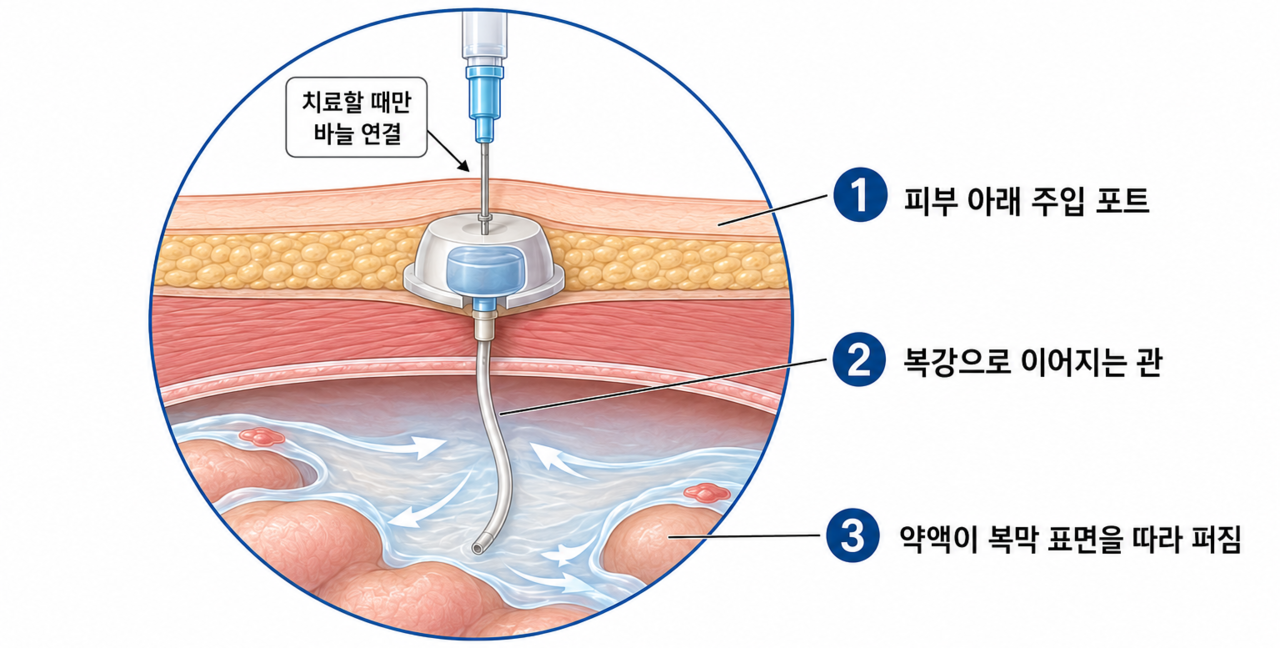
The clinical trial was conducted between 2021 and 2022 and enrolled 22 patients with peritoneal metastasis from gastric cancer. Every two weeks, participants received an injection of paclitaxel diluted in saline directly into the abdominal cavity, alongside FOLFOX-based intravenous chemotherapy.
The one-year overall survival rate after the start of treatment was 86.4%, and the progression-free survival rate was 63.6% — levels of efficacy that had rarely been seen in peritoneal metastasis from gastric cancer. The median overall survival was 20.2 months.
Particularly notable, nine of the participants (40.9%) saw their peritoneal lesions disappear entirely, making them eligible for conversion surgery. Those patients went on to undergo gastrectomy and lymph node dissection, achieving complete resection with no remaining cancer on the surface. The median overall survival among patients who received conversion surgery was 32.9 months.
The research team said the clinical trial is significant in that it demonstrated the potential of combined intraperitoneal and intravenous chemotherapy as a key treatment capable of bringing stage 4 gastric cancer patients with peritoneal metastasis to a surgically operable condition.

Building directly on these findings, the team led by Kang and Kim is now conducting a multicenter phase 3 clinical trial, with both serving as co-principal investigators. The phase 3 trial is enrolling 321 patients with peritoneal metastasis from gastric cancer across six hospitals nationwide. If the treatment demonstrates sufficient efficacy at that scale, it is expected to become a cornerstone therapy for peritoneal metastasis from gastric cancer, a condition long considered difficult to treat.
"Systemic chemotherapy alone has limitations in delivering sufficient concentrations of anticancer drugs to cancer cells in the abdominal cavity in cases of peritoneal metastasis from gastric cancer," Kang said. "Intraperitoneal chemotherapy is a strategy designed to overcome those limitations by delivering anticancer drugs directly to peritoneal lesions and enhancing treatment efficacy — we will continue to verify its effect on improving survival rates." The findings were published in Gastric Cancer, an international academic journal in the field of gastric cancer research.
kty@heraldcorp.com