
Analysis of 203 patients undergoing complex valve surgery including aortic valve replacement shows ICU stay cut by more than half compared with median sternotomy; hospital stay shortened by four days
A research team led by Professor Je Hyung-gon of the cardiovascular and thoracic surgery department at Seoul National University Bundang Hospital has found that minimally invasive surgery leads to faster postoperative recovery than median sternotomy in complex heart valve procedures involving the aortic valve. Resident physician Hwang Chan-sop served as first author. Complex valve surgery treats multiple heart valves in a single operation; the minimally invasive approach replaces the long sternal incision with a small cut on the right side of the chest.
The heart has four valves that open and close to keep blood flowing in one direction. The aortic valve, the focus of this research, sits at the outlet through which blood leaves the heart to circulate through the body, while the mitral and tricuspid valves are located between the atria and ventricles on the left and right sides of the heart, respectively.
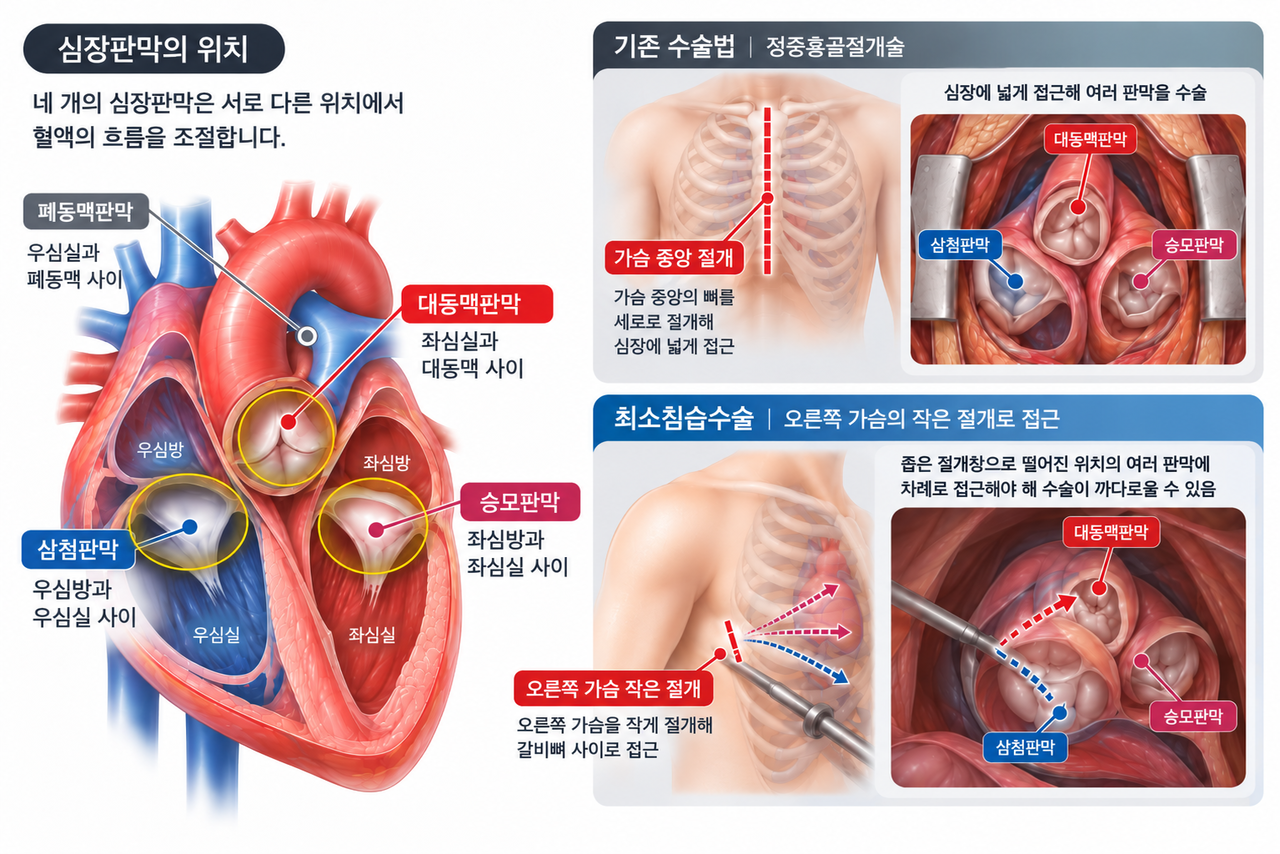
When valves deteriorate due to aging or disease and can no longer function properly, they must be repaired or replaced with prosthetic valves. When two or more valves — such as the aortic, mitral and tricuspid — develop problems simultaneously, the condition is called combined valvular disease.
Median sternotomy has long been the standard approach for complex valve surgery. Because multiple valves in different positions must be addressed at once, splitting the sternum down the center to give surgeons a wide view of the heart was considered the safer option. The sternal incision, however, carries significant postoperative pain, a heavy recovery burden, and risks of complications such as infection.
Minimally invasive surgery, the alternative drawing growing attention, involves a roughly 5-to-7-centimeter incision on the right side of the chest, with instruments passed between the ribs to reach the valves. Because the sternum is left intact, the physical burden on patients is reduced, and the technique is already widely used for single-valve procedures. Applying it to complex valve surgery is considerably more demanding, however, since surgeons must access valves in different locations through a narrow field of view. Whether the advantages of minimally invasive surgery carry over to the more challenging multi-valve setting remained an open question.
The research team analyzed outcomes for 203 patients who underwent complex valve surgery involving the aortic valve at Seoul National University Bundang Hospital and Yangsan Pusan National University Hospital between May 2015 and May 2025. Of those patients, 30 received minimally invasive surgery and 173 underwent median sternotomy.
There had been concern that the confined operating space in minimally invasive surgery could force a mid-procedure conversion to median sternotomy or prolong operating time. That concern was particularly acute in valve surgery, where the aorta must be clamped and the heart stopped while a cardiopulmonary bypass machine takes over, meaning longer procedures place greater strain on patients. All 30 patients in the minimally invasive group completed surgery without conversion to median sternotomy, and aortic cross-clamp time and bypass time showed no statistically significant difference from the sternotomy group.
Recovery outcomes favored the minimally invasive group. Those patients required less blood transfusion and had their ventilators removed earlier. The median ICU stay was 23 hours, roughly half the 46 hours recorded in the sternotomy group, and the median hospital stay was five days, four days shorter than the nine days seen in the sternotomy group.
Long-term follow-up — approximately three years for the minimally invasive group and about five years for the sternotomy group — found no statistically significant difference in survival rates between the two groups. The rate of valve regurgitation, in which valve function gradually declines and blood flows backward, also showed no significant difference between the groups. The findings confirm that valves can be repaired accurately and reliably through a small incision.

"This study shows that minimally invasive surgery is a viable option worth considering even in complex valve procedures," Je said. "What matters most is treating each valve accurately, so the appropriate surgical approach must be chosen for each individual patient based on their diagnostic results." Je added that applying minimally invasive surgery to suitable candidates could reduce postoperative pain and ease the recovery burden. The study was published in the Journal of Thoracic Disease, a peer-reviewed international journal in the field of thoracic medicine.
kty@heraldcorp.com





