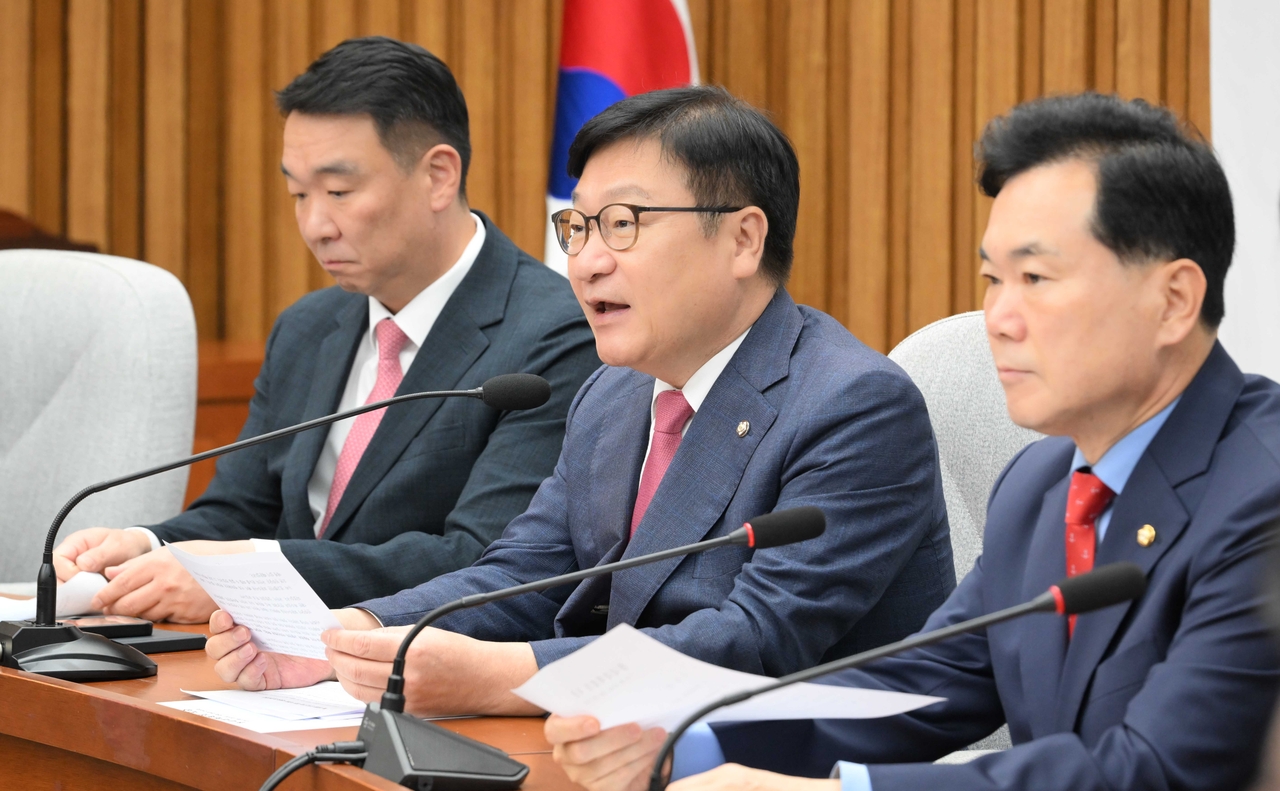
People Power Party floor leader Jeong Jeom-sik on Friday criticized the Democratic Party of Korea's push to amend the Criminal Procedure Act and abolish prosecutors' supplementary investigative powers, calling it "the end of rule of law." He also strongly opposed a proposed revision to the National Assembly Act that would shorten the fast-track review period, denouncing it as a "rubber-stamp bill."
Speaking at a floor strategy meeting at the National Assembly, Jeong said a filibuster would be forcibly terminated within hours "under collusion among pro-government forces," and warned that "an unprecedented bad law that will be remembered as a disgrace in constitutional history" was about to pass. "A majority of the public opposes abolishing the supplementary investigative powers, yet the Democratic Party is going against the will of the people," he said.
Jeong also took issue with a dismissal-of-indictments provision added during the review of the Criminal Procedure Act amendment. "They secretly inserted a clause on dismissal of indictments that could be used to erase the president's trial," he said. He added that "the National Assembly, which is supposed to uphold the law, has resorted to shameless trickery — like dealing from the bottom of the deck in a rigged card game."
He then questioned whether any of the Democratic Party's judicial reforms since the Moon Jae-in administration had been sound. "The redistribution of investigative powers between prosecutors and police only caused delays and confusion on the ground," he said, criticizing moves to expand the Supreme Court bench and introduce a law criminalizing distortion of the law as measures that "punched holes throughout the judicial system to help the president escape legal risk."
"If the supplementary investigative powers disappear, ordinary citizens will suffer from shoddy and sluggish investigations — and the less money and power a person has, the greater the harm they will face," Jeong said. "Meanwhile, those in power will pressure courts by invoking dismissal of indictments. Ultimately, the weak will be cast out from the protection of the law, and the powerful will escape its scrutiny. That is the end of rule of law."
Jeong was equally blunt about the National Assembly Act revision also set for a plenary vote Friday, calling it "in a word, a rubber-stamp bill" and "a dictatorial bad law designed to turn the National Assembly into the Democratic Party's rubber stamp — a compliant machine."
"The fast-track system was introduced under the National Assembly Advancement Act to end the 'animal parliament' of extreme partisan clashes and to protect the rights of minority parties," he said. "Cutting the review period from 330 days to 90 days destroys the balance of dialogue and compromise that the Advancement Act was built on."
Jeong also referenced the recent turmoil over single-stock leveraged ETFs, urging the Democratic Party to "learn from the chaos it caused in the stock market by hastily introducing single-stock leveraged ETFs without adequate review and deliberation." He called for the withdrawal of the National Assembly Act revision, saying "a rubber-stamp bill that only creates social disorder through rushed legislation must be scrapped."
Jeong also weighed in on Democratic Party lawmakers' demand that Assembly member Lee Jin-suk be removed from the National Assembly's Science, ICT, Broadcasting and Communications Committee. "Rep. Lee is no longer the Korea Communications Commission chairperson — she is a lawmaker chosen by the people," he said, criticizing the Democratic Party for "a parliamentary-dictatorship mindset that treats the National Assembly as its own possession or plaything."
thanks@heraldcorp.com