Monday — the day after the central region's monsoon season officially ended — Seoul sweltered under a high of 33 degrees Celsius, and air conditioners hummed without pause in buildings across the city.
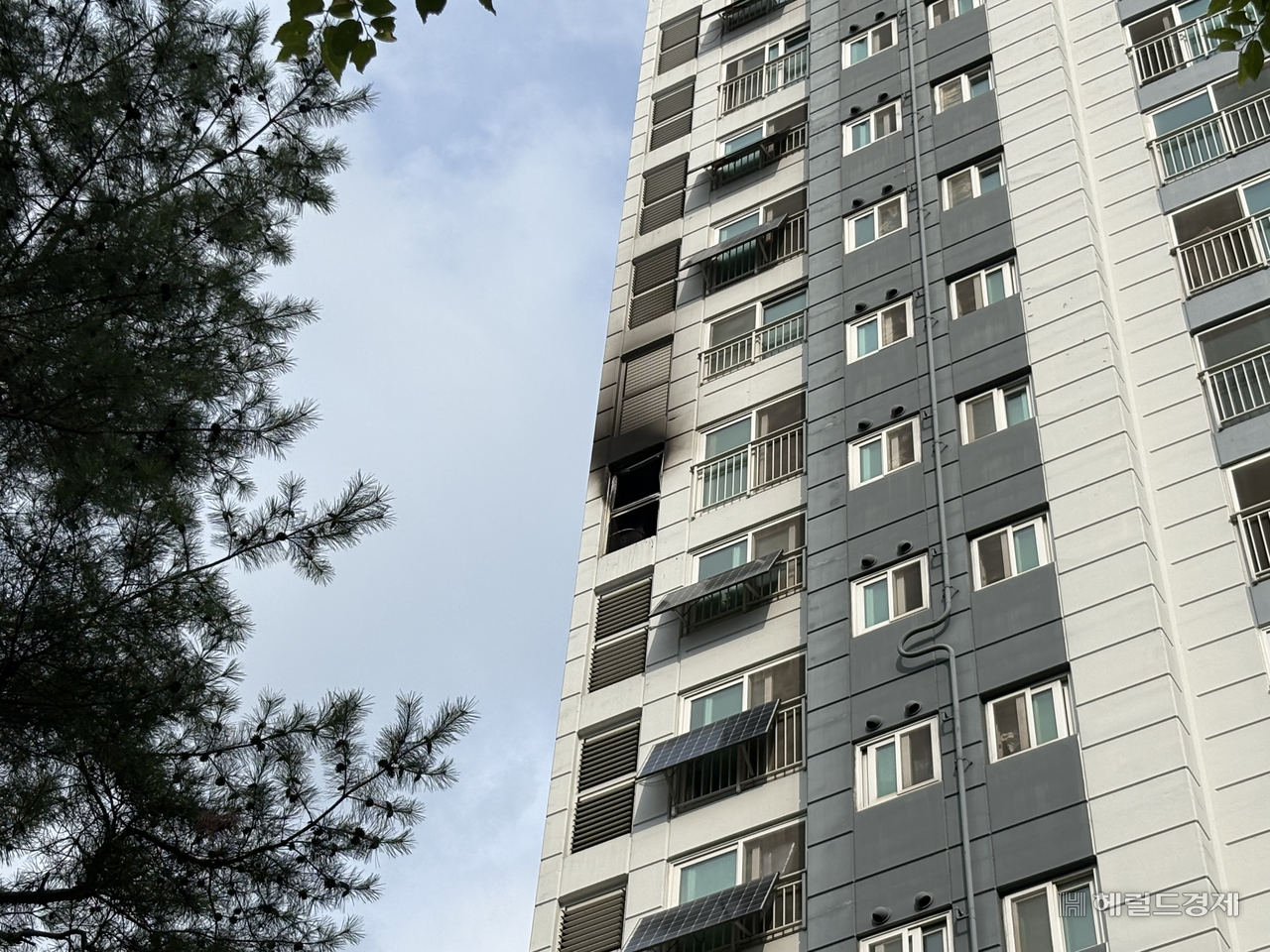
The relentless strain on cooling units has raised fears of fire. Fire authorities warn residents every year to maintain their outdoor units, yet similar incidents keep recurring. Recently, a fire that started in an air conditioner outdoor unit on the 11th floor of an apartment building in Magok-dong, Gangseo-gu, forced about 40 residents to evacuate on their own. Firefighters deployed 21 pieces of equipment and 76 personnel and extinguished the blaze in about 30 minutes.
A reporter who visited the scene found the building's exterior wall blackened with soot. Resident Lee Yun-hee, 47, who had evacuated with her children, described the moment: "There were two loud banging sounds," she said. "I'm on the third floor, so I was far from where the fire broke out, but I could still hear it clearly."
During summer, when air conditioner use is heaviest, the ventilation louvers on outdoor unit enclosures must be kept fully open at all times to allow heat to escape. Clutter or trash stored near outdoor units can significantly increase fire risk. When a reporter returned to the Magok-dong apartment the day after the fire, 53 of the 62 units in the affected building had their louvers fully open. Two units had theirs completely shut, one was partially closed, and five others were not fully open.
Park, 67, a resident of the same building, said the heat had driven him to run the air conditioner from early morning until the early hours of the next day. "I have not received any specific guidance about the outdoor unit enclosure," he added. Song Byeong-ju, 53, who lives on the 11th floor, said he runs his unit for about 12 hours a day. "There is a bit of space in the outdoor unit enclosure, so I have been storing some things I do not use in there," he said.
After the fire, a notice appeared on the apartment's bulletin board listing three reminders: keep outdoor unit ventilation louvers open at all times, do not store flammable materials nearby, and check regularly that ventilation openings are not blocked. The building management office said it had made one or two announcements about outdoor units since summer began. "Since the fire happened on Saturday, we will post more notices and make multiple announcements," it said.
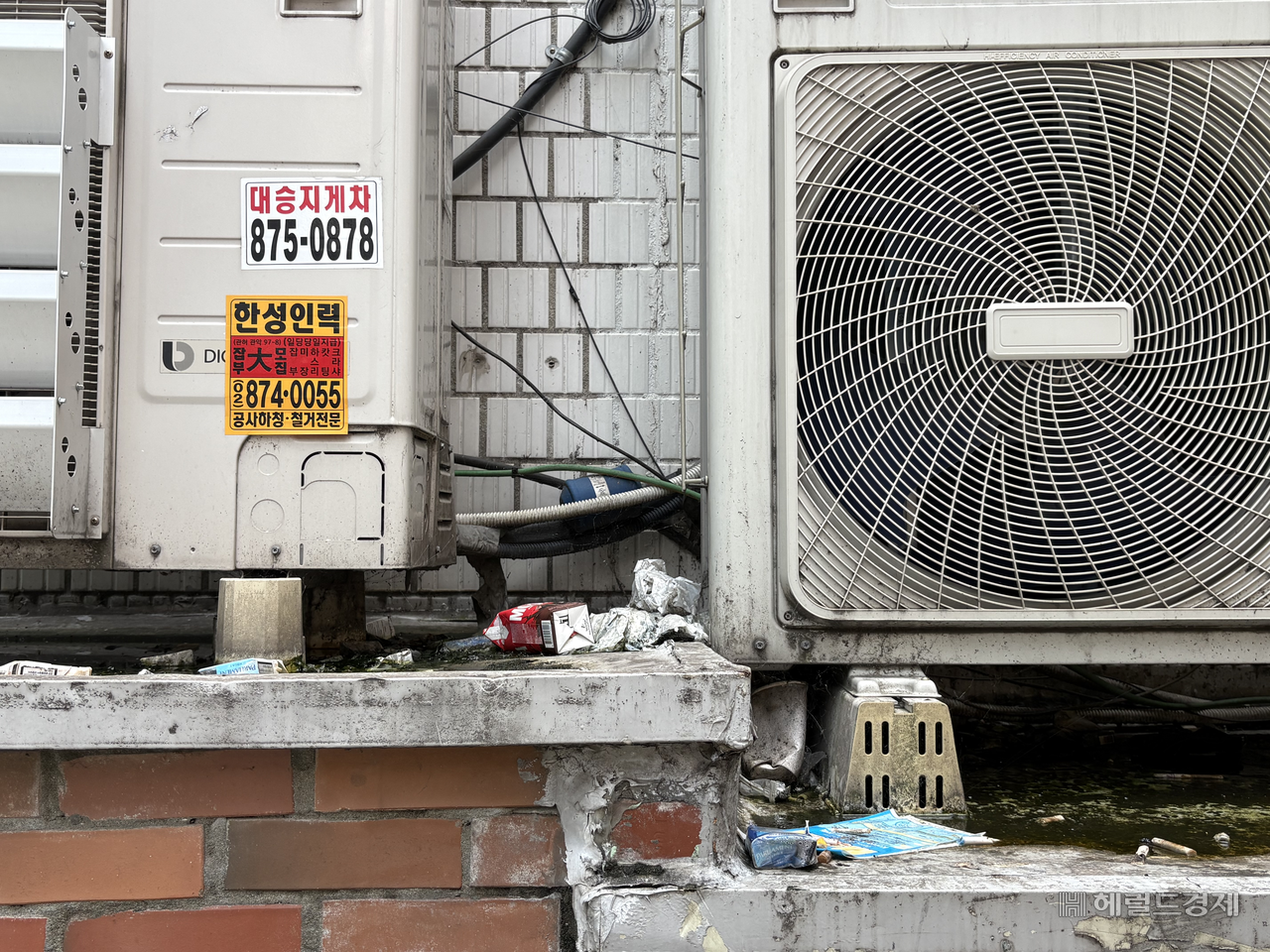
Trash and cigarette butts piling up around restaurant outdoor units
Poor outdoor unit maintenance is not a problem confined to apartment buildings. When a reporter visited an officetel complex near Seoul National University Station in Gwanak-gu, Seoul, on Tuesday, units with closed ventilation louvers were easy to find. Flowerpots and other items stacked around outdoor units were also a common sight.
Park, 24, a Seoul National University student living alone nearby, said he runs his air conditioner almost all day in this heat and has never cleaned the outdoor unit. Some residents acknowledged the fire risk but said they had no choice. Lee Seung-yun, 24, said: "My room is so small that I had no option but to put my laundry drying rack in the outdoor unit enclosure."
The situation was more serious in restaurant districts where outdoor units are exposed directly to the street. Stepping onto Sharosugil in Gwanak-gu — a street lined with bars and eateries — a reporter immediately spotted outdoor units caked in trash and cobwebs. In one spot, an outdoor unit was pressed up against a cigarette butt disposal bin with barely a hand's width between them. Son, 32, a passerby, said: "When you walk by, you cannot help but think it looks filthy. If a fire broke out because of all that trash, I would think it was only a matter of time."
According to the National Fire Agency, air conditioner and electric fan fires across the country totaled 2,184 over the five years from 2021 to 2025, killing 31 people and injuring 136. Property damage reached 14.2 billion won ($9.85 million). The fires were concentrated in July and August, when air conditioner use peaks. Of the 1,564 air conditioner fires, about 79 percent were caused by electrical factors. Mechanical causes such as motor overheating and overloading, as well as user negligence, were also cited as major contributors.
This month alone, 90 air conditioner fires were reported through Monday. Ryu Sang-il, a fire and disaster administration professor at Dong-eui University, said outdoor unit fires in summer are often sparked by flammable trash and debris left nearby. "Keeping the area clean is the single most important thing you can do," he said.
The National Fire Agency urged the public to make basic fire prevention habits part of daily life, citing four measures: use a dedicated outlet for the air conditioner, keep the area around the outdoor unit clean, ensure adequate ventilation space around the outdoor unit, and avoid overloading power strips. "Even a small moment of carelessness during summer, when cooling appliance use surges, can lead to a fire," the agency said.
newday@heraldcorp.com
shy@heraldcorp.com