![Apartments in Gangnam-gu as seen from Lotte World Tower in Songpa-gu, Seoul. [Yonhap]](https://wimg.heraldcorp.com/news/cms/2026/08/03/rcv.YNA.20260803.PYH2026080314170001300_P1.jpg)
The government's latest real estate tax reform package raises the basic deduction threshold for the comprehensive real estate tax to 1.4 billion won ($977,000) — equivalent to a market value of about 2 billion won — with a focus on protecting owner-occupiers of mid- to low-priced homes. For non-resident single-home owners, however, the taxable threshold is being lowered, and analysts expect the resulting wave of landlords moving back into their properties to shrink the supply of jeonse and monthly-rent units further.
Under the Ministry of Economy and Finance's 2026 tax reform plan released Monday, the basic deduction for the comprehensive real estate tax on residential property will rise from the current 1.2 billion won to 1.4 billion won for owner-occupying single-home households, while non-resident single-home owners will see their threshold cut from 1.2 billion won to 900 million won. For all other cases, when the combined publicly assessed value of housing exceeds 900 million won — roughly 1.3 billion won at market value — a base deduction of 400 million won applies, with an additional 500 million won deductible only in proportion to the share of the owner-occupied home's value within the total housing value.
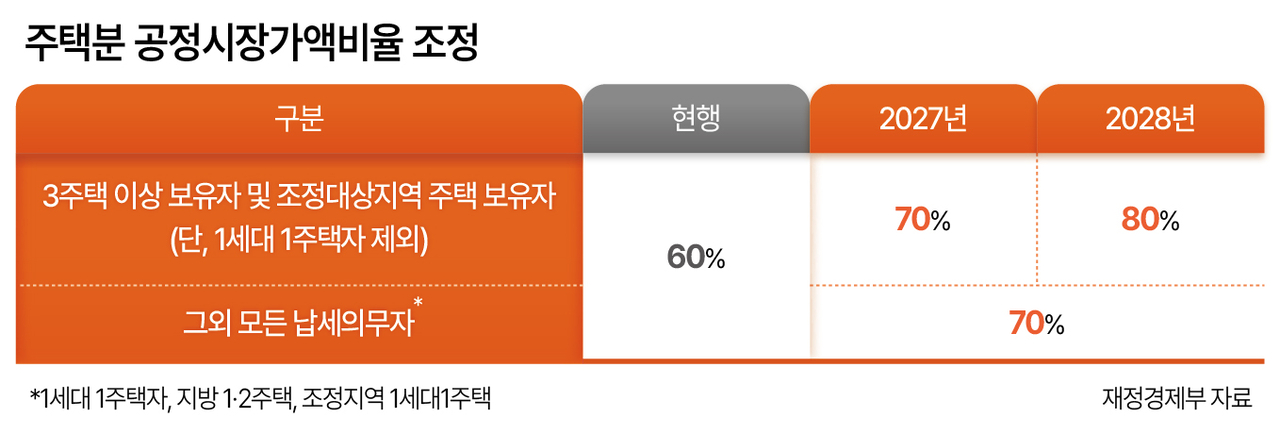
Except for owner-occupiers of mid- to low-priced single homes, the comprehensive real estate tax burden will rise sharply. The government plans to increase the fair market value ratio from the current 60 percent to 70 percent, and to phase it up to 80 percent by 2028 for owners of three or more homes and holders of property in regulated zones — excluding single-home households — in a bid to normalize the tax burden.
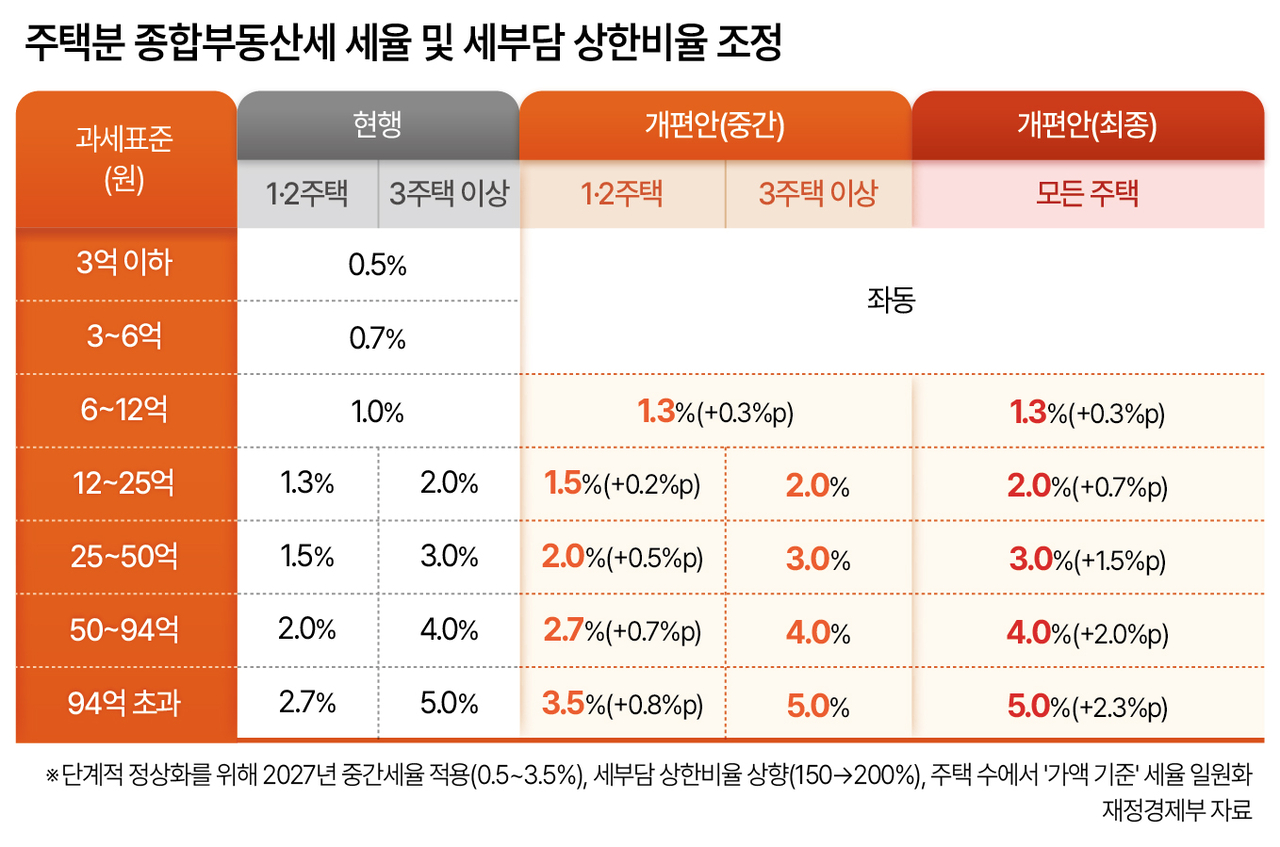
To ease the concentration of investment in a single high-value property, the government also decided to apply tax rates based on property value rather than the number of units owned. From 2028 onward, a unified rate schedule will apply based on housing value: 1.3 percent for properties valued between 600 million and 1.2 billion won, 2.0 percent for 1.2 billion to 2.5 billion won, 3.0 percent for 2.5 billion to 5 billion won, 4.0 percent for 5 billion to 9.4 billion won, and 5.0 percent above 9.4 billion won, with the rate for properties below 600 million won remaining unchanged.
The tax burden ceiling ratio will also be raised from 150 percent to 200 percent to amplify the reform's effect. The government has layered on additional regulations to shift the tax system's center of gravity toward actual residence, including converting the comprehensive real estate tax credit for single-home households into a deduction based on length of owner-occupancy.
In the rental market, analysts forecast that the structural shift will accelerate over the long term — with multi-home owners and non-resident single-home owners moving back into their properties, rental units being pushed into the sales market, and the private rental supply base shrinking, driving a sustained decline in rental listings and a conversion of jeonse contracts to monthly rent arrangements.
The shortage of jeonse and monthly-rent listings has already intensified under the government's tightened owner-occupancy rules, pushing the average jeonse price for Seoul apartments above 700 million won this month for the first time since records began — KB Kookmin Bank put the figure at 704.58 million won. By the jeonse price index, mid-sized apartments in the 14 districts of northern Seoul (exclusive area between 60 and 85 square meters) posted a reading of 107.277, outpacing the 105.143 recorded for the 11 districts of Gangnam.
Some analysts argue that as rental supply shrinks and upward pressure on rents builds, the impact will be felt more acutely in central urban areas than in outlying districts.
![Apartments in Gangnam-gu as seen from Lotte World Tower in Songpa-gu, Seoul. [Yonhap]](https://wimg.heraldcorp.com/news/cms/2026/08/03/rcv.YNA.20260803.PYH2026080314230001300_P1.jpg)
Kim Hyo-seon, a senior real estate specialist at KB Kookmin Bank, said that in outlying areas, where gap investment is prevalent, selling landlords are typically replaced by tenant-buyers, so rental demand falls alongside supply. "In core urban areas, however, when more landlords move back in to reduce their tax bills, rental demand stays the same while supply alone shrinks — so price pressure there can be considerably greater," she said.
There is also a possibility that landlords will pass on the heavier property-holding tax burden through higher rents.
Yang Ji-young, a specialist at Shinhan Premier Pathfinder, said the increase in the comprehensive real estate tax burden could translate into tax shifting in parts of the rental market — through conversions to monthly rent or semi-jeonse arrangements, or through higher rents on new leases. "At the same time, the likelihood of unsold listings accumulating for extended periods in outlying areas is not high, as some tenants priced out of the rental market will shift to buying," she added.
![An apartment complex in Seocho-gu, Seoul. [Herald Business]](https://wimg.heraldcorp.com/news/cms/2026/08/03/news-p.v1.20260803.59880dc306614974b916a1403e0a3fa7_P1.jpg)
On top of that, additional conditions attached to the cooperative landlord housing scheme and a reduction in benefits for purchased rental apartments — both included in the tax reform package — could also steer existing units toward the sales market and further reduce rental supply. The government decided to limit the heavy-tax exclusion period for purchased rental apartments in regulated zones to units transferred before Dec. 31, 2027, while easing the surcharge and additional tax rates for transfers in 2028 and scaling back preferential long-term holding deductions.
Kim said that while an exit path has been opened for owners of purchased rental apartments, the actual volume of registered rental apartments is limited, so the overall pool is not large. "However, if those units do come to market, it means the disappearance of affordable rental housing subject to the 5 percent rent-increase cap — so supply could still decline," she said.
She added that additional conditions attached to the cooperative landlord housing scheme would complicate landlords' calculations for exemptions from the owner-occupancy requirement. "On top of weakening the incentive to use the special provision, it could also reduce the motivation to keep rents low in renewal contracts — so the authorities should examine whether this conflicts with the original policy intent of protecting tenants," she said.
hope@heraldcorp.com
quq@heraldcorp.com