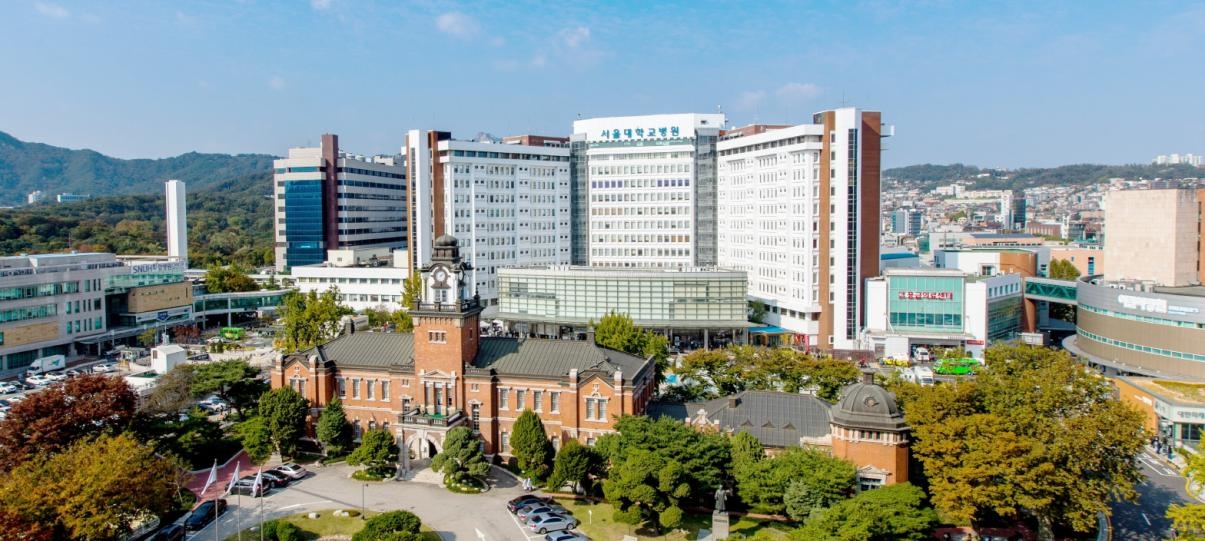
Seoul National University Hospital has ranked first in the general hospital category of the National Brand Competitiveness Index (NBCI), organized by the Korea Productivity Center (KPC), for 11 consecutive years, the hospital announced Tuesday. Led by President Baek Nam-jong, the hospital credited the recognition to its expansion of critical and essential medical services and advances in AI-based precision medicine.
The NBCI measures brand competitiveness by surveying consumers annually on brand awareness, image and relationships. This year's survey ran from April through June. Seoul National University Hospital also holds the top spot in the Brand Power (K-BPI) survey organized by Korea Management Association Consulting (KMAC), a title it has maintained for 26 consecutive years.
The hospital completed a renovation of its operating suites, adding 11 rooms — 10 for adults and one for pediatric patients — and recorded significant year-on-year growth in both total surgeries and robotic procedures, strengthening its capacity to handle complex, high-acuity cases. It also became the first institution in South Korea to perform a robot-assisted lung transplant. The hospital opened a critical maternal and neonatal care center overseeing the full continuum from delivery to newborn treatment for the most severely at-risk mothers and infants, serving as the country's final-referral institution. It also accelerated the expansion of regional and essential medical infrastructure through the groundbreaking of Baegot Seoul National University Hospital, the opening of the National Fire Service Hospital and the installation of equipment at the Gijang Heavy Ion Therapy Center.
AI-driven precision medicine initiatives moved into full operation as well. The hospital launched SNUH POLARIS, the country's first AI-powered precision medicine clinical decision-support system, integrating dispersed pathology, diagnostic, genomic and surgical data. It completed the standardization of cancer patient genomic data, laying the groundwork for precision diagnosis and personalized treatment. The hospital also unveiled KMed.AI, a healthcare-specialized AI model co-developed with Naver, and officially opened SNUH.AI, a medical AI agent platform.
Global research collaboration expanded further. Designated as South Korea's first National Strategic Technology Specialized Research Institute in advanced biotech and digital health data analysis, the hospital opened an overseas hub in Boston and broadened joint research with Harvard Medical School, MIT and Stanford University. With Harvard Medical School in particular, the hospital deepened ties by pursuing multiple collaborative research projects and expanding researcher exchanges.
The hospital continues to fulfill its public healthcare mandate. A number of public clinical professors rotate through regional public hospitals, helping to address gaps in essential medical services. The Seoul National University Hospital group — comprising the main campus along with Bundang Seoul National University Hospital, Boramae Hospital, the Gangnam Center, the National Traffic Rehabilitation Hospital and the National Fire Service Hospital — operates the largest public hospital network in the country.
"Ranking first in the NBCI for 11 consecutive years reflects the tangible results of our efforts to expand critical and essential care and drive innovation in AI-based precision medicine for the health of the public," Baek said. "We will continue to realize the values of public medicine and lead the way in future healthcare as the nation's central hospital."
kty@heraldcorp.com