![Apartment buildings in Gangnam-gu as seen from Lotte World Tower in Songpa-gu, Seoul. [Yonhap]](https://wimg.heraldcorp.com/news/cms/2026/08/05/rcv.YNA.20260803.PYH2026080314250001300_P1.jpg)
The government has been pushing an aggressive housing supply drive to stabilize home prices, but voices from the industry say a web of regulations is cutting off the supply pipeline. Construction companies are shouldering rising costs from raw materials and labor, while access to financing has grown increasingly difficult.
On top of strict lending restrictions, concerns are mounting that the government's proposed tax reform will further dampen housing demand. Industry officials say supply expansion will remain limited without step-by-step deregulation to unblock project viability, financing and ground-breaking.
According to industry sources Wednesday, the government is expected to announce a housing supply package soon. President Lee Jae Myung on Monday directed officials to conduct a full review of existing housing supply measures and move quickly to secure all available units. He also called for administrative action alongside financial, fiscal and regulatory relief to accelerate the pace of supply.
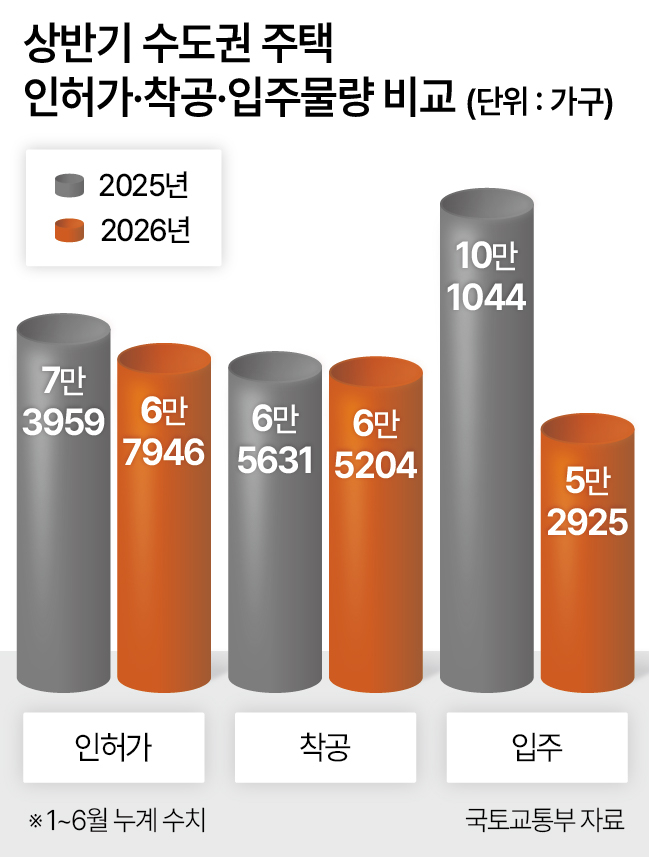
Construction industry: 'Projects blocked from the very first step — blanket lending curbs must go and demand must recover'
Construction companies, as the primary providers of housing, say the first priority must be restoring a weakened demand base. The government has pledged support measures for end-users, but on the ground, lending restrictions are shrinking the pool of buyers.
Mortgage loan limits for home purchases in the greater Seoul area and regulated zones are currently capped at 200 million to 600 million won ($145,000 to $435,000) depending on the property price. Commercial banks have also independently tightened their own mortgage limits on top of that. At a real estate forum President Lee hosted last month, a prospective resident of an apartment complex in Gyeonggi Province raised the issue of being unable to secure a balance payment loan — prompting the five major commercial banks to extend 500 billion won in loans.
"Even when a builder or developer finds a suitable site, the lending restrictions on buyers make them hesitant to proceed with supply," an official at the Korea Housing Association said. "Demand — the very first stage of a project — is being blocked."
Areas with a guaranteed minimum level of demand, such as prime locations in Seoul, are faring better, but the situation is far more serious in regional markets where unsold units continue to pile up.
"When financial institutions assess project financing, pre-sale viability is the top criterion — but with lending curbs cutting off buyer demand, lenders simply won't do the evaluation," said an official at a construction company. "Demand has to come back for supply to follow automatically, but the government's singular focus on managing household debt is stalling the supply pipeline."
The head of another construction company said pre-sale prices in Seoul have surged to a minimum of 80 million to 100 million won per 3.3 square meters, given land and construction costs. "I question how much demand there will be for prices like that under the tightened tax reform and lending environment," he added.
![A real estate agency in Gangnam-gu, Seoul. [Yonhap]](https://wimg.heraldcorp.com/news/cms/2026/08/05/rcv.YNA.20260802.PYH2026080205370001300_P1.jpg)
More small-scale sites struggle with construction costs: 'Redevelopment regulations must be eased'
Mid-sized construction companies concentrated in regional markets are finding their survival threatened by rising financing costs and mounting inventory burdens. Builders say they have little choice but to limit supply to large-scale complexes over smaller sites in order to secure project viability.
The situation is even more acute at small-scale sites. Major contractors often decline to provide guarantees for such projects, and securing project financing loans through financial institutions is difficult, leaving them heavily dependent on policy-backed financing from the Korea Housing and Urban Guarantee Corporation or Seoul Guarantee Insurance. But as costs have risen with raw material price increases, a growing number of sites can no longer cover construction expenses with existing loan amounts, according to those in the field.
Layers of accumulated regulation in redevelopment and reconstruction projects — a key channel for housing supply — are also cited as a major obstacle. Passive administration by local governments, complex approval processes and a flood of resident complaints frequently drag projects out indefinitely.
Financing costs and contribution burdens are creating bottlenecks at each stage of these projects. The Seoul Metropolitan Government has called for raising the loan-to-value ratio on relocation loans for redevelopment projects to 70 percent and temporarily easing restrictions on the transfer of union membership status for three years. Officials also say the legal floor-area ratio cap should be relaxed to 1.2 times the current limit, and the mandatory rental housing contribution rate for redevelopment projects should be lowered from the current 50 percent to 30 percent — in line with the rate for reconstruction projects — to open the door for new supply.
There are also calls to bring the purchase price of rental housing supplied in exchange for floor-area ratio incentives in redevelopment projects closer to market rates. "The government raised the public purchase price for rental units to 80 percent of the standard construction cost, but that is still well below market rates and eats into profitability," an official at a construction industry association said. "Additional measures such as cash land contributions and realistic construction cost adjustments need to follow."
Public housing sites face resident opposition and other hurdles; authorities weigh expanded PF guarantees
Rather than relying solely on private redevelopment, the government is considering early ground-breaking at public housing sites such as the Taereung Golf Course in Nowon-gu, Seoul, but practical obstacles are substantial. The Taereung site must clear issues including the preservation of views around a UNESCO World Heritage-listed Joseon royal tomb, consultations with the Cultural Heritage Administration, and opposition from nearby local governments and residents concerned about traffic congestion. The Yongsan International Business District in Seoul and sites at a racetrack and a counterintelligence command base in Gwacheon, Gyeonggi Province, are also facing significant community resistance.
Concerns have also emerged that the government's newly announced tax reform package — which includes higher property holding taxes — could further undermine supply incentives. The core of the reform raises the basic deduction for the comprehensive real estate tax for owner-occupiers with one home from 1.2 billion won to 1.4 billion won, while increasing the tax burden on properties with a taxable base exceeding 600 million won. Multi-home owners and non-resident single-home owners of ultra-high-priced properties would face a significantly heavier holding tax burden as a result.
"This tax reform could worsen buyers' financing conditions and pre-sale prospects, reducing the incentive for private housing supply," said Kim Deok-rye, a senior research fellow at the Korea Housing Industry Research Institute. "With business conditions difficult across apartments, non-apartment housing and private rental alike, public supply alone will ultimately be insufficient to meet market demand."
Meanwhile, financial regulators have begun reviewing financing support measures to stimulate housing supply. Expanding public guarantees for project financing and partially easing relocation loan restrictions are among the options under discussion, according to sources.
lucky@heraldcorp.com
hwshin@heraldcorp.com
quq@heraldcorp.com