From data-driven early forecasting to on-site water delivery — all-out effort to minimize farming losses
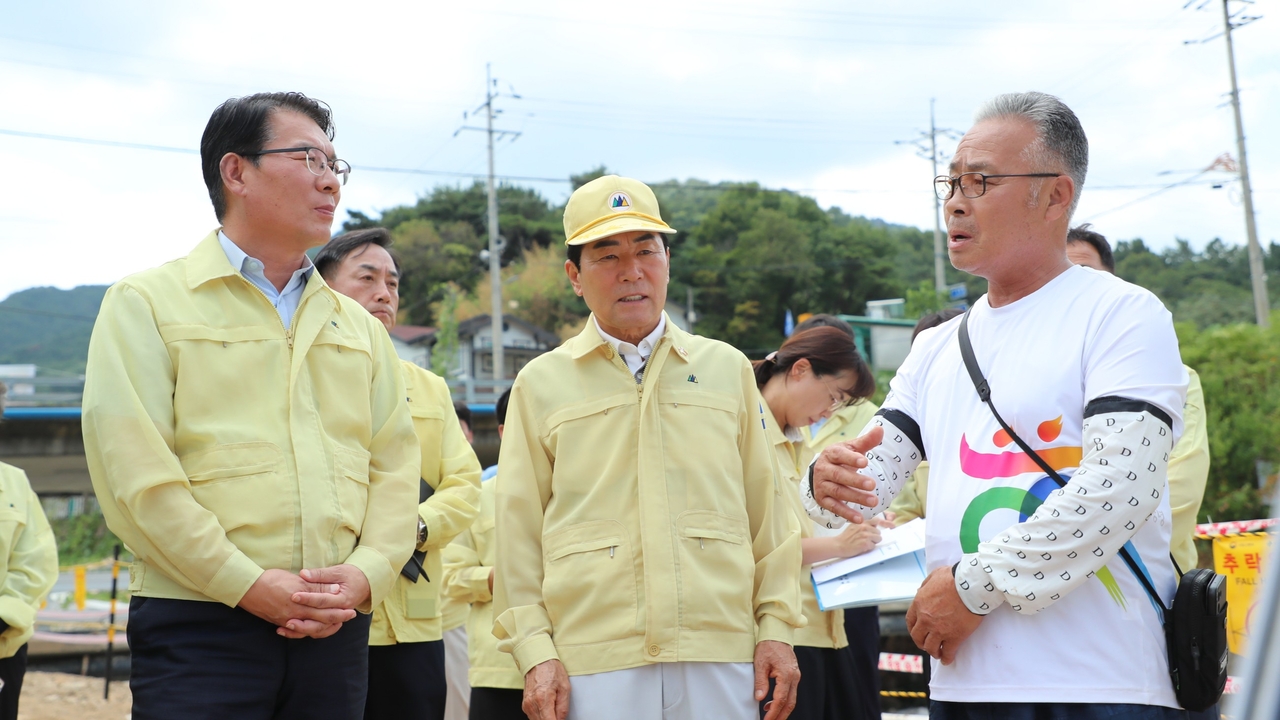
Korea Rural Community Corporation President Kim In-jung visited a drought-stricken area in Changnyeong-gun, South Gyeongsang Province, on Tuesday to inspect the implementation of the corporation's phased water-securing measures and the current state of agricultural water supply, the corporation announced Wednesday.
The visit came after Kim recently chaired a drought-response progress review meeting.
Kim visited Okcheon Reservoir in Changnyeong-gun that day. Persistent meteorological drought and heat waves have driven the reservoir's storage rate down to 11.1 percent — just 13.4 percent of its normal level.
The corporation is working to secure agricultural water by pumping drainage back upstream for reuse on farmland and installing pumps to draw directly from nearby streams. During the visit, Kim listened to farmers' concerns and checked the reservoir's water level, the status of agricultural water supply and the operational condition of alternative water sources such as groundwater wells, while reviewing progress on the phased water-securing plan.
"We must carry out on-site drought measures without any gaps so that farmers do not suffer losses," Kim said. "Please implement the phased water-securing plan without disruption in preparation for a prolonged drought, and maintain close communication and cooperation with relevant agencies."
The corporation is taking a proactive approach to drought through its phased water-securing measures. Using its Agricultural Drought Management System (ADMS), it analyzes reservoir storage rates, weather forecasts and projected water demand to identify in advance which reservoirs are likely to face shortages at each stage of the farming cycle — from pre-farming preparation through transplanting season to the main irrigation period.
In October last year, a first round of analysis identified 62 reservoirs at risk of water shortages during this year's farming season. As rainfall continued to fall short, a follow-up analysis in February expanded the list to 115 reservoirs. In May, direct water supply and temporary pumping station installations were carried out at two sites, including Ganghwa Gukwa Reservoir in Gyeonggi Province. In June, similar measures were taken at Geumyeon Reservoir in Cheorwon, Gangwon Province, with responses tailored to each reservoir's conditions.
A dry monsoon season has persisted across South Gyeongsang Province since mid-July. The average storage rate of agricultural reservoirs managed by the corporation has fallen to 39 percent — 34 percentage points below the normal level of 73 percent. In response, the corporation has designated additional low-storage reservoirs as priority management facilities and is pushing ahead with water supply measures.
The corporation is currently conducting pumped storage operations — drawing water from streams and other sources to replenish reservoirs — at 23 reservoir sites in South Gyeongsang Province. Direct water supply by pumping stream water to farmland is under way at 29 sites, while alternative supply using nearby reservoirs or groundwater wells is being carried out at 21 sites.
To prepare for a prolonged drought, the corporation is in ongoing consultations with the Ministry of Agriculture, Food and Rural Affairs, the Ministry of Interior and Safety, and local governments. It plans to swiftly provide drought-response funding, pumping equipment and personnel as needed in the field.
"We are using data to identify reservoirs at risk of water shortages in advance and securing water supplies proactively," Kim said. "Despite difficult weather conditions, all of our staff will work in close cooperation with relevant agencies and local farmers to ensure a stable supply of agricultural water and overcome this drought."
Meanwhile, Kim was set to visit Odong Reservoir in Yeonggwang-gun, South Jeolla Province, on Wednesday to check agricultural water supply conditions and drought-response efforts there.
kkm9971@heraldcorp.com