![A water-spraying truck cools the scorching pavement in front of the Busanjin District Office in Busan on Tuesday, as heat advisories remained in effect across the country. [Yonhap]](https://wimg.heraldcorp.com/news/cms/2026/08/10/news-p.v1.20260808.dc88f6187faa4ac2bba1c2c89548648f_P1.jpg)
Metal heat-treatment firms and other heavy power users brace for September electricity bill shock
Peak power demand topped 95 GW in first week of August — small businesses left out of summer rate relief
Traditional market sentiment index falls to 50.5 as cooling costs rise and sales drop
A, the owner of a metal heat-treatment company in Siheung, Gyeonggi Province, said the September electricity bill is keeping him up at night. "Delivery prices are fixed, but electricity costs have gone up so much," he said. "I've been running the air conditioner at the lowest possible temperature just to cool the workshop, and honestly I'm scared to see what the September bill will look like." Heat treatment is one of the most electricity-intensive industries in manufacturing, alongside casting and forging — which is why this summer's extreme heat has business owners dreading the autumn billing cycle.
An official at the Korea Metal Heat Treatment Cooperative also voiced concern. "Electricity costs are not covered by the parts-price linkage system — they come straight out of operating expenses," the official said. "So when electricity rates go up, profitability inevitably falls. Industrial electricity rates have risen sharply recently, and we're hearing from members across the board that things are very tough."
As this summer's heat wave drags on, small and medium-sized manufacturers and self-employed business owners are being squeezed from both sides: rising cooling costs and falling sales. On factory floors, cooling and ventilation systems cannot be switched off without putting workers at risk. Restaurants and convenience stores, meanwhile, must keep air conditioners and refrigeration units running even when foot traffic dries up. The longer the heat wave lasts, the heavier the fixed costs become — and the policy tools available to ease that burden remain limited.
According to the Korea Power Exchange, peak electricity demand in the first week of August — initially forecast at around 93 GW — surpassed 95 GW for three consecutive days starting Thursday. On Friday afternoon it climbed to 95.321 GW, approaching the all-time record of 97.115 GW set on Aug. 20, 2024. The government's outlook issued in June projected a summer peak of up to 98.8 GW. Cooling demand surged simultaneously in homes, commercial buildings and industrial facilities, driving rapid growth in power consumption. Many small manufacturers are coping not by air-conditioning entire factory floors but by placing portable cooling units, fans and ventilators around individual workstations.
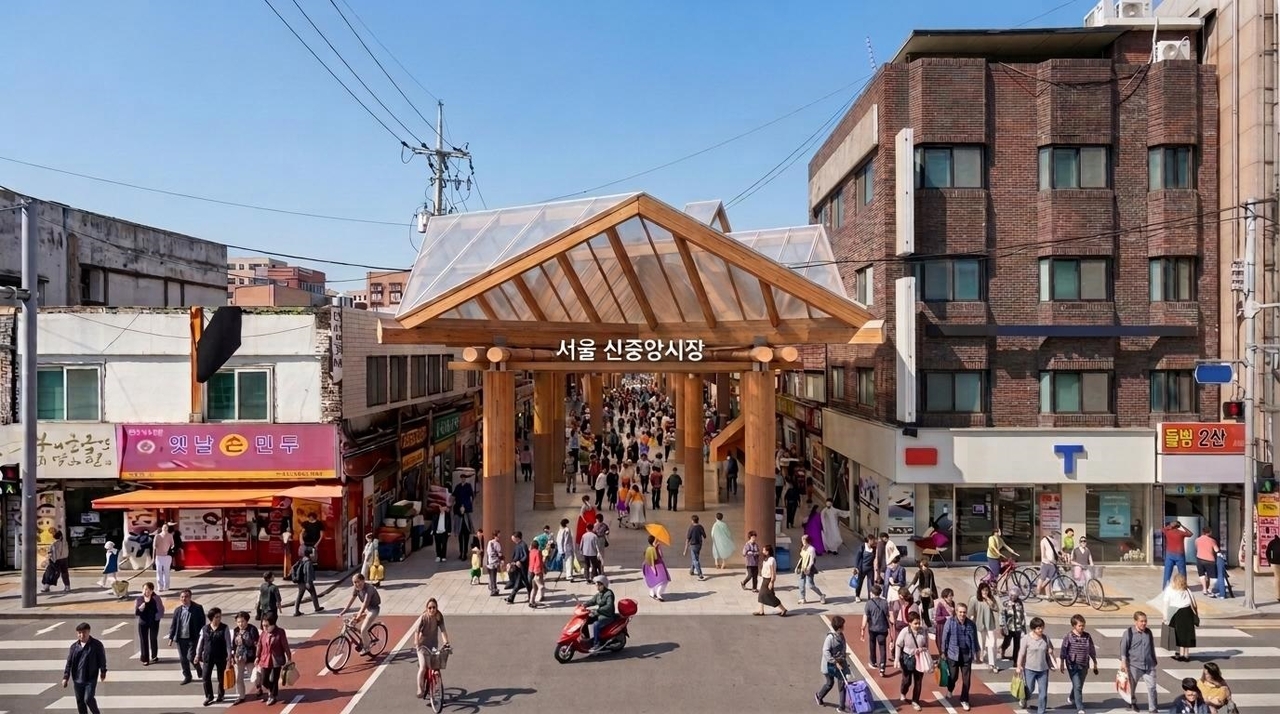
A tour of manufacturing districts in Jung-gu and Jongno-gu in Seoul showed how the heat wave is directly feeding into production costs. Kim, a woman in her 60s who runs a clothing shop at Namdaemun Market in Jung-gu, said customer numbers have been disappointing even for the summer holiday season. "Compared with the busy spell around Parents' Day in May, sales are about half," she said. Ha Dong-rim, 64, who sells corn and savory pancakes at Hwayangjeeil Alley Market in Gwangjin-gu, said business has ground to a halt. "Sales are nearly double what they are now when the weather is cool," she said. With so few customers, she has installed a doorbell so she can step away from her stall without missing anyone.
![Peak electricity demand has surged as cooling systems run at full capacity across the country. According to the Korea Power Exchange's power statistics system, peak demand reached 95.321 GW on Friday, the highest level this summer. Pictured are outdoor air-conditioning units installed on buildings in Seoul on Sunday. [Yonhap]](https://wimg.heraldcorp.com/news/cms/2026/08/10/rcv.YNA.20260809.PYH2026080903110001300_P1.jpg)
The heat-driven slowdown in consumer spending is showing up in economic indicators as well. In the Small Enterprise and Market Service's business conditions survey for June 2026, the business sentiment index for traditional markets in July stood at 70.7, down 12.5 points from the previous month. The July survey showed the actual sentiment index for traditional markets falling a further 9.3 points to 50.5. A reading below 100 means more respondents view business conditions negatively than positively.
At the same time, consumers are shifting their spending toward large retail outlets with air conditioning, widening the gap between traditional markets and indoor retail channels. The retail industry has noted a rise in demand since July for fresh food, ready-to-eat meals and household goods consumed at home. Analysts say the trend is hitting traditional markets and neighborhood commercial districts particularly hard: as more people turn to convenience foods to avoid using heat-generating cooking appliances indoors, fewer are buying fresh produce and cooking ingredients at traditional markets.
Despite the burden felt by merchants and small manufacturers, the electricity rate support system offers limited relief. The government temporarily eases the progressive rate tiers for residential electricity during July and August, when cooling demand peaks. Under the adjusted structure, the first tier covers consumption up to 300 kilowatt-hours (kWh), the second tier covers 301 to 450 kWh, and the third tier applies above 450 kWh. However, the general-use and industrial tariffs that apply to small businesses and small manufacturers operate under a separate rate structure and are not subject to the same summer progressive-rate relief.
Government support programs for small business owners also do not extend to small manufacturers. The special electricity bill support program for small business owners, introduced in 2024, initially provided 200,000 won ($145) to operators with annual sales below 30 million won, before expanding that year to cover those with annual sales below 104 million won. This year, the program is issuing business-stability vouchers worth 250,000 won to approximately 2.31 million small business operators with annual sales below 104 million won.
Small manufacturers subject to industrial electricity tariffs are excluded from that support. That is why the small-business community has begun treating the heat wave not merely as a seasonal inconvenience but as a structural driver of higher production costs. Changes to the industrial tariff structure add another layer of uncertainty. Since April, the time-of-use rate system for industrial users (category B) has been revised: rates during some daytime hours have fallen, but peak-load rates now apply between 6 p.m. and 9 p.m. — a window that could carry a heavier cost burden in summer than before.
Within the small-business community, calls are growing for additional support targeting neighborhood commercial districts. "We need marketing that gives people a reason to visit traditional markets in summer — positioning them as a place to beat the heat," one industry official said. "Creating spaces where visitors can cool down between shopping is also worth considering."
hong@heraldcorp.com