
![A shopper browses the meat section at Lotte Mart in Seoul. [Yonhap]](https://wimg.heraldcorp.com/news/cms/2026/08/13/rcv.YNA.20260621.PYH2026062106700001300_P1.jpg)
With Chuseok about a month away, prices for hanwoo — the premium Korean beef that ranks among the most popular holiday gifts — are surging. Even imported beef, long considered a more affordable alternative, has been rising, adding to the financial strain on consumers.
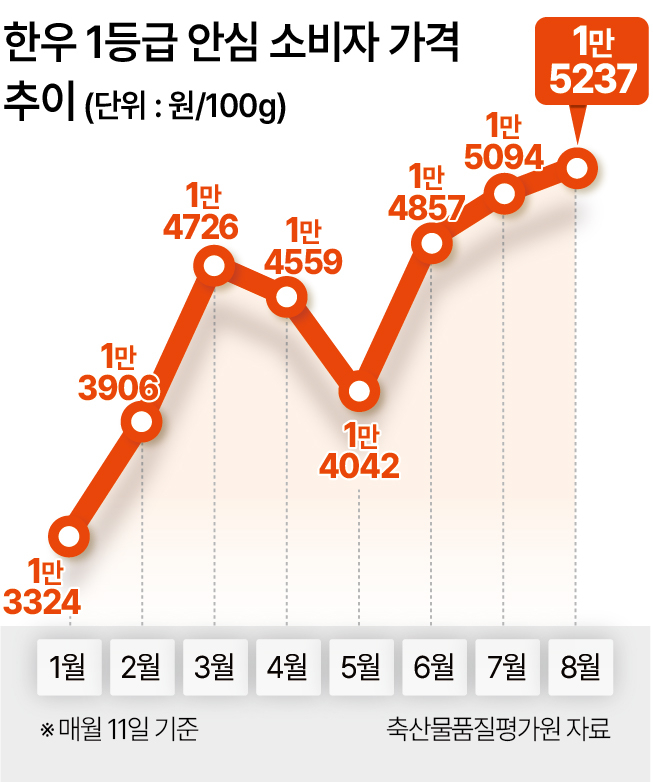
According to the Korea Institute for Animal Products Quality Evaluation's livestock retail data, the consumer price for grade-1 hanwoo tenderloin stood at 15,237 won ($11) per 100 grams as of Tuesday, up 15.1 percent from a year earlier and 14.3 percent above the five-year average. Grade 1+ tenderloin was priced at 16,838 won per 100 grams, a 17.3 percent year-on-year increase.
Other cuts have also risen. Grade-1 sirloin reached 11,058 won per 100 grams, up 14.3 percent from a year ago and 17.4 percent above the five-year average. Grade-1 brisket climbed 8.8 percent year on year and 7.7 percent above the five-year average.
The price surge stems largely from a contraction in supply as herd sizes have declined. The Korea Rural Economic Institute projected that the number of hanwoo slaughtered this year will fall to 862,000 head — down 9.0 percent from last year and 5.2 percent below the five-year average. In the third quarter, which includes Chuseok, slaughter volumes are expected to drop to 241,000 head, a 14.8 percent decline from a year earlier. The institute forecast that the wholesale price of hanwoo (castrated steers) will rise about 9.4 percent this year compared with last year, with the third quarter also expected to show a 7.5 percent year-on-year gain.
Imported beef prices have also continued to climb. The average retail price of frozen American galbi reached 4,584 won per 100 grams as of Tuesday, up 7.0 percent from a year ago and 8.7 percent above the five-year average. Australian frozen galbi rose 12.6 percent year on year and 8.6 percent above the five-year average. Chuck eye roll saw even steeper increases: chilled American chuck eye roll was priced at 4,081 won per 100 grams, up 13.5 percent from last year and 21.6 percent above the five-year average, while the Australian equivalent rose 12.7 percent year on year and 25.8 percent above the five-year average.
Analysts attribute the increases to lower production and higher import costs driven by a weak won. The US Department of Agriculture projected last month that American beef output this year will total 25.29 billion pounds, down about 2.7 percent from last year. US beef exports are also expected to fall 10 percent year on year.
According to the Korea Rural Economic Institute, the import unit price of beef in July was $9.39 per kilogram, up 13.2 percent from the same month last year. American beef came in at $10.86 per kilogram, an 11.7 percent increase, while Australian beef was priced at $8.30, up 17.8 percent. The weak won amplified the price increases in won terms: the Bank of Korea's import price index showed that beef import prices rose 14.1 percent in dollar terms in June compared with a year earlier, but surged 27.5 percent when measured in won.
There are growing concerns that the upward trend will persist through Chuseok, with rising demand expected to intensify the burden on consumers. "Looking at the current situation, there is a fairly high likelihood that prices for agricultural and livestock products will remain elevated through Chuseok," said Kim Dae-jong, a professor at Sejong University's School of Business Administration. "During holidays, demand for hanwoo, pork, fruit and vegetables all rises at the same time, and in a year like this — when supply conditions are already unstable due to heat waves — the one to two weeks before Chuseok will be the critical period for prices."

korean@heraldcorp.com





