![A view of Terminal 2 at Incheon International Airport [Incheon International Airport Corp.]](https://wimg.heraldcorp.com/news/cms/2026/08/13/news-p.v1.20260813.797de3a78db6437c976638c41a1cd499_P1.jpg)
Incheon International Airport has claimed the top spot in global international passenger traffic for the first half of this year, rewriting its history as a world-class aviation hub. The achievement reflects years of South Korean aviation policy and sustained infrastructure expansion reshaping the global air travel landscape.
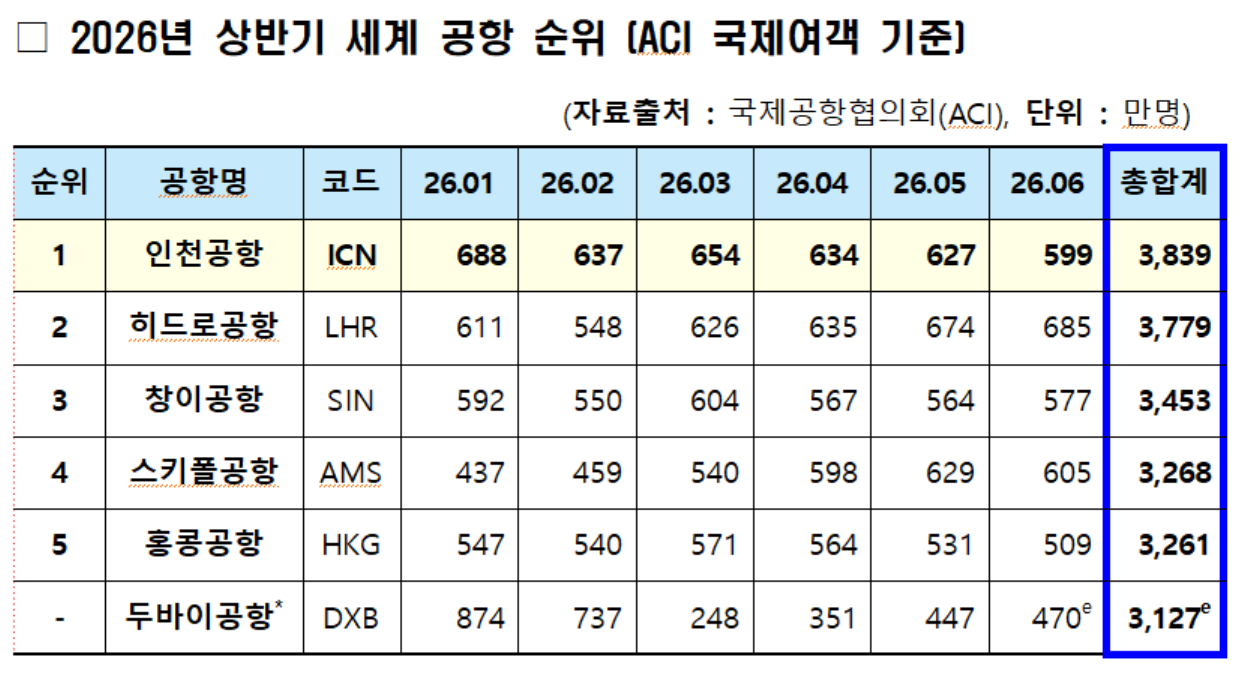
Incheon International Airport Corp. announced Thursday that the airport handled about 38.39 million international passengers in the first half of this year on a preliminary basis, ranking first in the world by Airports Council International standards. It marks the first time a South Korean airport has topped the global rankings in international passenger traffic, the key metric for measuring airport competitiveness.
Incheon Airport ranked 10th in 2002, shortly after opening, before climbing to fifth in 2018 and third in 2024. It now holds the top position among 1,234 airports worldwide. London Heathrow came in second with about 37.79 million passengers, while Singapore Changi placed third with about 34.53 million.
The result reflects Incheon Airport's ability to absorb surging international aviation demand while major Middle Eastern and European airports saw their growth slow in the wake of the US-Iran war. International passenger traffic at Incheon rose 6.3 percent from about 36.12 million in the same period last year, driven by growth in transit passengers and foreign arrivals. As the war weakened the transit function of Middle Eastern hubs such as Dubai, demand that had flowed through those routes shifted to direct flights and connections through Incheon. Transit passengers at the airport totaled about 4.24 million in the first half, up 18.1 percent year on year, with transit passengers on European routes surging 63.2 percent to about 213,542. The share of foreign passengers among all travelers in the second quarter hit an all-time high of 44.4 percent.
Timely infrastructure expansion and an extensive aviation network underpinned the No. 1 ranking. Incheon Airport has built capacity to handle 160 million passengers a year through four phases of construction. A total of 101 airlines now serve 183 cities in 53 countries, with international passenger routes reaching 158 cities — ahead of major rivals such as Tokyo Narita with 86 and Shanghai Pudong with 92.
Building on the achievement, the airport operator plans to maintain core functions including safe operations while advancing future competitiveness through AI transformation and urban air mobility infrastructure. The airport also intends to strengthen connections with major domestic regions to support the government's goal of attracting 30 million foreign tourists and improve access to overseas travel for people living outside the Seoul metropolitan area.
Kim Beom-ho, acting president of Incheon International Airport Corp., said the airport would press ahead with service innovation, including stronger links to regional cities, to better serve the public and contribute to the development of the national aviation industry. "I am grateful for the government's support, the encouragement of the Korean people, and the hard work of airport staff who have made Incheon the world's No. 1 airport," he said. "We will stay true to the fundamentals of airport operations while accelerating service innovation — including stronger regional connectivity — to become a truly people's airport that serves the public and advances the national aviation industry."
terry@heraldcorp.com