The South Jeolla Province-Gwangju integrated special city has launched a concerted push to lead what it calls the "M.AX" — manufacturing AI transformation — of the automotive sector. The initiative goes beyond simple process automation, aiming to fundamentally restructure the southwest region's auto industry by converging future mobility technologies with humanoid robot capabilities.
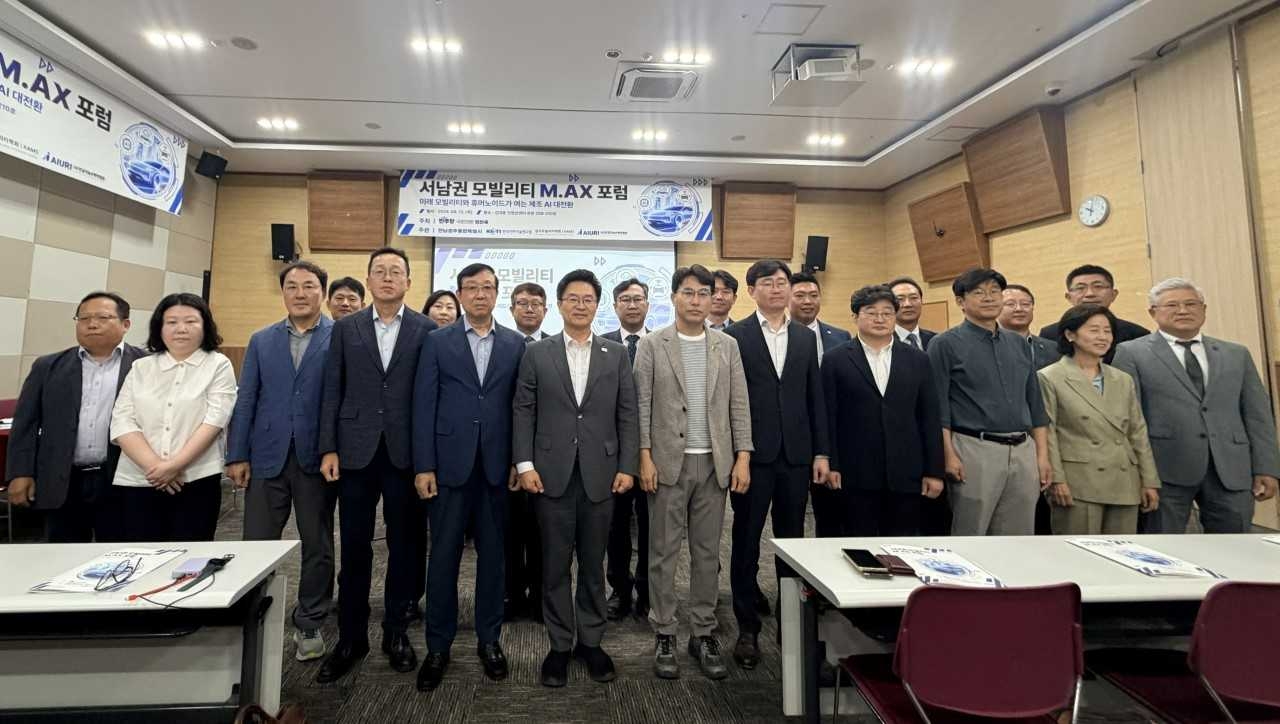
The city hosted the Southwest Mobility M.AX Forum at the Kim Dae-jung Convention Center on Thursday, drawing about 100 participants from industry, academia, research institutions and government. The forum centered on the theme of "AI transformation in manufacturing through future mobility and humanoid robots."
The forum was organized in line with the government's policy to drive AI adoption in manufacturing. Lawmakers Jeong Jin-uk and Im Mun-yeong co-hosted the event, with the integrated city, the Korea Electronics Technology Institute, the AI Industry-Academia Alliance and the Korean Mobility Society serving as co-organizers.
The program was divided into keynote addresses by experts and a series of specialized technology sessions.
Jeong Gu-min, co-chair of the Future Vehicle AI Digital Transformation Innovation Council, said in his opening remarks that the automotive industry's scope is rapidly expanding into robotics, shipbuilding and urban air mobility as AI, autonomous driving and software technologies converge. "The AI and automotive industry base that Gwangju possesses will serve as a vital engine driving South Korea's future industries," he said.
In the keynote that followed, Im Hyeon-taek, a director at the Gwangju Institute of Science and Technology, surveyed global technology trends in software-defined vehicles, autonomous driving and humanoid robots. Im outlined a roadmap for nurturing future industries — including automotive AI semiconductors and PBV-based services — and urged industry, academia and research institutions to pursue joint pilot projects to make AI transformation tangible for both finished-vehicle and parts manufacturers.
Kim Seong-cheol, branch manager of QNX, drew attention with a presentation on foundational software and pilot strategies for extending the functional safety and cybersecurity technologies proven in the automotive sector to manufacturing, logistics and robotics.
Participants also discussed deploying humanoid robots on automotive factory floors to reduce worker strain while improving productivity and safety, as well as expanding automotive AI, sensor and software technologies into robots, drones and electric vessels.
Lee Seung-ju, a center director at the Korea Electronics Technology Institute, outlined a concrete direction for AI transformation in humanoid robot-based manufacturing. "We need to build a future manufacturing environment where workers and robots collaborate safely by applying humanoid robots to tasks that require human judgment and response — such as vehicle trim-line assembly," he said.
The integrated city is developing the "Humanoid Robot-Based Automotive Industry M.AX Transformation" project together with Ulsan, a major hub for domestic vehicle production, reflecting on-site demand from finished-vehicle and parts manufacturers. The project plans to invest a total of 58 billion won ($41 million) over five years from 2027 to 2031, introducing and piloting customized humanoid robots at the manufacturing sites of two finished-vehicle companies and approximately 700 parts suppliers.
Son Du-yeong, director of the AI Industry Bureau, said the manufacturing sector is at a pivotal moment of transformation as AI technology rapidly reshapes production methods and industrial structures. "We will spare no administrative support — from technology development assistance and pilot programs to collaboration and ecosystem building — so that local companies can achieve technological innovation swiftly in response to these changes," he said.
sij@heraldcorp.com