![Koo Ja-kyun, chairman of LS Electric, who lives at Cobern House (left), and actor Ha Ji-won, who previously resided there (right) [Naver Profile · Naver Real Estate]](https://wimg.heraldcorp.com/news/cms/2026/08/14/news-p.v1.20260814.0c87ab4109c741768f39c23be5e5730b_P1.jpg)
Climbing the steep hill of UN Village in Hannam-dong, Yongsan-gu, Seoul, low-rise buildings come into view one after another, each looking out over the Han River. There are no sprawling complexes of hundreds of units, no towering apartment blocks announcing themselves from a distance. Instead, detached houses and small luxury villas tuck themselves behind walls and trees, arranged in terraced rows facing the river.
It is here that one of the country's seven most expensive apartment-type homes has quietly reappeared on the rankings. The property is Cobern House — a seven-unit villa that marks its 20th year since completion this year.
According to the Ministry of Land, Infrastructure and Transport's 2026 officially assessed prices for multi-unit housing, a single unit at Cobern House with an exclusive use area of 547.34 square meters carries an assessed value of 14.04 billion won ($9.92 million), placing it seventh nationwide. Cobern House is the only villa-type property among the top 10 nationally assessed multi-unit homes this year. The unit ranked just above it — a 244.75-square-meter unit at Hannam The Hill — is assessed at 16 billion won, while the one just below, a 234.86-square-meter unit at Banpo Raemian One Bailey, comes in at 13.56 billion won.
What makes the figure particularly striking is the 547.34-square-meter floor area itself. No unit of that size originally existed at Cobern House.
A review of court registry documents and building records shows that the unit was created after Boo Jae-hoon, vice chairman of MBK Partners, purchased two adjacent units — one of 273.65 square meters and another of 273.69 square meters — and merged them into a single home in 2025. The two areas add up to exactly 547.34 square meters, producing a residence of more than 545 square meters. The merger also reduced Cobern House from eight units to the current seven; publicly available real estate records now list the building as a three-story, single-block, seven-unit property.
The consolidation, as if by coincidence, has thrust the nearly 20-year-old Cobern House back to the center of the rankings for the most expensive homes in South Korea.
![The top 10 most expensive multi-unit homes by assessed value in 2026. [Ministry of Land, Infrastructure and Transport]](https://wimg.heraldcorp.com/news/cms/2026/08/14/news-p.v1.20260814.6e95a5683c054dc7a803b390d31cca2d_P1.png)
Ranked third nationwide 20 years ago — reappearing on the top-price list whenever it fades from memory
This is not the first time Cobern House has appeared on the list of the country's most expensive homes. In fact, it was among the most prestigious luxury villas in South Korea from the moment it was completed.
Located on UN Village 3-gil in Hannam-dong, Yongsan-gu, Seoul, Cobern House received its occupancy approval in September 2006. Built as a single block with four basement floors and three above-ground floors, it originally comprised eight units. The existing units range in exclusive use area from roughly 241 to 273 square meters. The building has parking for 20 vehicles.
At launch in 2006, pre-sale prices ranged from 2.8 billion to 3.3 billion won. By 2012, market prices had already climbed to around 4 billion won. Given that villas priced above 3 billion won were extremely rare at the time, Cobern House occupied a different market from ordinary multi-unit housing from the outset.
The building began appearing in price rankings the year after completion. In 2007, its assessed value of 2.336 billion won placed it third among all villa-type properties nationwide. It ranked fifth in 2008 at 2.344 billion won and climbed back to third in 2009 at the same price.
In 2010, the assessed value of the 273.7-square-meter unit rose to 2.536 billion won, pushing Cobern House to second place among villa-type properties nationwide, behind only Traumhaus 5 in Seocho-dong. It held that position in 2011, when the assessed value edged up to 2.544 billion won.
At the time, the ultra-high-end villa market was effectively dominated by Gangnam and Seocho. Of the 10 highest-assessed villa-type properties in 2008, nine were concentrated in those two districts — and Cobern House in Hannam-dong was the only property north of the Han River to make the list.
The landscape of Korea's most expensive homes shifted considerably in the years that followed, as large-scale luxury developments such as Hannam The Hill, Nine One Hannam and Parc Hannam opened in succession, and new ultra-premium properties including PH129 and Eterno Cheongdam appeared in Cheongdam-dong.
Through all of that, Cobern House largely disappeared from the overall top 10 for all multi-unit housing types nationwide, though it consistently remained among the highest-assessed villa-type properties. As recently as 2016, it still ranked near the top of that category, behind properties such as La Terrasse Hannam and Lucid House.
Then last year, two units were merged into one. Assessed this year at 14.04 billion won as an oversized single residence, Cobern House has entered the top 10 for all multi-unit housing nationwide for the first time in its 20-year history.
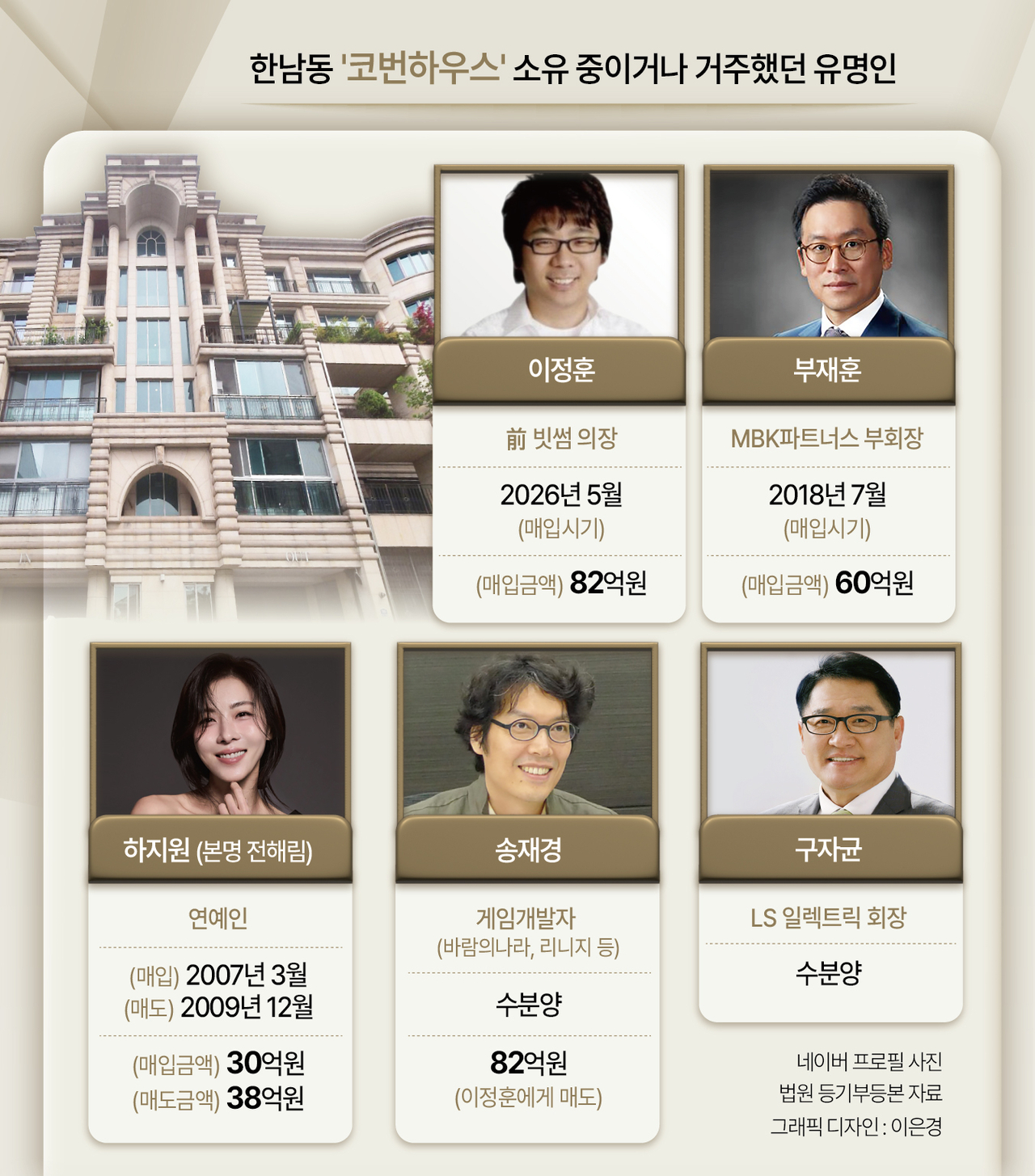
From Ha Ji-won to a conglomerate chairman, a crypto exchange chief and the developer of Lineage
Another defining feature of Cobern House is the roster of past owners who have passed through what was, at its peak, a building of just eight units.
Koo Ja-kyun, chairman of LS Electric, was among the original buyers at Cobern House and is understood to still own one unit there.
Actor Ha Ji-won, whose legal name is Jeon Hae-rim, also has a connection to the building. She purchased a unit in March 2007 for about 3 billion won and sold it in December 2009 for 3.8 billion won.
Song Jae-kyung, a first-generation figure in the Korean gaming industry, was also an original buyer. Song contributed to the development of some of the earliest landmark titles in Korean online gaming, including Baram ui Nara and Lineage.
The building changed hands again this year. Lee Jung-hoon, former chairman of Bithumb Holdings, purchased the unit Song had owned on May 7 for 8.2 billion won. The transfer of ownership was completed in June, and registry records show no new collateral mortgage registered in Lee's name, suggesting the purchase was likely made entirely in cash.
Boo, the MBK Partners vice chairman, did not acquire both units at once. He first bought the 273.65-square-meter unit in 2013 for 4.6 billion won — a transaction confirmed in records analyzing high-value multi-unit housing deals of 3 billion won or more reported to the Ministry of Land, Infrastructure and Transport at the time. In July 2018, he added the adjacent 273.69-square-meter unit for 6 billion won; that unit had been purchased in 2013 for 4.9 billion won by Cho Hyun-moon, a former president of Hyosung Heavy Industries. Boo held both units before merging them into one last year.
In a building with only a handful of units, transactions in the 4 billion to 5 billion won range had been occurring one after another.
The greatest advantage of UN Village is security and privacy. A shared security service operated by the residents' association is stationed at the entrance to the neighborhood, and individual luxury villas have also maintained their own on-site security personnel.
UN Village's origins: foreign housing built on a presidential order in 1956
The main reason Cobern House's value cannot be explained by the building alone is its location within UN Village.
Hannam-dong's UN Village had very different beginnings. Today it is home to some of the wealthiest individuals in South Korea, but its roots trace back to a 1950s government policy to build residential quarters for foreigners.
After the Korean War, Yongsan became a hub for personnel from the UN Command, USFK, the Eighth United States Army and various international organizations. Yet housing suitable for foreign families was in critically short supply. When UN forces and foreign diplomats and economic officials began leaving their families in Japan and commuting back on weekends, the government moved to provide housing for foreign residents.
President Syngman Rhee directed the Cabinet in 1956 to move quickly on developing a foreign residential district. Housing for foreigners subsequently went up in Hannam-dong, Itaewon and Ichon-dong, and the residential area that formed around lots 1 and 11 in Hannam-dong became the foundation of what is now UN Village.
After foreign engineers and diplomats settled in the area in the late 1950s, foreign embassies, consulates and international business representatives followed. Through the 1970s, heads of major Korean conglomerates and senior officials also began moving in, and UN Village gradually transformed from a foreign enclave into one of South Korea's most exclusive residential addresses.
Turning off Hannam-dong's Dokseodang-ro and heading up the hill toward the Han River, the roads narrow and the gradient steepens. The river spreads out below, and Namsan rises behind. Set back from the main road, the area sees little through traffic. The houses step down the hillside in terraced rows, giving many of the units facing the river unobstructed views. It is, in the middle of Seoul, a place that almost no one passes through without a reason to be there.
Lee Sang-min, head of Kings Realty, a brokerage specializing in luxury homes, said Cobern House has been "a landmark complex within UN Village since the early 2000s, when the high-end housing market was just taking shape," adding that while newer developments have since claimed the top price positions, the building retains its representative status — to the point that street signs within UN Village still carry a separate directional marker for Cobern House.

quq@heraldcorp.com