![Signs restricting development activity in a greenbelt zone are posted throughout the Seoripul district in Seocho-gu, Seoul. [The Herald Business DB]](https://wimg.heraldcorp.com/news/cms/2026/08/19/news-p.v1.20251118.1e70637ceb3849898832738a748b10dd_P1.jpg)
The Seoul Metropolitan Government is pushing to gradually scale back and eventually abolish the current zoning system, which divides land by use and development density. The move comes as the central government announced plans to ease land-use regulations — including converting non-residential land to residential use — to boost housing supply through its Aug. 13 supply package, raising questions about whether the country's land-use framework is set for a fundamental overhaul.
The Seoul Metropolitan Government said Wednesday that it commissioned a study on Aug. 11 titled "Developing a Progressive Alternative to the Zoning System and Institutional Improvements for Future Urban Readiness." The 18-month study, which will go to tender on Sept. 8, will assess the shortcomings of the current zoning system across Seoul and design a new urban management framework to replace it.
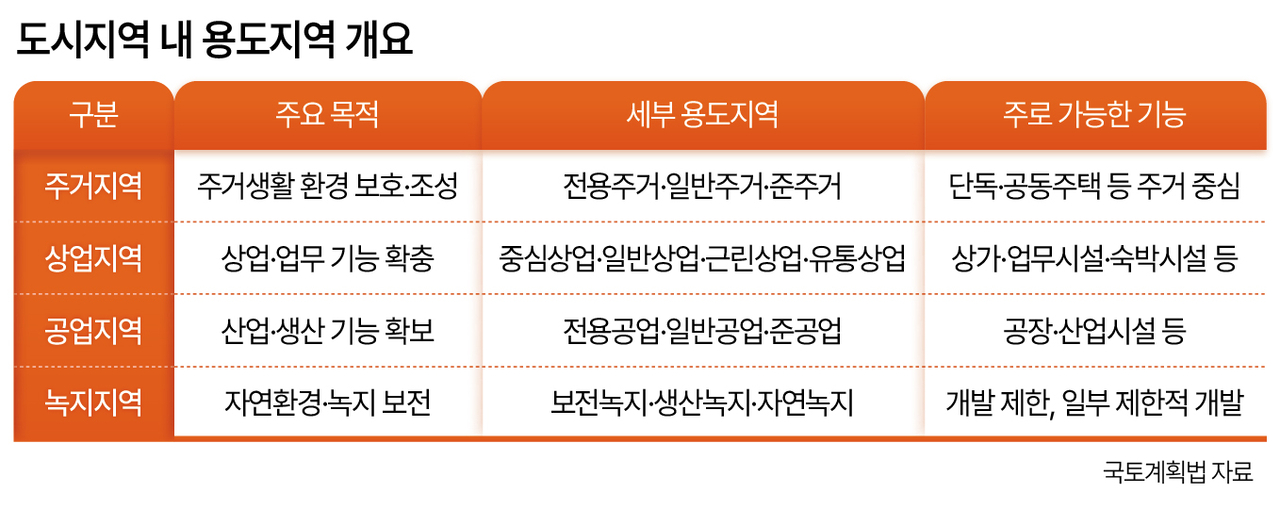
The zoning system divides land into residential, commercial, industrial and green zones, applying different rules on land use, building purposes, and floor-area and building-coverage ratios. Under the current National Land Planning Act and its enforcement decree, the law sets upper limits on those ratios by zone, with local governments setting detailed standards through municipal ordinances.
The city plans to take a fundamental look at the system itself through the study. "We determined that the existing rigid, one-size-fits-all zoning system is ill-equipped to respond to rapid changes in the urban environment," a Seoul city official said. "The study itself has been in the works since last year, but it ended up coinciding with the moment housing supply in Seoul emerged as a major policy challenge."
The study will first draw up a roadmap to phase down or eliminate the zoning system in short-, medium- and long-term stages, then design new land-use regulatory tools and a future-oriented urban management model to replace it. The target year is 2040, with the city aiming to build an entirely new medium- to long-term housing supply framework.
The city plans to identify candidate areas by type — residential, commercial and others — establish evaluation criteria, select pilot sites, and then conduct empirical analysis of how spatial use would change under the new system. Areas where boundaries between zones are already blurring, such as semi-industrial districts, are expected to be among the pilot candidates.
Relaxing zoning boundaries and making land use more flexible would make it easier to add residential functions to existing commercial, office and industrial land, or to raise the development density of low-density plots — directly linking the reform to housing supply.
The government's own supply policy is moving in the same direction. In its "Plan for Rapid Housing Supply to Stabilize the Jeonse, Monthly Rent and Sales Markets" announced Aug. 13, the government said it would "reform urban and architectural regulations to respond to changing land-use demand driven by the AI revolution and the rise of single-person households," pledging to increase housing supply flexibility by allowing more fluid conversion of land and building uses.
As a first step, the government will convert non-residential land — such as commercial plots that were over-planned relative to demand or have sat idle for years — into residential use. The plan calls for breaking ground on 30,000 units by 2030 through such conversions, including 10,000 units in third-generation new towns, with additional conversion targets to be identified on an ongoing basis. Related standards will also be revised to allow use adjustments in line with shifting land demand.
The scope will extend beyond publicly owned land to private holdings. The Ministry of Land, Infrastructure and Transport plans to launch a research study next month to examine ways to convert privately owned but underutilized non-residential or low-density residential land into medium- to high-density residential use.
A Seoul city official said the study "was not coordinated in advance with the Ministry of Land, Infrastructure and Transport for the purpose of housing supply, but we are thinking along similar lines."
Seoul faces limits, however, in overhauling the zoning system on its own. The National Land Planning Act and its enforcement decree set the zoning framework — covering residential, commercial and industrial categories — along with the upper limits on floor-area and building-coverage ratios, so amending only the city's urban planning ordinance would not be enough to change the system as a whole.
With that in mind, the city has decided to include specific proposals for revising the National Land Planning Act, urban planning ordinances and other related laws as part of the study. Depending on the findings, Seoul may also consider formally recommending that the central government amend the National Land Planning Act and related legislation.
Overseas, there is also a growing trend toward easing zoning regulations to expand housing supply. The 21st Century ROAD to Housing Act, passed in the United States last July with bipartisan support, directed the Department of Housing and Urban Development to develop zoning reform guidelines covering relaxed parking requirements, higher floor-area ratios and height limits, expanded allowances for multi-family housing, and high-density transit-oriented development. Adoption, however, was left to the discretion of state and local governments.
Kwon Dae-jung, a chair professor at Hansung University, said that while land use was once divided along the lines of heavy industries that occupied large physical spaces, the shift toward high-tech industries has blurred the lines between zones and pushed areas toward mixed-use development.
Kwon added that as zoning boundaries break down, more "transitional areas" — where commercial zones shift to residential use, for example — are likely to emerge. "It would be natural and desirable to factor in housing supply when planning for those areas," he said.

quq@heraldcorp.com