
Lawsuit filed to exclude Han River-facing Building 5 from Gwangjin-gu project
Myeongil Samik proceeds without Building 5 after court split
Mokdong Complex 3 dispute spills into voting rights row
Experts say large-unit owners deserve indirect benefits on views, pre-sale pricing
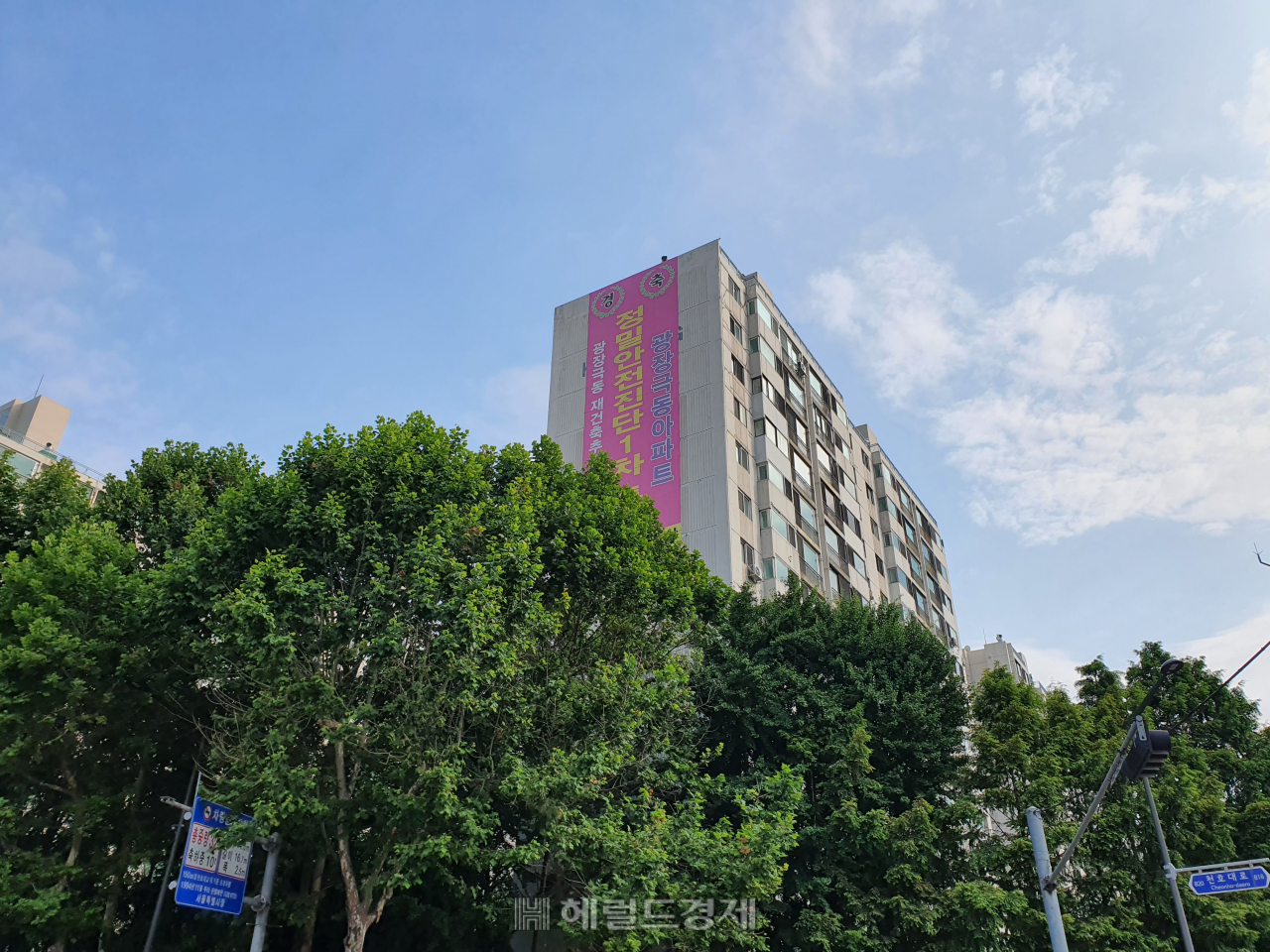
A residents' association at the Gwangjang Geukdong apartment complex in Gwangjin-gu, Seoul, has filed a lawsuit to exclude a specific building from a reconstruction project after a prolonged dispute with large-unit owners. The move came after owners holding relatively large land shares raised objections over how asset values and rights would be distributed following reconstruction — concerns that threatened to stall the entire project. Similar conflicts have emerged at the Myeongil Samik Mansion complex in Gangdong-gu and Mokdong Complex 3 in Yangcheon-gu, pushing unit-size disputes to the forefront as a key variable in Seoul's reconstruction landscape.
According to industry sources, the association working to establish a reconstruction cooperative at Gwangjang Geukdong filed a partition lawsuit at the Seoul Eastern District Court on Nov. 2, seeking to separate Building 5 — the first phase — from the rest of the project. Although overall consent for cooperative formation had reached about 74 percent, Building 5 fell short of the majority threshold required within its own building, making it difficult to hold the planned inaugural general assembly. The association said it would withdraw the lawsuit if a majority of Building 5 owners agreed to join the cooperative.
Building 5 consists of 84 units with an exclusive use area of 156 square meters each and a land share of roughly 95 square meters per household. Some owners have argued that the value of Han River views and their larger land shares may not be adequately reflected in the reconstruction plan, and have called for the introduction of an independent accounting system for the first and second phases of the complex.
Under an independent accounting arrangement, reconstruction proceeds under a single cooperative but revenues and costs are calculated separately for each existing sub-complex. On Nov. 14, Han Hyeong-gi, a former acting head of the reconstruction cooperative for Raemian One Bailey, held an information session at Gwangjang Geukdong and proposed integrated reconstruction based on independent accounting as an alternative. One Bailey brought together Sinbanpo 3-cha and Gyeongnam apartments under an independent accounting and in-place reconstruction model and completed move-in in 2023.
The Gwangjang Geukdong association considers independent accounting impractical, however. The second phase — closer to Gwangnaru Station on subway Line 5 than the first phase, which includes Building 5 — secured a combined floor-area ratio of about 340 percent through transit-oriented area incentives, making it difficult to separate development gains by sub-complex. An in-place reconstruction requirement could also constrain the layout of new apartment buildings.
Disagreements over the assessed value of existing assets have also been significant. "We have tried to accommodate Building 5 owners' demands — including reflecting guaranteed Han River views in the draft articles of association — but the opposition has continued," an association official said. "Some Building 5 owners are insisting their existing asset valuations be set 500 million to 600 million won higher than those of owners in other buildings with the same unit size."
With Building 5's consent rate stuck, the association plans to pursue the lawsuit and the cooperative formation process simultaneously. "We plan to continue with the remaining project procedures while the lawsuit is pending," the official said. The association is pushing to hold the cooperative's inaugural general assembly on Dec. 20.
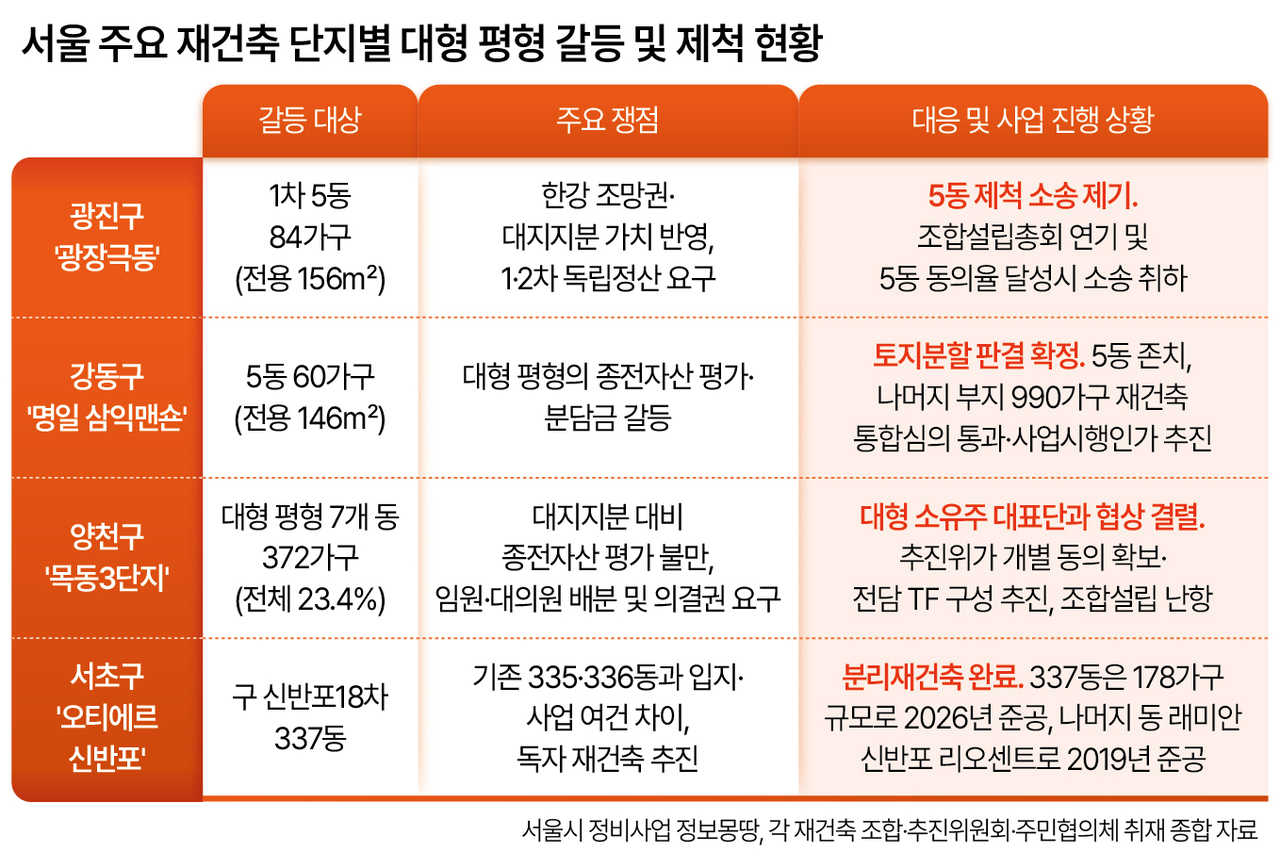
At several major reconstruction complexes, disputes with large-unit owners have already resulted in the physical separation of specific buildings. At Samik Mansion in Myeongil-dong, Gangdong-gu, the cooperative clashed with the 60 households in Building 5 — all 146-square-meter units — over existing asset valuations and contribution assessments. The cooperative filed a land partition lawsuit in 2020, and following a court ruling in 2024, Building 5 was separated into a distinct parcel. The remaining site, covering 708 of the original 768 households, cleared the Seoul Metropolitan Government's integrated review in July under a plan to rebuild as a complex of up to 39 floors with 990 units.
Building 5 will remain as a preservation zone, keeping its existing structure. The reconstruction of the remaining buildings is moving through subsequent procedures, including an application for project implementation authorization filed in July.
Mokdong Complex 3 in Yangcheon-gu is also struggling to form a cooperative because of friction with large-unit owners. Units of 122 square meters or larger account for 372 households, or 23.4 percent of the total. Those owners are believed to hold about 34 percent of the complex's total land share, yet they argue that their proportionally larger holdings have not been adequately reflected in preliminary existing-asset valuations.
The dispute has spilled into questions over voting rights in cooperative governance. Representatives of large-unit owners demanded that 50 percent of executive and delegate seats be reserved for them, that votes be split by unit size, and that key quorum thresholds be raised — but they were unable to reach an agreement with the preparatory committee.
There are also cases where separate reconstruction has been carried out all the way through to move-in. Building 337 of Sinbanpo 18-cha in Jamwon-dong, Seocho-gu, broke away from the adjacent Buildings 335 and 336 to pursue reconstruction independently. Buildings 335 and 336 were integrated with Sinbanpo 24-cha and completed in 2019 as Raemian Sinbanpo Rio Centro, while Building 337 — fronting the Han River — proceeded on its own and was completed this July as Otiere Sinbanpo, a 178-unit complex.
The recurring conflicts across these complexes stem from a fundamental tension between land share size and the way existing assets are valued. Large-unit owners hold proportionally more land, but reconstruction asset assessments are based on market value — a composite of the building and land-use rights — rather than land area alone.
"Under the current structure, where existing asset values are assessed based on market prices, it is true that a larger land share cannot be fully reflected in the reconstruction process," said Kim Je-gyeong, director of Toomi Real Estate Consulting. "That said, there is a need to provide indirect benefits to large-unit owners who already have priority in unit allocation — such as guaranteeing Han River views or setting relatively lower pre-sale prices for large units when calculating cooperative member pricing."
quq@heraldcorp.com





