At Jirisan's "Hwayamong" program, novelist Jeong Ji-a speaks candidly about life and literature, family and history, neighbors and community
![Writer Jeong Ji-a speaks with participants at the "Hwayamong" program at Hwaeomsa on Saturday night. [Hwaeomsa]](https://wimg.heraldcorp.com/news/cms/2026/08/23/news-p.v1.20260823.1b95fff065f34c9f9c0d0202adfddb19_P1.jpg)
Daehwaeomsa, the head temple of the 19th district of the Jogye Order of Korean Buddhism, held the second session of its summer humanities program "Hwayamong" on Saturday, featuring a conversation with Gurye-born novelist Jeong Ji-a.
This year's Hwayamong carries the theme "After the Wind of Jirisan, a Cup of Tea Under the Starlight." Following a July session on "the world of tea" led by the monk Deokje, Saturday's gathering brought Jeong to Hwaeomsa in Gurye, where she spoke openly about her life and writing, her family and its history, and the bonds between neighbors and community. Jeong is the author of "Abeoji-ui Haebang Ilji" ("Father's Liberation Diary"), a novel that has resonated deeply with the Korean literary world and some 400,000 readers.
The lecture went beyond a simple discussion of her work, becoming a shared inquiry into how we should live, what it means to live well, and what connects people to one another.
"In 'Father's Liberation Diary,' the people of Gurye who lived alongside my parents and their generation for their entire lives are woven in as a vital motif," Jeong said. "And in 'Jjini Juuibo,' the lives and relationships of Gurye people I have encountered from childhood to today form an important thread running through the work."
Jeong spoke about how her perspective on life and people changed significantly after she left Seoul, where she had been working as a writer, and returned to Gurye to care for her mother.
Stepping away from a way of seeing people through the lens of academic credentials, profession and outward markers of social success, she said she came to realize — through close observation of everyday life in Gurye — that each person has their own worth and role, and that the value of a life cannot be ranked.
During the lecture, Jeong shared her belief that "a life of good relationships is a happy life," emphasizing the importance of the bonds through which parents and children, siblings and friends, neighbors and fellow villagers lean on one another.
Another moment that resonated strongly was Jeong's account of the "rice cake shop sister" — the real-life model for a character in "Father's Liberation Diary."
Describing an ordinary Gurye resident who, on turning 80, chose to treat her children, relatives and friends to a meal rather than receive their congratulations — saying "Thank you for being with me until today" — Jeong said: "A heart that lives with gratitude and tries to offer even a small measure of help to those around you can be more beautiful and greater than any dazzling success."
"Meeting people like that changed my idea of what a successful life looks like," Jeong said. "Rather than rising to a high position or accumulating more, warming the lives of family and neighbors from where you have lived and being a source of strength to even one person may be a deeper and more precious way to live." She added: "The everyday life of each person — someone we might not think of as remarkable — can reach family, friends and neighbors and become the force that helps someone go on living."
The session also included discussion of her new novel "Jjini Juuibo" alongside "Father's Liberation Diary."
"Jjini Juuibo" is set in a contemporary rural community and explores the conflicts, misunderstandings, understanding and coexistence that arise when different lives meet. What runs through both works is, ultimately, people and relationships.
The question Jeong's literature posed to Hwaeomsa that night was this: even when ideology, generation, education, profession and ways of life differ, prejudice begins to crumble and relationships take shape the moment we start to understand the time a person has lived through.
Before the conversation with Jeong, attendees were treated to a pre-event performance of Gurye Hyangje Julpungnyu, a traditional instrumental ensemble tradition passed down for more than a millennium.
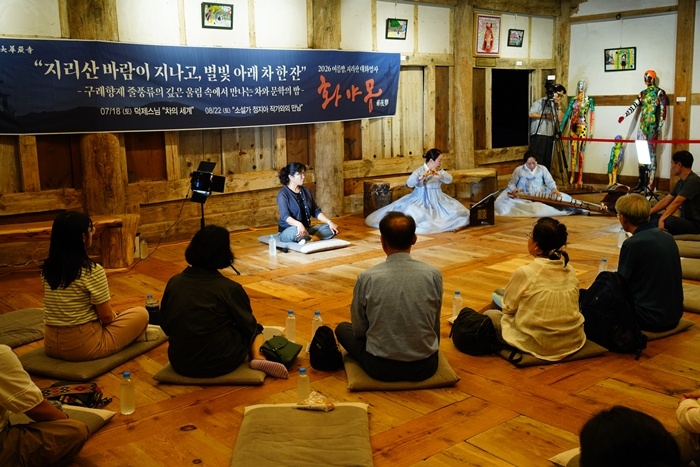
The elegant melodies of daegeum player Lee So-jeong and gayageum player Jang Ha-yeon opened the summer night at Hwaeomsa, as the stillness of the ancient temple, the mountain breeze of Jirisan, traditional music and literature came together in one space to offer participants a singular experience at a mountain monastery.
Hwaeomsa's head monk Useok said the temple's summer nights are "a special time when the wind and starlight of Jirisan and the quiet of this thousand-year-old temple all linger together," adding that the stories Jeong shared Sunday "were ultimately a deep reflection on how we perceive and live out the bonds between people."
Seong Gi-hong, head of Hwaeomsa's public relations and planning committee, said Sunday's lecture showed "what the most precious humanistic asset of Gurye truly is — the story of how bonds formed by sharing a single pumpkin or a few perilla leaves accumulate over decades to become a community."
parkds@heraldcorp.com